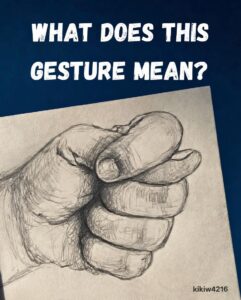
Long before written language became universal and long before digital communication reduced human expression to emojis and icons, people relied heavily on gestures to communicate meaning, emotion, and intent. Among these ancient non-verbal expressions was a small but powerful hand sign known historically as manus fica, or “making a fig.” At first glance, it appears simple: a clenched fist with the thumb tucked between the index and middle fingers. Yet beneath this modest shape lies a rich cultural history spanning centuries, crossing empires, and blending superstition, humor, resistance, and social communication.
The fig gesture is a reminder that even the smallest movements of the human body can carry profound meaning. It functioned not only as a form of communication but also as a symbolic shield against unseen forces, a silent protest against authority, and a playful expression among friends and families. Its evolution reflects the changing nature of human societies and how people have historically navigated fear, power, belief, and interaction.
Ancient Origins in Ritual and Belief
The earliest known associations of the fig gesture trace back to ancient Mediterranean civilizations, particularly within Roman culture. In Roman tradition, the gesture was closely linked to both superstition and ritual protection. It was believed to possess apotropaic power—meaning it could ward off evil influences, curses, and the notorious “evil eye,” a widespread belief that envy or malicious intent could cause harm simply through gaze alone.
During certain Roman festivals, especially those centered on honoring and appeasing ancestral spirits, gestures like the fig were believed to have protective significance. The Lemuria festival, for example, involved rituals intended to drive away restless spirits of the dead. Within this cultural framework, the fig gesture was thought to symbolically trap or repel negative forces. The tucked thumb was interpreted as a concealed strength, something hidden yet powerful, capable of protecting the individual from spiritual harm.
Archaeological evidence and written references suggest that symbolic hand gestures were commonly integrated into everyday Roman life. Amulets shaped like the fig hand were carved from materials such as coral, bone, silver, and gold. These objects were worn by both adults and children as protective charms. Their widespread use demonstrates that belief in the gesture’s power extended beyond ritual contexts and into daily life, where fear of misfortune and the supernatural was deeply embedded in cultural consciousness.
In Roman symbolic thinking, physical form often carried metaphorical meaning. The fig fruit itself was associated with fertility, abundance, and life. The gesture’s resemblance to the fruit or to protective bodily symbolism reinforced its dual nature: it was both life-affirming and defensive, both symbolic and practical.
A Gesture of Defiance in Everyday Roman Life
Beyond its spiritual significance, the fig gesture also functioned as a subtle form of communication in Roman society. Life in the Roman Empire was structured by strict hierarchies of power, class, and authority. In such an environment, open defiance could carry serious consequences. Yet human beings have always found ways to express resistance indirectly.
The fig gesture provided a discreet means of signaling refusal or contempt. A quick motion of the hand, often concealed or performed subtly, could communicate rejection without spoken words. It was a silent “no,” a gesture of disagreement that allowed individuals to avoid confrontation while still expressing their stance.
This dual function—both protective and expressive—made the fig gesture particularly versatile. It could be used in serious ritual contexts to repel evil or in everyday social interactions to navigate power dynamics. In marketplaces, domestic settings, and informal gatherings, gestures often carried as much meaning as speech itself. The fig gesture thus became part of a broader non-verbal vocabulary that helped people navigate complex social environments.
Transformation Through the Middle Ages
As the Roman Empire declined and transitioned into the medieval world, many cultural practices evolved rather than disappeared entirely. The fig gesture survived this transformation, adapting to new social, religious, and political contexts.
During the Middle Ages, Europe was characterized by feudal structures, localized authority, and strong religious influence. In such societies, open opposition to authority—whether secular or ecclesiastical—could be dangerous. Yet everyday life still required ways to express disagreement, humor, or resistance in socially acceptable forms.
The fig gesture continued to serve as a subtle tool for communication. In rural communities, it became part of folk expression. People used it in everyday interactions to signal refusal, skepticism, or playful defiance. It could be used between friends as a joke or directed toward authority figures in a hidden or symbolic way.
Its meaning expanded during this period. While still associated with protection against the evil eye in many regions, it also developed a more social dimension. It became a gesture of quiet resistance—something that could be performed without drawing attention or punishment. In environments where speech was restricted or dangerous, non-verbal communication carried special importance.
Parents sometimes taught children versions of the gesture as part of folk culture. In some regions, it was considered a harmless way for children to respond to teasing or minor conflicts. This ensured its transmission across generations, even as its original Roman context faded into memory.
Protective Symbolism in Mediterranean and Balkan Traditions
The fig gesture maintained strong cultural significance in Mediterranean and Balkan regions well into the modern era. In these areas, belief in the evil eye remained deeply rooted in everyday life. The idea that envy or negative attention could bring misfortune was not merely superstition but part of a broader worldview that explained uncertainty and hardship.
In this context, the fig gesture became a practical form of protection. It was commonly used when someone felt exposed to jealousy, bad luck, or negative energy. A quick hand movement could serve as a symbolic barrier, a way of deflecting unseen harm.
Grandparents often passed down such practices orally, teaching younger generations how and when to use the gesture. It might be performed when encountering suspicious individuals, when traveling alone, or during moments of perceived vulnerability. In some cases, it was combined with spoken phrases or other protective customs.
The gesture also appeared in folk rituals related to fertility, marriage, and family well-being. Its symbolic association with life and protection made it suitable for ceremonies intended to ensure prosperity and safe childbirth. Over time, it became embedded not only in superstition but also in cultural identity.
Gradual Decline in the Modern Era
The Industrial Revolution and subsequent modernization of European societies brought significant cultural changes. Urbanization, scientific advancement, and the spread of formal education transformed how people understood the world. Superstitions that once shaped daily life gradually lost their influence, replaced by rational explanations and institutional knowledge.
As communication systems evolved—first through print, then telegraph, telephone, radio, and television—the need for subtle, localized gestures diminished. People increasingly relied on standardized languages and explicit verbal expression. Social interaction became more formalized and less dependent on shared folk symbolism.
The fig gesture, once widely understood across regions, began to fade from common use. In urban environments, younger generations were less likely to learn it. Its meanings became obscure, preserved mainly in rural traditions or family memories.
By the 20th century, it had largely disappeared from everyday communication. What remained were fragments: references in literature, occasional cultural studies, and oral histories from older generations. Its symbolic power weakened as belief systems changed and modern society prioritized clarity over ambiguity.
The Gesture in Contemporary Perspective
In the present day, the fig gesture is largely unknown to the general public. Most people encountering it would not recognize its historical meaning. It might be mistaken for a simple clenched fist or dismissed as an arbitrary hand position. Yet for historians, anthropologists, and cultural scholars, it represents an important example of how humans have used the body as a tool for complex communication.
The decline of the fig gesture reflects broader transformations in human communication. Modern society favors explicit expression—spoken language, written text, and digital symbols. Emojis and icons now serve many of the functions that gestures once fulfilled, condensing emotion and intent into standardized visual forms.
Yet something is lost in this transition. Gestures like the fig carried layered meanings that depended on context, shared understanding, and cultural memory. They were flexible, adaptable, and deeply human. They allowed people to communicate subtly in ways that modern digital systems rarely replicate.
Cultural Legacy and Human Expression
Despite its decline, the fig gesture remains a fascinating symbol of human creativity in communication. It illustrates how societies develop shared systems of meaning that extend beyond words. It also shows how belief, emotion, and social structure shape even the smallest physical actions.
At its core, the gesture represents three enduring aspects of human behavior:
First, the need for protection—whether from physical danger, social harm, or imagined forces.
Second, the desire for expression—particularly in situations where speech is limited or risky.
Third, the use of symbolism to compress complex ideas into simple, repeatable forms.
These functions remain relevant even today, though they manifest in different ways. Digital communication may have replaced physical gestures in many contexts, but the underlying human impulse remains the same.
Conclusion: A Quiet Echo from the Past
The ancient practice of “making a fig” stands as a quiet reminder of a world where communication was more physical, symbolic, and layered with meaning. It bridged the gap between superstition and social interaction, between fear and humor, between resistance and protection.
Though it has largely vanished from modern life, its legacy persists in the broader history of human expression. It reminds us that communication is not limited to words or technology but is deeply rooted in the body itself. Every gesture, no matter how small, carries the potential to express defiance, belief, or connection.
In rediscovering such forgotten traditions, we gain insight into how past societies understood themselves and the world around them. And perhaps, we are reminded that even in a digital age, human communication will always find ways to be creative, symbolic, and profoundly expressive.