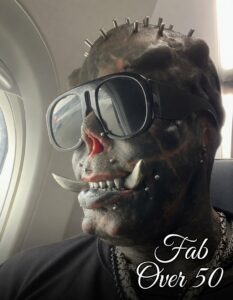
The story of Michel Praddo—now widely known as Diabão, or the “Human Satan”—is one of the most extreme and polarizing examples of body modification in modern times. What began as a career in tattoo artistry evolved into a decades-long personal transformation that challenges conventional ideas about identity, beauty, and the limits of the human body.
Born in 1975 in Santos, Brazil, Praddo’s early life followed a far more typical path. He worked as a tattoo artist, gradually becoming immersed in the world of body art. But over time, what started as professional interest turned deeply personal. Tattoos gave way to more dramatic modifications, and eventually to a complete reimagining of his physical identity.
Today, Diabão is recognized globally for his striking and often shocking appearance. More than 80% of his body is covered in black tattoos, creating a uniform, shadow-like canvas. He has undergone dozens of procedures, including silicone horn implants embedded beneath the skin of his scalp—one of the features that earned him a record in Guinness World Records for the most horn implants.
His transformation extends far beyond tattoos and implants. Over the years, he has removed his external ears, reshaped parts of his face including his nose, tattooed the whites of his eyes, split his tongue, and modified his teeth into sharp, fang-like structures with metallic elements. In one of his most controversial recent decisions, he underwent surgical removal of multiple fingers to create claw-like hands—a change he openly documented online.
These procedures place him within the realm of Body modification, a subculture that ranges from common tattoos and piercings to far more radical transformations. While body modification has existed for centuries in cultural, spiritual, and aesthetic contexts, Diabão’s case represents one of its most extreme modern expressions.
What makes his story particularly compelling is not just the physical transformation, but the motivations behind it. In interviews, he has described his journey as a form of personal rebirth. Having experienced periods of homelessness and struggles with addiction earlier in life, he frames his transformation as a way of reclaiming control and redefining himself entirely.
Rather than seeing his body as fixed, he treats it as a canvas—one that can be reshaped to reflect his inner identity. For him, the “Human Satan” persona is not about shock value alone, but about embodying something symbolic, powerful, and entirely self-defined.
His wife, Carol Praddo, plays a central role in this narrative. Known as “Mulher Demônia” (Demon Woman), she has also undergone extensive body modifications, including tattoos and facial alterations. Together, they present a unified visual identity that reinforces their shared philosophy of transformation and nonconformity.
Their relationship adds a unique dimension to the story. It’s not just about individual change, but a partnership built around mutual understanding of an unconventional lifestyle. They often appear together in photos and public settings, embracing both admiration and criticism from the public.
Reactions to Diabão’s appearance and choices are deeply divided. Supporters view him as a bold example of personal freedom—someone who has taken the concept of self-expression to its absolute limit. In a world where cosmetic procedures and aesthetic enhancements are increasingly common, they argue that his actions simply extend that logic further.
Critics, however, raise serious concerns. Some medical professionals question the long-term health risks of such extensive procedures, including infection, nerve damage, and loss of function. Others point to possible psychological factors, such as Body dysmorphic disorder, although diagnosing such conditions requires careful clinical evaluation and cannot be assumed based on appearance alone.
Ethical debates also emerge around the role of practitioners who perform extreme modifications. Where should the line be drawn between respecting personal autonomy and preventing harm? This question becomes more complex as procedures move further away from traditional medical or cosmetic purposes.
Socially, Diabão’s life is marked by both visibility and isolation. He has built a large following online, where his posts documenting procedures and healing processes attract millions of views. At the same time, he faces frequent public scrutiny, discrimination, and strong reactions in everyday settings.
Financially, he and his wife sustain themselves through digital platforms, merchandise, and appearances. Their online presence has turned their transformation into a form of livelihood, blurring the line between personal identity and public performance.
Culturally, his image carries additional weight. In a country like Brazil, where religious traditions—particularly Christianity—are deeply rooted, adopting a demonic aesthetic can be seen as provocative or even offensive. This adds another layer of controversy to his public persona.
Yet despite the backlash, Diabão remains consistent in his message. He emphasizes autonomy, authenticity, and the right to shape one’s own body. He often responds to criticism with calm, philosophical reflections about identity and the temporary nature of physical form.
His story also taps into a broader human fascination with transformation. Throughout history, people have altered their bodies for cultural, spiritual, or artistic reasons—from ritual scarification to modern cosmetic surgery. Diabão’s journey can be seen as an extreme continuation of this impulse.
At the same time, it forces difficult questions. How far can self-expression go before it becomes self-harm? Who decides where that boundary lies—the individual, society, or medical authorities? And how should such cases be understood in a world that increasingly values both individuality and well-being?
There are no simple answers. What is clear is that Diabão’s transformation is not accidental or impulsive. It is the result of years of deliberate decisions, each building on the last to create a cohesive—if controversial—identity.
Now in his 50s, he shows no signs of stopping. He continues to share updates, hint at future modifications, and engage with a global audience that watches his journey with a mix of fascination, admiration, and concern.
Whether seen as a living artwork, a cautionary example, or something in between, his story leaves a lasting impression. It challenges assumptions, provokes debate, and highlights the complexity of human identity in an age where the boundaries of the body itself are increasingly negotiable.
In the end, Diabão’s transformation is less about becoming something inhuman and more about redefining what it means to be human—pushing that definition to its outermost edge, and asking the rest of the world to decide how it feels about what it sees.