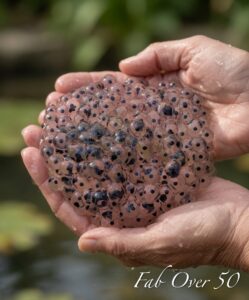
At first glance, they hardly look real. A handful of shimmering, jelly-like spheres—each with a dark center resembling a tiny staring pupil—can appear more like something from a science fiction film than a natural phenomenon. Often nicknamed “eyeball eggs” online, these clusters captivate viewers with a mix of curiosity and unease. Yet despite their surreal appearance, they are a perfectly natural and important part of the life cycle of many amphibians.
These unusual formations are known scientifically as Amphibian egg masses, and they represent one of nature’s most elegant solutions to protecting early life in unpredictable environments. Each transparent orb within the cluster contains a developing embryo, and together they form a gelatinous mass that floats or rests in shallow water.
One species commonly associated with this appearance is the Southern leopard frog, though similar egg masses can also be produced by related frogs. What makes these clusters so visually striking is the contrast between the clear outer jelly and the dark embryo inside, creating that unmistakable “eye-like” look.
But these aren’t just visually intriguing—they are biologically sophisticated.
Each egg is enclosed in a protective gelatinous layer composed mostly of water, proteins, and complex sugars. This jelly serves multiple critical functions. It helps retain moisture, which is vital if water levels fluctuate. It also provides a physical barrier against bacteria and fungi, while its slippery texture makes it harder for predators to grasp or consume.
Another important function is light transmission. The transparent jelly allows sunlight to penetrate, which can slightly warm the eggs and accelerate development in cooler conditions. At the same time, it filters out some harmful radiation, striking a balance between protection and exposure.
The dense clustering of eggs is not accidental either. It’s a survival strategy. By laying hundreds or even thousands of eggs in a single mass, amphibians increase the odds that at least some will survive. Predators may consume a portion, but rarely all of them. This “safety in numbers” approach has proven effective over millions of years of evolution.
The dark “pupil” seen inside each sphere is the developing embryo itself. In early stages, this embryo often shows a form of pigmentation that helps with camouflage—a concept related to Countershading. The upper side appears darker, helping it blend in when viewed from above, while the underside is lighter, reducing visibility from below.
These egg masses are typically found in calm, shallow water environments such as ponds, marshes, and seasonal wetlands. Many species rely on temporary water bodies known as Vernal pools, which fill during rainy periods and dry out later in the year. These habitats are especially important because they often lack fish, which are major predators of eggs and tadpoles.
Reproduction in these amphibians usually begins in early spring. Males call to attract females, and once a pair forms, they engage in a process called Amplexus, where the male clasps the female as she lays eggs. Fertilization happens externally, meaning the eggs are fertilized as they are released into the water.
Within hours, development begins. The embryo undergoes rapid cell division, forming the basic structures of a future tadpole. Over the next several days or weeks—depending on temperature and environmental conditions—the embryo grows more complex.
Oxygen plays a crucial role during this stage. Since there is no direct parental care, the eggs rely entirely on diffusion. Oxygen from the surrounding water passes through the jelly and into the embryo, while waste products move out the same way. This delicate exchange highlights how finely tuned the system is—too little oxygen or poor water quality can disrupt development.
As the embryo matures, it begins to resemble a tiny tadpole. Eventually, it breaks free from the jelly and enters the next stage of life. This marks the beginning of Metamorphosis, one of the most remarkable transformations in the animal kingdom.
The newly hatched tadpole lives entirely in water, using gills to breathe and feeding on algae and organic material. Over time, it develops legs, lungs, and other features needed for life on land. This transition from aquatic larva to terrestrial adult is a defining characteristic of amphibians.
Beyond their fascinating biology, these egg masses also play a vital ecological role. Amphibians are considered indicator species, meaning their presence—or absence—can reveal important information about environmental health. Because their eggs and skin are sensitive to pollution, changes in water quality often show up first in amphibian populations.
A decline in egg masses in a given area may signal problems such as contamination, habitat destruction, or disease. One notable threat is Chytridiomycosis, which has affected amphibian populations worldwide.
At the same time, these clusters support entire food webs. While some embryos will become frogs, many serve as food for insects, fish, birds, and other wildlife. This makes them an essential link in aquatic ecosystems.
Interestingly, their unusual appearance has also made them popular online. Photos of “eyeball eggs” often go viral, sparking curiosity and sometimes confusion. While some viewers react with discomfort, others are drawn in by their strange beauty. This mix of reactions has helped bring attention to amphibians and their habitats in ways traditional education sometimes cannot.
For nature enthusiasts and citizen scientists, spotting these egg masses can be an exciting experience. Observing them in the wild offers a glimpse into a hidden stage of life that many people never see. However, it’s important to handle them with care—if at all—and return them to their environment quickly to avoid disrupting development.
From a broader perspective, these gelatinous clusters are a powerful reminder of how life adapts to its surroundings. Every detail—from the прозрачный jelly to the pigmentation of the embryo—serves a purpose shaped by evolution.
What might initially seem strange or even unsettling becomes, upon closer inspection, a story of survival, adaptation, and continuity. Each tiny sphere holds the potential for life, contributing to a cycle that has persisted for millions of years.
In the end, “eyeball eggs” are more than just a visual curiosity. They are a window into the complexity of nature—where even the smallest and most unusual forms can reveal deep biological insight. The next time you encounter one of these shimmering clusters in a quiet pond, it’s worth pausing to look a little closer. Beneath the surface lies an entire world in development, waiting to emerge.