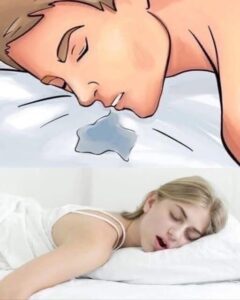
Drooling during sleep is one of those everyday human experiences that often goes unnoticed or lightly joked about, yet it carries surprisingly rich scientific meaning. Far from being a random or embarrassing bodily function, it reflects the complex coordination between the brain, nervous system, muscles, and sleep cycles. Understanding why it happens provides insight into how deeply the body relaxes during sleep and how different physiological systems interact during restorative rest.
The Biology of Saliva and Sleep
Saliva is continuously produced by the salivary glands throughout the day and night. While awake, swallowing happens frequently and automatically, guided by both conscious and subconscious control mechanisms in the brainstem and cerebral cortex. This constant swallowing prevents saliva from accumulating in the mouth.
During sleep, however, especially in deeper stages, conscious control is reduced. The brain prioritizes restorative functions over voluntary motor control. As a result, swallowing frequency decreases significantly. When saliva continues to be produced but is not swallowed as regularly, it can accumulate and eventually escape from the mouth, resulting in drooling.
This process is entirely natural and reflects the shift in the nervous system from active awareness to restorative maintenance.
Sleep Stages and Muscle Relaxation
Sleep is divided into multiple stages, primarily non-REM (light to deep sleep) and REM (rapid eye movement) sleep. Drooling is most commonly associated with deep non-REM sleep, particularly slow-wave sleep, which is the most restorative phase.
During slow-wave sleep:
- Brain activity slows significantly
- Heart rate and breathing become more regular and reduced
- Muscle tone decreases throughout the body
- Energy conservation and tissue repair processes increase
The muscles of the jaw and face relax during this stage, sometimes allowing the mouth to open slightly. This relaxed state makes it easier for saliva to escape, especially if the sleeper is lying on their side or stomach.
REM sleep introduces another dynamic. While most muscles are temporarily paralyzed during REM, transitions between sleep stages can create brief periods where muscle control is inconsistent. In these moments, drooling may also occur.
Sleep Position and Gravity’s Role
Sleep posture plays a major role in whether drooling occurs. Gravity naturally influences the direction saliva flows when the mouth is open or partially open.
- Side sleeping: Increases likelihood of drooling because saliva can pool toward one side of the mouth.
- Stomach sleeping: Also increases drooling due to downward gravitational flow.
- Back sleeping: Often reduces drooling because saliva tends to remain more centralized in the mouth or is swallowed more easily.
Thus, drooling is not only a neurological or muscular phenomenon but also a mechanical one influenced by body orientation.
Brain Activity and Restorative Processes
Although drooling itself is passive, it occurs during some of the most active phases of brain restoration. During deep sleep, the brain performs essential functions such as:
- Memory consolidation
- Emotional regulation
- Neural pathway strengthening
- Toxin clearance through the glymphatic system
These processes require reduced external activity and lowered bodily awareness. The decrease in voluntary control over swallowing is part of this broader neurological shutdown of non-essential functions.
In this sense, drooling can be indirectly associated with healthy, deep brain activity. It often appears when the body has successfully entered a stage of full relaxation and recovery.
Breathing Patterns and Nasal Function
Breathing also plays a significant role in nighttime drooling. Under normal conditions, humans breathe through their noses during sleep. However, when nasal passages are blocked due to:
- Allergies
- Colds
- Sinus congestion
- Structural issues
The body shifts toward mouth breathing. Mouth breathing increases the likelihood that saliva will escape rather than be swallowed.
This connection means that frequent drooling may sometimes indicate temporary or chronic respiratory issues rather than purely neurological relaxation.
Neurological and Medical Considerations
While drooling is usually harmless, certain neurological or medical conditions can influence its frequency and intensity.
Conditions that may contribute include:
- Sleep apnea, which disrupts normal breathing patterns
- Parkinson’s disease, which can affect muscle control
- Stroke-related muscle weakness
- Gastroesophageal reflux disease (GERD), which may increase saliva production
In these cases, drooling is not just a sign of deep sleep but may reflect altered neurological or muscular function. Sudden changes in drooling patterns, especially in adults, can sometimes warrant medical evaluation.
Saliva Production and Physiological Factors
Saliva production itself is influenced by multiple factors:
- Hydration levels
- Diet (spicy or acidic foods may increase salivation)
- Medications that affect nervous system or gland activity
- Hormonal fluctuations
Increased saliva production combined with reduced swallowing efficiency during sleep naturally increases the chance of drooling. This is why some individuals experience it more frequently than others without any underlying health issues.
Developmental Aspects in Children
Drooling is especially common in infants and young children. In these cases, it is primarily due to:
- Immature swallowing reflexes
- Teething processes
- Developing nervous system coordination
As children grow, their ability to control saliva improves, and drooling during sleep usually decreases. In this age group, drooling is generally considered a normal part of development rather than a medical concern.
Evolutionary Perspective
From an evolutionary standpoint, drooling during sleep is not unique to humans. Many mammals, including dogs, cats, and primates, exhibit similar behaviors during deep rest.
This suggests that drooling is a byproduct of deep relaxation and energy conservation. In evolutionary terms, a relaxed jaw and reduced muscular tension may indicate a safe environment, allowing the brain to fully enter restorative states without maintaining defensive alertness.
Sleep Quality and Cognitive Restoration
Modern sleep science emphasizes the importance of deep sleep in cognitive performance and emotional stability. Drooling often coincides with prolonged deep sleep cycles, which are essential for:
- Learning and memory retention
- Stress recovery
- Emotional balance
- Physical restoration
While drooling itself is not a direct marker of sleep quality, its presence can suggest that the body has reached deep restorative stages where voluntary control is minimized.
Dental and Structural Influences
Oral and dental structure can also affect drooling. Factors include:
- Misaligned teeth
- Jaw positioning issues
- Temporomandibular joint (TMJ) disorders
- Dental appliances or retainers
These conditions can prevent the mouth from fully closing during sleep, increasing saliva leakage. In such cases, drooling is more mechanical than neurological.
Emotional and Psychological Dimensions
Interestingly, perceptions of drooling are often shaped by social and psychological factors. Many people associate it with loss of control or embarrassment, even though it is a natural physiological process.
Understanding its biological basis can reduce stigma and shift perception toward viewing it as a sign of relaxation rather than dysfunction. It is a reminder that during sleep, the body prioritizes restoration over appearance or voluntary control.
Aging and Changes in Sleep Physiology
As people age, muscle tone naturally decreases, including in facial and jaw muscles. This can make drooling more common in older adults. Additionally, changes in sleep architecture and neurological efficiency may also contribute.
In most cases, age-related drooling during sleep is benign and reflects normal physiological aging rather than disease.
Managing or Reducing Drooling
While drooling is generally harmless, individuals who find it bothersome can take simple steps to reduce it:
- Adjusting sleep position, especially avoiding stomach sleeping
- Treating nasal congestion or allergies
- Using supportive pillows to maintain head alignment
- Maintaining good oral and dental health
Persistent or excessive drooling should be evaluated if it is accompanied by other symptoms such as snoring, breathing interruptions, or neurological changes.
Conclusion: A Window Into Restorative Sleep
Drooling during sleep is far more than a minor inconvenience. It is a visible expression of deep biological processes that occur when the body and brain enter restorative states. It reflects muscle relaxation, reduced conscious control, altered breathing patterns, and active neurological recovery.
Rather than being viewed as a flaw or embarrassment, drooling can be understood as a sign that the body is functioning as designed during sleep—prioritizing healing, memory consolidation, and energy restoration.
In this way, something as simple as a small trace of saliva becomes a subtle but fascinating indicator of the complex and highly coordinated systems that sustain human health every night.