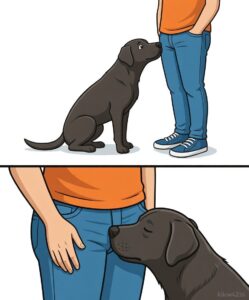
Dogs experience the world in a way that is fundamentally different from humans. While people rely heavily on sight and sound to interpret their surroundings, dogs depend primarily on scent. Their noses are not just tools for detecting odors—they are sophisticated biological instruments capable of analyzing complex chemical information in ways that humans cannot even imagine. What might feel awkward or embarrassing to a person, such as a dog sniffing their private area, is actually a completely natural and instinctive behavior rooted in science, biology, and evolution.
To understand this behavior, it is important to first appreciate just how powerful a dog’s sense of smell truly is. Humans possess around five to six million olfactory receptors in their noses. Dogs, on the other hand, can have anywhere between one hundred million and three hundred million, depending on the breed. This massive difference means that dogs can detect scents at concentrations that are thousands—even tens of thousands—of times weaker than what humans can perceive. In practical terms, this allows dogs to identify subtle chemical changes in the human body that go completely unnoticed by people.
When a dog approaches a person and begins sniffing, it is not simply smelling in the way humans do. It is analyzing a detailed chemical profile. Every human emits a unique combination of compounds influenced by genetics, diet, health, hormones, and emotional state. To a dog, this is like reading a detailed biography written in scent. The act of sniffing is how dogs gather information, confirm identity, and understand the condition of the individuals around them.
Certain areas of the human body are particularly rich in scent-producing glands. Among these are the armpits and the groin region. These areas contain apocrine glands, which produce a thicker type of sweat than other parts of the body. When this sweat interacts with bacteria on the skin, it creates strong and distinctive odors. While humans often try to mask these smells with deodorants or perfumes, dogs can easily detect the underlying chemical signals.
The groin area, in particular, is a hotspot for scent information. Because of its concentration of apocrine glands and its proximity to major blood vessels, it reflects changes in the body’s internal chemistry quite clearly. When a dog sniffs this area, it is essentially accessing a concentrated source of biological data. It can detect differences in hormone levels, identify whether a person is male or female, and even sense changes related to health or emotional states.
A key component of this process involves pheromones. Pheromones are chemical signals released by the body that carry information between individuals. In many animals, pheromones play a crucial role in communication, influencing behaviors related to mating, social bonding, and territory. Although humans rely less on pheromones for communication than many other species, we still produce them. Dogs, with their advanced olfactory systems, are highly sensitive to these signals.
Inside a dog’s nasal cavity is a specialized structure known as the vomeronasal organ, or Jacobson’s organ. This organ is specifically designed to detect pheromones and other chemical signals that are not processed by the regular sense of smell. It allows dogs to interpret subtle cues about reproduction, stress, and identity. When a dog sniffs a person’s groin area, this organ plays a significant role in analyzing the information it receives.
Through scent, dogs can learn an astonishing amount about a person. They can detect hormonal fluctuations that occur during different life stages, such as puberty, menstruation, pregnancy, or menopause. They can sense emotional states by identifying chemical markers associated with stress hormones like cortisol and adrenaline. They can even pick up on certain health conditions, as illnesses often alter the body’s chemical composition in detectable ways.
This ability is not just theoretical. It has been demonstrated in numerous real-world applications. Medical detection dogs are trained to identify diseases such as cancer by recognizing specific scent patterns associated with abnormal cell activity. Some dogs can alert their owners to changes in blood sugar levels, helping individuals manage conditions like diabetes. Others have been observed to anticipate seizures before they occur, likely due to subtle chemical changes in the body that precede the event.
Given this extraordinary sensitivity, it becomes easier to understand why a dog might show particular interest in certain individuals. People who are experiencing hormonal changes, taking medications, or dealing with health conditions may emit scents that are especially noticeable to dogs. Even something as simple as a change in diet, a new soap, or a different laundry detergent can alter a person’s scent profile enough to attract a dog’s attention.
It is also worth noting that dogs rely heavily on scent when meeting someone for the first time. Unlike humans, who might use visual cues or spoken introductions, dogs gather information primarily through smell. If a dog does not have prior scent information about a person, it will naturally seek out the areas that provide the most data. The groin region, being one of the richest sources of scent, becomes a logical focus.
From a human perspective, this behavior can feel intrusive or inappropriate. Social norms dictate that certain parts of the body are private, and interactions involving them are restricted. Dogs, however, do not share these cultural understandings. In the canine world, sniffing is a standard and essential form of greeting. Dogs commonly sniff each other’s rear ends as a way of exchanging information. This behavior is not seen as rude—it is a normal part of social interaction.
When a dog applies this same behavior to a human, it is simply using the communication methods it knows. It does not intend to embarrass or offend. It is trying to understand who the person is, how they are feeling, and whether they are familiar or new. In essence, it is performing a social check-in using the tools evolution has provided.
For those who find this behavior uncomfortable, it is possible to manage it through training. The key is to respond calmly and consistently. Dogs do not benefit from punishment or harsh reactions, as these can create confusion or anxiety. Instead, gentle redirection is more effective. Offering a hand for the dog to sniff, giving a simple command like “sit,” or guiding the dog’s attention elsewhere can help establish boundaries without discouraging natural instincts.
Positive reinforcement plays a crucial role in shaping behavior. When a dog chooses a more appropriate way to greet someone, such as sniffing a hand or sitting calmly, rewarding that behavior with praise or treats encourages it to repeat the action. Over time, the dog learns that while sniffing is acceptable, there are preferred ways to interact with humans.
Providing dogs with ample opportunities to use their sense of smell in appropriate contexts is also important. Activities like walks, scent games, and exploration allow dogs to satisfy their natural curiosity. When their need for olfactory stimulation is met, they may be less likely to engage in behaviors that humans find awkward.
Interestingly, this behavior highlights the deep connection between humans and dogs. Over thousands of years of domestication, dogs have evolved to become highly attuned to human cues. They can read body language, interpret facial expressions, and, perhaps most impressively, detect changes in scent that reveal emotional and physical states. This makes them uniquely capable of understanding humans in ways that few other animals can.
Rather than viewing a dog’s sniffing behavior as a nuisance, it can be seen as a reflection of this remarkable bond. It demonstrates how closely dogs pay attention to the people around them and how they use their senses to maintain social connections. Even though the behavior may need to be guided or redirected, its underlying purpose is rooted in curiosity, communication, and awareness.
There are also many misconceptions surrounding this behavior. Some people believe that dogs sniff private areas because they are poorly trained or trying to assert dominance. In reality, the behavior is instinctive and not related to dominance at all. Others assume that only certain dogs, such as those that are not neutered, exhibit this behavior. However, it can occur in any dog, regardless of age, breed, or reproductive status.
Another common myth is that dogs are showing inappropriate attraction to humans. This is not the case. Dogs do not interpret humans in the same way they interpret other dogs. What might appear to be attraction is simply heightened interest in scent information. The dog is responding to chemical signals, not engaging in any form of human-like intention.
Understanding the science behind this behavior can transform how it is perceived. What initially feels embarrassing can become fascinating when viewed through the lens of biology and sensory perception. It is a reminder that dogs inhabit a world rich in information that humans cannot access. Their experiences are shaped by signals that are invisible and undetectable to us, yet incredibly meaningful to them.
This perspective also encourages greater empathy toward dogs. Recognizing that their actions are driven by instinct and curiosity helps foster patience and understanding. Instead of reacting with frustration, it becomes possible to guide behavior in a way that respects both the dog’s nature and human comfort.
In the end, a dog sniffing a person’s private area is not an act of rudeness or misbehavior. It is a natural expression of a highly विकसित sensory system doing exactly what it is designed to do. It reflects the dog’s attempt to gather information, establish familiarity, and engage in social interaction.
By learning more about how dogs perceive the world, humans can better appreciate the depth of their abilities and the uniqueness of their perspective. What might seem like a simple or awkward action is actually part of a complex and sophisticated process that reveals just how extraordinary dogs truly are.
The next time this situation occurs, it may still feel a bit uncomfortable—but it can also be seen as a moment of insight into the canine mind. Behind that curious sniff is a powerful biological system at work, quietly decoding the invisible signals that define who we are.