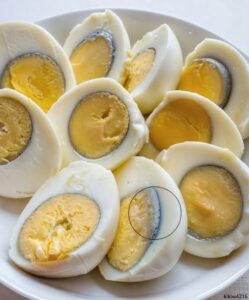
If you’ve ever sliced open a hard-boiled egg and noticed a greenish-gray ring encircling the yolk, you’re not alone. This common kitchen occurrence has puzzled countless home cooks, often leading to concerns about food safety, freshness, or even contamination. In reality, that unappealing green ring is simply the result of overcooking. While harmless, it is a clear indicator that your cooking method needs adjustment.
Understanding why this happens, and more importantly how to prevent it, can significantly improve not only the appearance of your eggs but also their texture, flavor, and overall quality. What may seem like a minor detail actually reflects a deeper relationship between heat, chemistry, and cooking precision.
At the heart of the green ring phenomenon is a basic chemical reaction. Egg whites contain sulfur, while egg yolks are rich in iron. When eggs are exposed to high temperatures for too long, these two elements react to form iron sulfide. This compound is what creates the distinctive greenish-gray discoloration around the yolk.
The reaction becomes more pronounced the longer the egg remains hot, especially after boiling. Many people assume that once the heat is turned off, cooking stops immediately—but that’s not the case. Residual heat continues to cook the egg internally, often pushing it beyond the ideal doneness point.
This is why eggs that are left sitting in hot water after boiling are particularly prone to developing the green ring. The key issue isn’t just boiling—it’s prolonged exposure to heat without rapid cooling.
Despite its unappealing look, the green ring does not mean the egg is unsafe to eat. It does not indicate spoilage, bacterial contamination, or poor storage. The egg remains fully edible. However, the visual flaw is usually accompanied by noticeable changes in texture and taste.
Overcooked yolks tend to become dry, crumbly, and chalky rather than smooth and creamy. The whites, meanwhile, can turn rubbery and tough. This significantly reduces the eating experience, especially in dishes where eggs are the main feature.
Many people first encounter this issue when following overly simplistic cooking instructions like “boil eggs for 10 minutes.” While this advice might seem straightforward, it fails to account for important variables such as egg size, starting temperature, altitude, and even the type of cookware used.
For example, larger eggs require slightly more time to cook than smaller ones. Eggs taken straight from the refrigerator behave differently than those at room temperature. At higher altitudes, water boils at a lower temperature, which alters cooking dynamics. These factors all influence how quickly the sulfur and iron reaction occurs.
The image of hard-boiled eggs with green-ringed yolks—often shared online—has sparked widespread curiosity and confusion. In many cases, one egg is circled to highlight the discoloration, making it clear just how common this issue is. But rather than being a cause for concern, it should be seen as an opportunity to refine your cooking technique.
Achieving perfect hard-boiled eggs is less about strict timing and more about controlled temperature and proper cooling. One of the most reliable methods is the “cold start” technique.
To begin, place your eggs in a single layer at the bottom of a saucepan. Add enough cold water to cover them by about an inch. Starting with cold water ensures even heating and reduces the risk of cracking.
Next, place the pot over medium-high heat and bring the water to a gentle boil. Once the water reaches a full boil, remove the pot from the heat immediately and cover it with a lid.
At this point, timing becomes important. Let the eggs sit in the hot water for about 9 to 12 minutes, depending on your desired level of doneness. For slightly softer centers, aim closer to 9 minutes. For fully set yolks that are still bright yellow, 10 to 11 minutes is ideal. Avoid exceeding 12 minutes to prevent the green ring.
Once the time is up, transfer the eggs immediately to a bowl of ice water. This step is crucial. The rapid cooling halts the cooking process, preventing further chemical reactions and preserving the yolk’s vibrant color and creamy texture.
The ice bath also has another benefit: it makes the eggs easier to peel. Cooling causes the egg to contract slightly inside the shell, creating a small gap that helps separate the membrane from the egg white.
Peeling can still be tricky, especially with very fresh eggs. Interestingly, slightly older eggs are actually easier to peel because their internal pH changes over time, weakening the bond between the egg white and the shell membrane.
If peeling remains difficult, you can try adding a teaspoon of baking soda or vinegar to the cooking water. While the science behind this is debated, many home cooks report improved results.
Another helpful tip is to gently tap the egg on a hard surface and roll it slightly to create small cracks all over the shell. Then peel under running water to help lift the shell away smoothly.
Avoid overcrowding your pot when cooking multiple eggs. Eggs should be arranged in a single layer to ensure even cooking. If stacked, some eggs may overcook while others remain underdone.
Consistency is key. Using a timer instead of guessing can make a significant difference. Even a minute or two can determine whether your yolks are perfectly yellow or tinged with green.
Beyond technique, it’s worth considering why this matters. Eggs are one of the most versatile and nutritious foods available. They are rich in high-quality protein, vitamins like B12 and D, and essential minerals.
While overcooking doesn’t eliminate these benefits entirely, excessive heat can degrade some heat-sensitive nutrients. More importantly, it diminishes the sensory qualities that make eggs enjoyable to eat.
Perfectly cooked eggs elevate simple dishes. Egg salad becomes creamier. Deviled eggs have a smoother filling. Sliced eggs on toast or in salads look more appealing and taste better.
The difference is especially noticeable in dishes where eggs are the star ingredient. A bright yellow yolk signals freshness, care, and attention to detail.
There are also psychological factors at play. Food that looks good tends to taste better because visual appeal influences perception. A green-ringed yolk can make even a perfectly safe egg seem less appetizing.
Many myths surround the green ring, contributing to unnecessary worry. Some believe it indicates that eggs are old or spoiled. Others think it’s a sign of chemical contamination or improper storage.
These assumptions are incorrect. Fresh eggs can develop the green ring just as easily as older ones if overcooked. The reaction is purely a result of heat and time, not quality or safety.
Professional chefs are well aware of this issue and take steps to avoid it. In commercial kitchens, precision is essential. Eggs are often cooked in controlled environments with exact timing and immediate cooling.
Home cooks can achieve similar results with a bit of practice and attention. You don’t need specialized equipment—just a reliable method and awareness of the process.
It’s also helpful to understand that cooking is not just about following instructions but about observing and adjusting. If your eggs consistently develop green rings, it’s a sign that something in your method needs tweaking.
Maybe the water is boiling too vigorously. Maybe the eggs are sitting too long after cooking. Maybe the cooling step is being skipped or rushed.
Each of these factors contributes to the final result. By making small adjustments, you can dramatically improve your outcomes.
Cooking eggs can even become an educational activity. For families, it’s a great way to introduce basic food science concepts. Children can learn how heat affects proteins and how chemical reactions change color and texture.
Turning a simple task into a learning experience adds value beyond the meal itself. It encourages curiosity, experimentation, and confidence in the kitchen.
Over time, mastering small techniques like this builds a strong foundation for more complex cooking. It teaches patience, precision, and the importance of detail.
The green ring, once a frustrating mystery, becomes a useful signal—a reminder that cooking is both an art and a science.
It’s also worth noting that preferences vary. Some people don’t mind slightly overcooked eggs, and that’s perfectly fine. Cooking should ultimately align with personal taste.
However, understanding the ideal method gives you control. You can choose your preferred level of doneness rather than ending up with unintended results.
For those who prepare meals in advance, properly cooked hard-boiled eggs are a convenient option. They can be stored in the refrigerator for up to a week and used in a variety of dishes.
Keeping them unpeeled helps maintain freshness. When ready to eat, simply peel and enjoy or incorporate into recipes.
From breakfast to lunch to snacks, eggs play a role in countless meals. Improving how you cook them has a ripple effect across your diet.
In the end, the green ring is not a problem—it’s feedback. It tells you that your eggs were exposed to too much heat for too long.
By responding to that feedback and adjusting your technique, you can consistently produce better results.
The next time you boil eggs, pay attention to the process. Start with cold water, control the timing, and cool them quickly.
These simple steps make all the difference. You’ll notice brighter yolks, better texture, and a more enjoyable eating experience.
Cooking is full of small moments like this—opportunities to learn, refine, and improve. Even something as simple as boiling an egg can teach valuable lessons.
With practice, what once seemed like a minor annoyance becomes a marker of progress. No more green rings, no more guesswork—just perfectly cooked eggs every time.