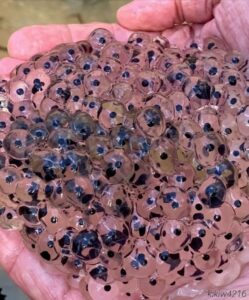
What looks at first like something from a science-fiction prop room or an artist’s surreal installation is, in reality, one of nature’s most elegant and uncanny reproductive forms. The image of translucent, gelatinous spheres clustered together—each containing a dark, pupil-like center—has earned the internet nickname “eyeball eggs.” Held delicately in a human palm, they appear almost alive in a way that feels unsettling and fascinating at the same time, as though thousands of tiny eyes are quietly observing the world.
Yet behind this striking visual illusion lies a completely natural biological structure: amphibian egg masses, most commonly belonging to frogs such as the Southern leopard frog, scientifically known as Lithobates sphenocephalus. Similar egg clusters are also produced by related species such as pickerel frogs and wood frogs, all of which share reproductive strategies adapted to freshwater wetlands.
These egg masses are not only visually extraordinary but also biologically sophisticated, representing millions of years of evolutionary refinement designed to protect the earliest and most vulnerable stage of amphibian life.
Why These Eggs Look Like Staring Eyes
The “eyeball” illusion comes from a combination of structure, light, and embryonic development. Each sphere in the cluster is a single egg encased in a thick, transparent jelly coat. Inside each egg is a developing embryo, and at certain stages, the dark pigmentation on the upper side of the embryo creates a strong contrast against the translucent background.
This dark spot is not actually an eye in the human sense, though early development does include eye formation. Instead, it is primarily a concentration of pigment cells and developing neural structures that shield sensitive tissues from sunlight. When viewed through the magnifying lens of gelatin and water, these dark embryonic regions appear like pupils staring outward.
The result is a powerful optical illusion: a field of tiny, suspended “eyes” floating in a shimmering, jelly-like matrix.
The Architecture of Amphibian Egg Masses
Each egg is encased in multiple protective layers that serve distinct biological functions. The outer jelly coating is composed largely of water mixed with mucopolysaccharides and specialized proteins. This structure is not random—it is a carefully evolved protective system.
The jelly serves several critical purposes:
It cushions the embryo against physical shock in flowing or disturbed water.
It prevents dehydration when water levels fluctuate.
It provides a barrier against bacteria and fungal infections.
It deters some predators due to its slippery, unpalatable texture.
It allows oxygen to diffuse inward and carbon dioxide to diffuse outward.
Together, these functions create a self-contained incubator that supports life without any parental care after the eggs are laid.
When freshly deposited, the egg mass is compact. As it absorbs water, it expands into a larger, gelatinous sphere or cluster that floats or anchors to aquatic vegetation.
Where These Eggs Are Found
Egg masses like these are typically laid in shallow freshwater habitats such as ponds, marshes, seasonal wetlands, and vernal pools. These environments are temporary by design, often filling with rainwater in early spring and drying out later in the year.
This temporary nature is actually beneficial. Many fish species that would normally eat frog eggs cannot survive in these short-lived waters. As a result, amphibians like Lithobates sphenocephalus exploit these environments as relatively safe nurseries.
Breeding typically occurs after seasonal warming. Males gather in breeding sites and produce loud mating calls to attract females. Once a pair forms, the male clasps the female in a behavior called amplexus, and fertilization occurs externally as eggs are released into the water.
A single female may lay hundreds to several thousand eggs in one reproductive event, forming the dense clusters that appear so visually dramatic.
Inside the “Eyeballs”: Rapid Life in Slow Motion
Although they appear static, these egg clusters are sites of intense biological activity. Each embryo begins dividing almost immediately after fertilization.
Inside the jelly sphere:
Cells multiply rapidly.
A basic body axis forms.
Early nervous system structures begin developing.
Eye regions become prominent due to pigmentation.
The tail bud begins to form.
The embryos rely entirely on yolk stored within the egg for nutrition during this stage. Oxygen diffuses through the jelly coating, which is thin enough at a microscopic level to support gas exchange.
Temperature plays a major role in development speed. Warmer water accelerates growth, while cooler temperatures slow it down. In some species, embryos can even adjust their hatching timing slightly in response to environmental stress, such as vibrations or chemical signals indicating predator presence.
The Transformation: From Egg to Tadpole
Once development reaches a certain point, the embryos hatch into tadpoles. This transition is one of the most dramatic transformations in the animal kingdom.
The tadpoles emerge with:
A long tail for swimming
External or internal gills for breathing underwater
A simple digestive system designed for algae and organic matter
At this stage, they are entirely aquatic. Over time, they undergo metamorphosis:
Legs develop
The tail is absorbed
Gills are replaced by lungs
The body structure reshapes for land movement
Eventually, they become fully formed frogs capable of leaving the water and beginning terrestrial life.
This process illustrates the remarkable adaptability of amphibians, bridging aquatic and land-based ecosystems.
Why the “Eyeball Effect” Fascinates People
Humans are naturally drawn to patterns that resemble faces or eyes, a psychological phenomenon known as pareidolia. This is why clouds, rock formations, and even toast sometimes appear to “look back” at us.
The egg masses of Lithobates sphenocephalus amplify this effect dramatically. The combination of spherical shapes, internal dark centers, and fluid transparency creates a powerful illusion of awareness—even though none exists.
This visual ambiguity triggers both curiosity and mild unease. It feels like something alive is observing the observer, even though what we are actually seeing is a highly organized cluster of embryos protected by gelatin.
Ecological Importance of These Egg Masses
Beyond their visual appeal, amphibian egg clusters play a critical role in ecosystems.
They are:
A food source for insects, fish, and birds
Indicators of wetland health
Early life stages of insect-controlling predators
Amphibians like frogs consume large quantities of mosquitoes and other insects later in life, making their survival ecologically valuable.
Because of this, scientists often monitor egg masses as bioindicators. A decline in their numbers can signal environmental problems such as pollution, habitat destruction, or disease outbreaks like chytrid fungus, which has severely affected amphibian populations worldwide.
Human Reactions: Awe, Curiosity, and Misinterpretation
When people first encounter images of these “eyeball eggs,” reactions vary widely. Some see them as beautiful natural art. Others find them unsettling or even alien. Online discussions often range from scientific identification to humorous comparisons with candy, gemstones, or science-fiction organisms.
This emotional range highlights how unfamiliar biological structures can challenge human expectations of what “life” should look like.
What appears strange at first glance becomes fascinating once understood.
Conservation and the Future of Amphibians
Despite their abundance in some regions, amphibians globally are among the most threatened groups of animals. Habitat loss, pollution, climate change, and disease have all contributed to population declines.
Protecting breeding habitats like ponds and wetlands is essential for ensuring that species like Lithobates sphenocephalus continue to reproduce successfully.
Simple actions—such as preserving natural wetlands, avoiding pesticide runoff, and supporting conservation efforts—help maintain the delicate balance these species depend on.
A Final Reflection on Nature’s Design
The so-called “eyeball eggs” are more than a visual curiosity. They are a reminder that nature often creates forms that blur the line between the familiar and the alien. What looks eerie or surreal is actually a finely tuned system for sustaining life in unpredictable environments.
Inside each translucent sphere is a future frog—waiting, developing, transforming. What appears to be a cluster of staring eyes is really a quiet promise of renewal, hidden in plain sight within the waters of the natural world.
And perhaps that is what makes them so unforgettable: they invite us to look closer, question our assumptions, and recognize that even the strangest-looking things in nature are part of a deeply interconnected story of life.