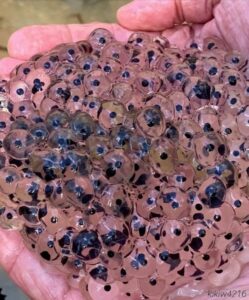
Cradled in a human hand or gently floating in a quiet pond, these shimmering clusters of translucent spheres appear almost otherworldly—like props from a science fiction film or delicacies from a fantastical confectionery. Yet these striking formations are entirely natural, representing the egg masses of amphibians such as the Southern leopard frog. Commonly nicknamed “eyeball eggs” due to their uncanny resemblance to tiny staring pupils suspended in jelly, these clusters have fascinated both scientists and casual observers alike, blending eerie beauty with biological brilliance.
Each orb within the mass is an individual egg, a self-contained life-support system housing a developing embryo. The dark “pupil” at the center is the embryo itself, often pigmented on its upper side, creating the illusion of a miniature eye gazing outward. This striking visual effect is not merely aesthetic—it reflects important biological adaptations. The pigmentation helps shield the embryo from harmful ultraviolet radiation while also providing camouflage from predators when viewed from above or below.
The surrounding jelly matrix is a marvel of evolutionary design. Composed primarily of water and complex carbohydrates, it serves multiple purposes essential to survival. It acts as a protective barrier against physical damage, prevents dehydration if water levels fluctuate, and inhibits the growth of harmful bacteria and fungi. Its slippery texture can deter some predators, while its transparency allows sunlight to penetrate, supporting the embryo’s development. Oxygen diffuses easily through this gelatinous layer, ensuring that each embryo receives what it needs despite the absence of parental care.
These egg masses are typically laid in clusters, a strategy that enhances survival through sheer numbers. While some eggs may fall prey to fish, insects, or other amphibians, many survive simply because predators cannot consume them all. This “safety in numbers” approach is common among amphibians and reflects the challenges of reproducing in open aquatic environments.
The reproductive process itself is equally fascinating. During a behavior known as amplexus, the male frog clasps the female as she releases hundreds or even thousands of eggs into the water. The male simultaneously fertilizes them externally, resulting in the formation of these dense, jelly-like clusters. Species like the wood frog and pickerel frog produce similar egg masses, each with subtle differences in structure and appearance that experts use for identification.
These clusters are most often found in seasonal wetlands, vernal pools, and shallow ponds—habitats that are crucial for amphibian reproduction. Such environments typically lack large fish populations, reducing predation pressure on eggs and tadpoles. However, they are also highly sensitive ecosystems, vulnerable to pollution, climate change, and habitat destruction. The presence of amphibian egg masses is often a strong indicator of environmental health, making them valuable to scientists studying ecosystem stability.
Inside each egg, a remarkable transformation is underway. Following fertilization, the embryo begins dividing rapidly, forming the basic structures of a tadpole. The neural tube develops, followed by the formation of eyes, a tail, and gills. The dark pigmentation becomes more pronounced as the embryo matures, enhancing the “eyeball” appearance. Within days or weeks—depending on temperature and species—the tadpole emerges, wriggling free from the jelly and beginning its independent aquatic life.
At this stage, the tadpole relies initially on yolk reserves for nutrition before transitioning to feeding on algae and organic matter. Over time, it undergoes one of nature’s most dramatic transformations: metamorphosis. Limbs develop, gills are replaced by lungs, and the tail is gradually absorbed. Eventually, the tadpole becomes a juvenile frog, capable of living on land and continuing the cycle of life.
Beyond their biological significance, these “eyeball eggs” have captured the imagination of people around the world. Images shared online often spark curiosity, humor, and sometimes mild discomfort, as viewers grapple with their unusual appearance. This widespread fascination provides an अवसर for education, encouraging people to learn more about amphibians and the ecosystems they inhabit.
Amphibians play a critical role in maintaining ecological balance. As both predators and prey, they help regulate insect populations and serve as a food source for birds, mammals, and reptiles. Their permeable skin makes them particularly sensitive to environmental changes, positioning them as important indicators of ecosystem health. Declines in amphibian populations—often linked to habitat loss, pollution, and diseases like chytridiomycosis—highlight the need for conservation efforts.
Protecting the habitats where these egg masses are found is essential not only for amphibians but for entire ecosystems. Wetlands filter water, support biodiversity, and act as natural buffers against flooding. Preserving these environments ensures that future generations will continue to witness the strange and beautiful phenomena they harbor.
For those who encounter these jelly-like clusters in the wild, a sense of wonder is almost inevitable. Holding or observing them offers a rare glimpse into the earliest stages of life, a moment where potential is suspended in delicate balance. Each tiny sphere represents a developing organism, a future frog that will contribute to the intricate web of life.
In the end, the allure of these mesmerizing “eyeball eggs” lies in their ability to surprise and inspire. They challenge our expectations of what nature looks like, revealing that even the most unusual forms can have purpose and elegance. What may initially seem bizarre or even unsettling becomes, upon closer inspection, a testament to the ingenuity of evolution.
So the next time you spot a glistening cluster in a pond or see an image that looks like a handful of translucent pearls with staring black centers, take a moment to appreciate what you’re witnessing. Within that gelatinous mass lies a story of survival, adaptation, and transformation—one that has been unfolding for millions of years and continues to captivate all who take the time to look a little closer.