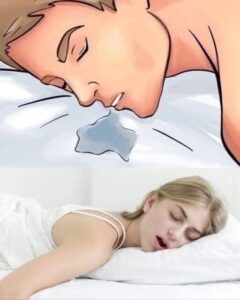
Drooling while sleeping is one of those human experiences that tends to provoke embarrassment, humor, or mild curiosity, yet beneath its surface lies a surprisingly rich story about how the brain and body behave during rest. Far from being random or meaningless, nocturnal drooling reflects a complex interaction between neurological control, muscular relaxation, sleep stages, and even subtle health conditions that influence how the body manages saliva during unconsciousness.
At its core, drooling occurs because the mechanisms that normally regulate swallowing and facial muscle tone are partially “dialed down” during sleep. When we are awake, swallowing is a continuous, semi-automatic process coordinated by the brainstem and supported by conscious awareness. We swallow saliva frequently without thinking about it. However, once sleep begins, especially during deeper stages, conscious oversight fades and many reflexes become less active. This shift is not a malfunction—it is part of the brain’s natural transition into restorative states.
During non-REM sleep, particularly slow-wave sleep (often considered the deepest stage), the body enters a highly restorative mode. Heart rate slows, breathing becomes steadier, and muscle tone decreases significantly. This reduction in muscle activity includes the muscles of the jaw, lips, and cheeks. When these muscles relax too much, the mouth may open slightly, allowing saliva to escape rather than being swallowed as it normally would during wakefulness.
Sleeping position plays a major role in this process. People who sleep on their side or stomach are more likely to experience drooling because gravity encourages saliva to pool toward the edges of the mouth. In contrast, sleeping on the back may reduce drooling for some individuals, although it can introduce other considerations such as snoring or airway obstruction. The physical orientation of the head and jaw can therefore directly influence whether saliva remains contained or escapes during the night.
Beyond posture and muscle relaxation, drooling can also provide indirect clues about brain activity. Sleep is not a uniform state but a dynamic cycle that alternates between non-REM and REM stages. During REM sleep, when dreaming is most vivid and the brain is highly active, the body undergoes a unique condition known as muscle atonia—temporary paralysis of most voluntary muscles. This prevents dream enactment. However, not all muscles are equally suppressed, and transitions between sleep stages can create brief windows where swallowing reflexes are less coordinated, allowing saliva to accumulate.
From a neurological perspective, drooling is therefore not simply “leakage,” but a side effect of the brain prioritizing internal restoration over external control. The same systems that regulate attention, movement, and conscious awareness are partially disengaged so that memory consolidation, emotional processing, and cellular repair can occur efficiently.
In some cases, drooling may also reflect underlying physiological or medical factors. Nasal congestion, for example, forces individuals to breathe through the mouth, increasing the likelihood of saliva accumulation. Conditions such as sleep apnea can also contribute by disrupting normal breathing patterns and sleep architecture. Gastroesophageal reflux disease (GERD) may stimulate excess saliva production as a protective response. Even certain medications that influence the nervous system or muscle tone can subtly alter swallowing reflexes during sleep.
Neurological conditions may also play a role, particularly in persistent or severe cases. Disorders that affect motor control or facial muscle coordination can reduce the efficiency of nighttime swallowing. While occasional drooling is typically harmless and common across all age groups, a noticeable change in pattern or frequency can sometimes warrant medical attention, especially if accompanied by other symptoms.
Interestingly, drooling is not unique to humans. Many animals experience it during deep sleep or relaxation states. Dogs, cats, and even some primates may drool when entering restorative rest phases, suggesting that the phenomenon has evolutionary roots. In this context, drooling may be seen as a biological signal of safety and deep relaxation—when an organism is no longer on alert, the body can fully release muscular tension, including those responsible for oral control.
Sleep scientists also associate drooling with the depth and quality of sleep. Extended periods of slow-wave sleep are considered essential for physical recovery, immune regulation, and cognitive restoration. While drooling itself is not a direct measure of sleep quality, its occurrence often aligns with deeper relaxation states. In this way, it can indirectly suggest that the body is reaching stages of sleep necessary for effective restoration.
Another factor worth considering is saliva production itself. Saliva is continuously produced by glands in the mouth and serves important functions, including digestion, oral health maintenance, and protection against bacteria. Its production does not stop during sleep. Therefore, drooling is not due to “excess saliva” being created, but rather a temporary imbalance between production and swallowing efficiency during unconsciousness.
Hydration levels, diet, and even emotional stress can subtly influence drooling tendencies. For example, dehydration may reduce saliva production, while certain foods or late-night eating habits can increase it. Stress and fatigue can also alter sleep depth and muscle tone, indirectly influencing how the body manages saliva overnight.
From a developmental perspective, drooling is extremely common in infants and young children. In early life, the nervous system is still maturing, and coordination between swallowing and muscle control is not fully developed. As the brain matures, most individuals gain better control over these reflexes during wakefulness, though sleep-related drooling may still persist intermittently throughout adulthood.
In older adults, drooling can sometimes become more noticeable again due to natural changes in muscle tone, dental structure, or neurological efficiency. While often benign, it may occasionally intersect with age-related conditions affecting motor control or swallowing coordination. Even so, in many cases it remains a normal part of sleep physiology.
There is also a psychological dimension to how drooling is perceived. Many people associate it with embarrassment or loss of control, yet scientifically it represents the opposite: a sign that the body has successfully entered a deeply relaxed, low-consciousness state. In other words, drooling can be interpreted as evidence that the brain has effectively stepped away from active monitoring and allowed restorative processes to take over.
Modern sleep research tools such as polysomnography have made it possible to observe these processes in detail. Studies tracking muscle activity, brain waves, and physiological responses confirm that drooling often coincides with deep sleep phases, reinforcing its connection to restorative rest rather than dysfunction.
In practical terms, individuals who wish to reduce drooling can often do so by adjusting sleep posture, improving nasal airflow, or addressing underlying conditions such as congestion or reflux. However, in most cases, occasional drooling requires no intervention at all and is simply part of normal sleep behavior.
Ultimately, drooling during sleep should not be viewed as a flaw or inconvenience, but as a small visible outcome of a much larger and more sophisticated system at work. It reflects the brain’s shift into restorative mode, the body’s relaxation of voluntary control, and the ongoing production of saliva that continues even during unconsciousness.
Rather than signaling something wrong, drooling often signals that everything is working exactly as it should. It is a reminder that sleep is not a passive shutdown but an active, highly coordinated process of recovery, repair, and renewal.