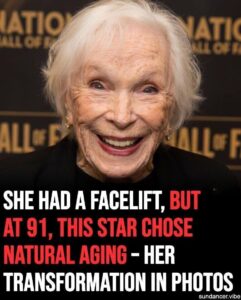
Few figures in Hollywood history have sustained the kind of enduring presence achieved by Shirley MacLaine. At 91, she remains not only recognizable but culturally relevant—an uncommon distinction in an industry that often prioritizes novelty over longevity. Her continued visibility is not driven by spectacle or reinvention for its own sake, but by something more substantial: a lifetime of artistic achievement, personal conviction, and an evolving understanding of what it means to age in the public eye.
MacLaine’s story is not simply one of survival in Hollywood, but of adaptation without surrender. Across more than six decades, she has resisted being confined to a single image or identity. Instead, she has allowed her career—and her perspective—to evolve naturally, shaped as much by her personal philosophy as by the roles she has chosen to play.
Early Life and the Foundations of Discipline
Born in 1934 in Richmond, Virginia, MacLaine grew up in a household where creativity was not only encouraged but expected. Her mother, a drama teacher, introduced her to performance at an early age. By the time she was three, MacLaine had begun studying ballet, a discipline that would profoundly influence her approach to both art and life.
Ballet instills more than technical skill. It demands consistency, resilience, and a tolerance for discomfort—qualities that would later define MacLaine’s career. The physical rigor of dance, combined with the emotional demands of performance, helped her develop a strong internal compass. She learned early that progress often comes quietly, through repetition and persistence rather than sudden breakthroughs.
When she moved to New York City after high school, the decision was less a leap of faith than a continuation of a path already in motion. She had spent years preparing—mentally and physically—for a life in the performing arts. What followed would confirm that preparation matters most when opportunity appears unexpectedly.
A Breakthrough Born of Readiness
MacLaine’s entry into the spotlight came through a moment of chance. While working as an understudy in the Broadway production of The Pajama Game, she stepped into a leading role when the star was unable to perform. It was the kind of situation that tests both skill and composure.
Her performance caught the attention of producer Hal Wallis, who quickly recognized her potential and offered her a film contract. This pivotal moment led to her screen debut in The Trouble with Harry, directed by Alfred Hitchcock.
From the outset, MacLaine stood apart. She did not conform to the conventional standards of Hollywood glamour that dominated the era. Instead, she brought a distinctive blend of intelligence, wit, and emotional subtlety to her roles. This uniqueness became her defining strength, allowing her to build a career that was both versatile and enduring.
Critical Acclaim and Career Longevity
The late 1950s and early 1960s marked a period of rapid ascent. MacLaine delivered a series of performances that earned widespread critical acclaim and multiple award nominations. Films like Some Came Running and The Apartment showcased her range as an actress capable of balancing vulnerability with sharp emotional insight.
Her eventual Academy Award win for Terms of Endearment solidified her place among Hollywood’s most respected performers. Yet her legacy cannot be reduced to a single accolade. Over the years, she has received numerous honors, including Golden Globe Awards and lifetime achievement recognitions, each reflecting a body of work defined by consistency and depth.
What distinguishes MacLaine’s career is not just its length, but its adaptability. She has navigated shifting trends, changing audience expectations, and evolving industry norms without losing her identity as a performer.
A Different Relationship With Fame
While many actors become deeply embedded in the culture of celebrity, MacLaine has maintained a certain distance from it. She has often spoken about prioritizing personal growth over public image, choosing experiences that enrich her understanding of the world rather than simply enhance her visibility.
Travel, in particular, has played a central role in her life. For MacLaine, exploring different cultures and perspectives has been as important as any professional achievement. This broader outlook has informed her work, adding layers of authenticity and curiosity to her performances.
Her approach to fame is rooted in independence. She has consistently made choices based on personal conviction rather than external expectation, a quality that has contributed to her longevity in an industry where conformity is often rewarded.
Aging, Beauty, and Personal Choice
One of the more widely discussed aspects of MacLaine’s life is her openness about aging and appearance. At a time when many public figures avoided such topics, she spoke candidly about undergoing a facelift earlier in her life.
Rather than framing the decision in terms of regret or necessity, she has described it as a choice reflective of a particular moment in time. Over the years, her perspective has evolved. She has expressed a growing appreciation for natural aging, emphasizing acceptance rather than resistance.
This shift mirrors broader cultural conversations about beauty and self-image. In an environment where cosmetic procedures are often either glamorized or criticized, MacLaine’s stance offers a more balanced view. She neither dismisses such choices nor defines herself by them.
Her willingness to discuss these topics openly has contributed to a more nuanced dialogue about aging—one that acknowledges both the pressures individuals face and the freedom that comes with self-acceptance.
Continued Creativity in Later Life
At an age when many have stepped away from demanding careers, MacLaine remains engaged. Her ongoing interest in acting reflects a deeper commitment to creativity itself. For her, artistic expression is not tied to a specific phase of life but is an ongoing process.
This continued involvement challenges common assumptions about aging. It demonstrates that ambition, curiosity, and passion are not confined to youth. Instead, they can evolve, taking new forms while retaining their मूल essence.
Her presence in the industry today serves as a reminder that longevity is not merely about duration—it is about sustained relevance and purpose.
Legacy Beyond Film
MacLaine’s influence extends beyond her filmography. She has also built a reputation as a writer and thinker, exploring topics ranging from spirituality to personal development. While not all of her ideas have been universally accepted, her willingness to explore unconventional perspectives has added another dimension to her public persona.
This intellectual curiosity reinforces the idea that her career has never been limited to acting alone. It reflects a broader commitment to understanding life from multiple angles, an approach that resonates with audiences seeking authenticity rather than perfection.
Redefining What It Means to Age
Perhaps the most significant aspect of MacLaine’s legacy is the way she has redefined aging in the public eye. Rather than attempting to preserve a fixed image, she has allowed herself to change—physically, emotionally, and philosophically.
This willingness to evolve stands in contrast to the industry’s traditional emphasis on maintaining youth. By embracing change, she has demonstrated that aging can be a process of expansion rather than decline.
Her example suggests that relevance is not tied to appearance alone, but to the ability to remain engaged, thoughtful, and authentic.
Final Reflections
At 91, Shirley MacLaine represents something increasingly rare: a public figure whose life and career offer both inspiration and perspective. Her journey illustrates the value of resilience, the importance of self-definition, and the possibility of growth at every stage of life.
In an era often dominated by fleeting attention and rapid change, her story provides a sense of continuity. It reminds us that true longevity—whether in art, career, or personal identity—is built not on resisting change, but on embracing it with honesty and intention.
Her legacy, ultimately, is not just about what she has accomplished, but about how she has chosen to live: with independence, curiosity, and an unwavering commitment to being herself.