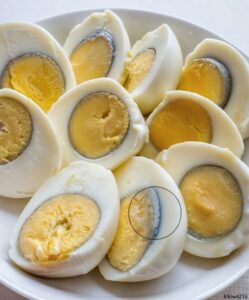
Why That Green Ring Appears
The color change comes from a basic chemical reaction:
- Egg whites contain sulfur
- Yolks contain iron
- Too much heat → they react and form iron sulfide
That compound creates the greenish-gray ring around the yolk.
This usually happens when:
- Eggs are boiled too long
- They sit in hot water after cooking
- They aren’t cooled quickly
Is It Safe to Eat?
Yes—completely safe.
Food safety guidance from organizations like the United States Department of Agriculture confirms:
- The green ring is harmless
- It does not mean spoilage
- It does not indicate contamination
So there’s no health risk—just a less appealing egg.
What Actually Gets “Ruined”
Not your health—just the texture and taste.
Overcooked eggs tend to have:
- Chalky, dry yolks
- Rubbery whites
- Slight sulfur smell
Nutritionally, eggs are still solid. You might lose a bit of heat-sensitive nutrients, but nothing dramatic.
How to Avoid the Green Ring
Getting perfect eggs is mostly about controlling heat and timing.
Simple method:
- Place eggs in cold water (about 2–3 cm above eggs)
- Bring to a gentle boil
- Turn off heat and cover
- Let sit:
- 9–10 min → slightly creamy center
- 10–11 min → fully set, bright yellow
- Transfer immediately to ice water
Cooling quickly stops the reaction that forms iron sulfide.
Common Mistakes
People usually run into trouble by:
- Boiling aggressively for too long
- Leaving eggs in hot water “just in case”
- Skipping the ice bath
That leftover heat is often the real culprit.
Extra Tips for Better Eggs
- Use slightly older eggs (they peel easier)
- Don’t overcrowd the pot
- Chill for at least 5 minutes before peeling
- Crack and peel under running water for clean shells
Bottom Line
A green ring means:
- ✔ Overcooked egg
- ✔ Slightly worse texture
- ❌ Not unsafe
- ❌ Not unhealthy
It’s a visual cue to tweak your technique—not a warning sign for your health.