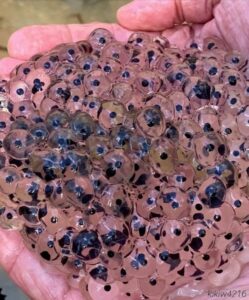
At first glance, they look almost unreal—like something from a science fiction film or an experimental dessert display. Translucent, glossy spheres cluster together in a gelatinous mass, each containing a dark circular center that resembles a tiny, unblinking eye. This uncanny appearance has earned them the nickname “eyeball eggs” across the internet, where images of these strange formations spark fascination, curiosity, and occasional discomfort.
In reality, these are amphibian egg masses—most commonly associated with species like the Southern leopard frog and other pond-breeding frogs. What appears eerie at first is, in fact, a remarkable example of biological efficiency and evolutionary design. Each “eyeball” is a developing embryo, safely enclosed within a transparent, jelly-like capsule that protects it during its earliest and most vulnerable stage of life.
The structure of these egg masses is deceptively sophisticated. The gelatinous outer layer is composed largely of water, along with specialized proteins and mucopolysaccharides that form a flexible but protective barrier. This jelly serves multiple purposes at once: it prevents the eggs from drying out, shields them from harmful ultraviolet radiation, and reduces the risk of infection from bacteria or fungi. Its slippery texture can also deter some predators, making the eggs harder to grasp or consume.
Inside each sphere, the dark “pupil” is the embryo itself. Early in development, amphibian embryos often display strong pigmentation on their upper side—a feature known as countershading. This helps camouflage them in their environment, making them less visible to predators from above or below. As development progresses, this pigmentation becomes more pronounced, which is why the black centers appear so striking in photographs.
The clustered arrangement of the eggs is another survival strategy. By grouping hundreds or even thousands of embryos together, the species increases the likelihood that at least some will survive. Predators may consume part of the mass, but rarely all of it. This “safety in numbers” approach is common among amphibians that breed in open or temporary water sources.
These egg masses are typically found in shallow ponds, wetlands, and vernal pools—environments that form seasonally and often lack fish, which are major predators of amphibian eggs. During breeding season, triggered by rising temperatures and rainfall, adult frogs gather in these habitats. Through a process called amplexus, the male fertilizes the eggs externally as the female releases them into the water, forming the gelatinous clusters seen in images.
Lighting and handling can influence how these egg masses appear. The subtle pink or warm tones sometimes visible are not always natural pigmentation—they can result from light passing through the jelly and reflecting off nearby surfaces, such as human skin. This effect enhances the surreal, almost artificial look of the cluster, making it appear even more like a collection of glassy “eyes.”
Within days, the embryos begin a rapid transformation. Cell division gives way to more complex structures: a neural tube forms, the beginnings of a spine develop, and the characteristic tadpole shape starts to emerge. The large, dark area that resembles a pupil is actually where the developing brain and eyes are concentrated, making it one of the most visually prominent features at this stage.
Oxygen passes through the jelly by diffusion, while waste products are carried away in the surrounding water. The embryos rely entirely on the nutrients stored within their yolk until they hatch. Environmental conditions—such as temperature, oxygen levels, and even vibrations—can influence how quickly this development occurs. In some cases, embryos may hatch early if they detect nearby threats.
Once they emerge, the tiny tadpoles begin their aquatic phase of life. They feed on algae and organic matter, gradually growing and changing until they undergo metamorphosis. Over time, they develop legs, lungs, and the ability to live on land, completing one of the most dramatic transformations in the animal kingdom.
Beyond their unusual appearance, these egg masses play a vital ecological role. Amphibians act as both predators and prey, helping regulate insect populations while supporting birds, fish, and other wildlife. Their eggs, in turn, provide a food source for many organisms, forming an essential link in the food web.
They are also important environmental indicators. Because amphibians are highly sensitive to changes in water quality and habitat conditions, the presence of healthy egg masses often signals a thriving ecosystem. Conversely, their absence can point to pollution, habitat loss, or disease.
In recent years, images of “eyeball eggs” have spread widely online, capturing the imagination of people far beyond scientific communities. This blend of curiosity and unease reflects something deeper: a fascination with the unfamiliar hidden within the familiar. A simple pond, often overlooked, can contain scenes that feel almost alien when viewed up close.
Encounters like these remind us that nature does not need to be distant or exotic to be extraordinary. Even the most ordinary environments can reveal unexpected complexity when observed carefully. What initially appears strange or unsettling often turns out to be a finely tuned system shaped by millions of years of evolution.
Ultimately, these mesmerizing clusters are more than just a visual curiosity. They are a snapshot of life in transition—a moment where potential is suspended in translucent form, waiting to unfold. Each tiny “eye” represents a developing organism, part of a cycle that has repeated for countless generations.
So the next time you come across a glistening jelly mass in shallow water, resist the urge to dismiss it as something strange or unsettling. Instead, take a closer look. Beneath the surface lies one of nature’s most elegant processes quietly at work—transforming simple beginnings into life that will soon leap, swim, and continue the cycle all over again.