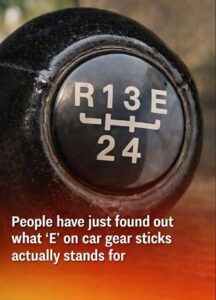
For many drivers, the gear stick has always felt like one of the most familiar parts of a car’s interior. Whether it’s a manual transmission with its numbered gears or an automatic system marked with simple letters like P, R, N, and D, the layout has remained surprisingly consistent across decades and countries. That consistency created a kind of universal driving language—one that made it easy for people to switch between vehicles without much confusion.
But occasionally, older cars reveal something unfamiliar. A symbol that doesn’t quite fit the modern pattern. Among the most confusing of these was a simple letter: “E.”
For some drivers, especially those encountering older European vehicles, this letter appeared on the gear selector or dashboard in a way that felt out of place. It wasn’t part of the standard transmission system most people were taught. It wasn’t explained in modern driving lessons. And it certainly wasn’t something seen in newer vehicles.
Naturally, confusion followed.
The Mystery of the Missing Explanation
When drivers first noticed the “E” marking, interpretations varied widely. Without clear context, people filled the gap with assumptions.
Some believed it stood for “extra gear,” thinking it might unlock hidden performance. Others speculated it could mean “emergency mode,” perhaps a fallback setting for mechanical issues. A few even assumed it was related to electric functionality, especially as modern vehicles increasingly shift toward electrification.
Online discussions only amplified the mystery. A simple question—what does the “E” mean on this gear stick?—quickly turned into a wave of theories, guesses, and nostalgia-driven explanations.
But the real answer, as older drivers eventually pointed out, was far simpler than expected.
The “E” stood for Economy.
The Original Purpose: Driving Efficiency Before Automation
To understand why this feature existed, it helps to step back into a different era of automotive design.
Before modern onboard computers, before adaptive transmissions, and before fuel efficiency systems became fully automated, drivers had far more direct control over how their vehicles consumed fuel. Engine behavior depended heavily on driving style—how aggressively someone accelerated, when they shifted gears, and how they maintained speed.
In that context, manufacturers introduced features like Economy mode as a way to assist drivers in reducing fuel consumption without requiring constant manual adjustments.
When the “E” setting was engaged, the car would prioritize efficiency over performance. In practical terms, this often meant:
- Lower engine revolutions (RPM) during acceleration
- Earlier gear shifts in automatic transmissions
- Reduced throttle sensitivity
- Smoother, less aggressive power delivery
In some vehicles, it effectively acted like an “upshift bias,” encouraging the transmission to move into higher gears sooner and stay there longer.
The goal was simple: use less fuel without forcing the driver to constantly think about it.
A Simple Idea for a Different Time
Today, fuel efficiency is often handled invisibly by software. But in earlier decades, it required explicit input from the driver.
Economy mode represented an early attempt at bridging that gap. It was not fully automated intelligence—it was assistance. The driver still had control, but with guidance toward more efficient behavior.
This made the “E” setting particularly useful during:
- Highway cruising
- Long-distance travel
- Stop-and-go traffic where fuel waste was common
- Situations where smooth driving was more important than acceleration
For many drivers at the time, it became a subtle but valuable tool. It didn’t transform the car into something different—it simply adjusted its behavior slightly to prioritize efficiency.
Why It Eventually Disappeared
Despite its usefulness, the “E” mode gradually faded from modern vehicles. The reason wasn’t that it failed—but that it became unnecessary in its original form.
Automotive technology evolved rapidly in several key areas:
1. Electronic fuel injection replaced carburetors
Fuel delivery became more precise and adaptive, allowing engines to adjust automatically based on conditions.
2. Transmission systems became intelligent
Modern automatic transmissions began using sensors and software to determine optimal shift points without driver input.
3. Engine control units (ECUs) emerged
Computers started managing performance in real time, balancing power, efficiency, and emissions dynamically.
4. Driving modes became integrated systems
Instead of a single “Economy” setting, vehicles began offering multiple selectable modes (Eco, Sport, Comfort), each controlled by advanced algorithms.
As a result, the need for a dedicated “E” gear or switch diminished. Efficiency was no longer something the driver manually selected in a fixed way—it became something the car continuously optimized on its own.
In essence, the “E” didn’t disappear because it failed. It disappeared because it evolved into something more advanced and less visible.
From Manual Efficiency to Invisible Optimization
One of the most significant shifts in automotive history is the move from driver-controlled efficiency to system-controlled efficiency.
In older vehicles, driving economically required awareness:
- Shift earlier
- Avoid hard acceleration
- Maintain steady speeds
- Use special modes like “E” when available
In modern vehicles, much of that responsibility has been transferred to the car itself.
Sensors monitor:
- Speed
- Road incline
- Throttle input
- Traffic conditions
- Engine load
Based on this data, the vehicle continuously adjusts performance. The driver no longer needs to activate a separate mode to save fuel—the system is always working in the background.
What was once labeled “E for Economy” became embedded into every aspect of vehicle design.
The Psychological Shift in Driving
The disappearance of the “E” mode also reflects a deeper change in how people interact with cars.
Older driving systems required engagement. Drivers had to understand mechanical behavior and actively manage it. There was a sense of partnership between human and machine.
Modern systems, by contrast, emphasize automation. The car becomes more autonomous in its decision-making, reducing the need for driver intervention.
This shift has clear advantages:
- Greater fuel efficiency
- Reduced driver fatigue
- Lower emissions
- More consistent performance
But it also changes the experience of driving itself. Some enthusiasts argue that it reduces the sense of connection between driver and vehicle.
The “E” gear, in that sense, represents a transitional moment in automotive history—when control was shared rather than fully automated.
The New Meaning of “E”: Electric Revolution
Interestingly, while the original “Economy” meaning has faded, the letter “E” has not disappeared from automotive culture.
Instead, it has been redefined.
In today’s context, “E” is far more likely to be associated with electric vehicles than fuel-saving modes.
The rise of electric mobility has completely reshaped the automotive landscape. Vehicles no longer rely on multi-gear transmissions in the traditional sense. Many electric cars use single-speed systems, delivering instant torque and smooth acceleration without shifting gears at all.
In this new world:
- “E” often implies electric power
- Driving modes are software-based rather than mechanical
- Efficiency is built into the propulsion system itself
- Traditional gear sticks are being replaced by digital interfaces
The symbol that once helped conserve fuel in combustion engines now represents a complete departure from them.
From Mechanical Symbol to Digital Identity
In many modern electric vehicles, the physical gear stick itself is disappearing. In its place, drivers may find:
- Push-button selectors
- Rotary dials
- Touchscreen controls
- Fully automated drive systems
This evolution reflects a broader transformation: cars are becoming software-defined machines rather than purely mechanical ones.
Within that context, symbols like “E” are no longer tied to physical gear positions. Instead, they become part of a digital identity system—representing energy type, driving mode, or system configuration.
A Letter That Traveled Through Time
The story of the “E” gear is ultimately a story of adaptation.
It began as a practical solution to a specific problem: fuel efficiency in manually influenced driving systems. It helped drivers reduce consumption in an era before automation.
Then it faded as technology advanced, replaced by smarter and more integrated systems that no longer required manual activation.
And finally, it reemerged in a completely different form—no longer as “Economy,” but as part of the language of electric mobility.
Few automotive symbols have undergone such a transformation in meaning.
Why Small Details Matter
What makes the “E” so interesting is not just its function, but what it represents.
It shows how small design choices in vehicles often reflect larger technological shifts. A single letter on a gear stick can carry decades of engineering philosophy, changing definitions, and evolving user expectations.
To older drivers, it may represent a practical tool from a more hands-on era of driving.
To newer drivers, it may feel like a confusing relic.
To the automotive industry, it represents progress—how systems evolve from manual control to intelligent automation.
Conclusion: From Economy to Evolution
The forgotten “E” on gear sticks is more than a curious detail from automotive history. It is a symbol of transition.
It reminds us that technology rarely disappears completely—it transforms. What once required direct human input becomes automated. What once had a clear mechanical purpose becomes integrated into broader systems. And what once stood for “Economy” now lives on as part of “Electric” innovation.
In the end, the story of the “E” is not about a missing feature.
It is about how driving itself has changed.
From hands-on control to intelligent assistance. From fuel management to energy optimization. From mechanical simplicity to digital complexity.