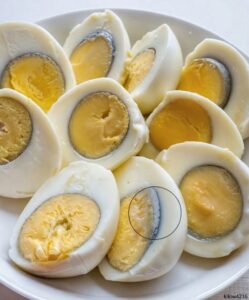
When you peel a hard-boiled egg and notice a green-gray ring circling the yolk, it can feel like something has gone wrong in the kitchen. The appearance is slightly unsettling, especially when you were expecting a bright, buttery yellow center. But despite how it looks, this phenomenon is not a sign of spoilage, contamination, or poor egg quality. It is simply the visible result of a predictable chemical reaction that occurs when eggs are exposed to too much heat or left too long in hot water after cooking.
At its core, the green ring is a lesson in food chemistry. Eggs are made up of two main parts: the white (albumen), which is rich in proteins and sulfur-containing amino acids, and the yolk, which contains fats, nutrients, and small amounts of iron. Under normal cooking conditions, these components transform gently—proteins solidify, flavors develop, and textures become firm but tender. However, when heat is excessive or prolonged, sulfur from the egg white begins to interact with iron in the yolk. This reaction forms iron sulfide, a compound responsible for the greenish-gray ring that appears between the yolk and the white.
The key factor is not just boiling, but overcooking. Many home cooks unknowingly trigger this reaction by leaving eggs in boiling water for too long or allowing them to sit in hot water after turning off the stove. Eggs retain heat efficiently, meaning the cooking process continues even after they are removed from direct heat. Without rapid cooling, the internal temperature stays high enough for the sulfur and iron interaction to intensify.
One of the most overlooked steps in preventing this issue is immediate cooling. Placing cooked eggs into an ice water bath halts the internal cooking process almost instantly. This step is critical because it locks in texture and prevents further chemical change. Without it, even perfectly timed boiling can still result in a green ring due to residual heat alone.
While the green ring is harmless and safe to eat, it does affect quality. The yolk becomes slightly chalky and dry instead of smooth and creamy, and the overall eating experience is less enjoyable. This is why chefs and experienced cooks pay close attention not just to boiling time, but also to cooling technique. Precision, not guesswork, is what separates average hard-boiled eggs from perfect ones.
Timing plays a major role. Depending on egg size and starting temperature, most hard-boiled eggs require between 9 and 12 minutes of controlled cooking. Starting eggs in cold water and bringing them gradually to a boil is often more reliable than dropping them into already boiling water, as it reduces the risk of uneven heating. Once boiling is reached, many methods recommend removing the pot from heat entirely and letting the eggs sit covered for a controlled period. This gentle approach minimizes turbulence inside the shell and reduces the likelihood of overcooking.
Despite its scientific explanation, the green ring has generated numerous myths. Some believe it indicates old eggs, poor storage, or even chemical contamination. In reality, freshness has little to do with it. Fresh eggs and older eggs can both develop the green ring if subjected to excessive heat. The reaction is purely structural and chemical, not biological or safety-related.
Another common misconception is that the green ring is unavoidable. In truth, it is entirely preventable with proper technique. The combination of controlled heat, precise timing, and rapid cooling eliminates the conditions that cause sulfur and iron to react. This makes the issue less about the egg itself and more about the cooking method used.
Understanding this process also highlights how sensitive food can be to small changes in preparation. A difference of just two or three minutes in cooking time can dramatically alter texture and appearance. Similarly, delaying the ice bath by even a short period can allow enough residual heat to trigger discoloration. These subtle variables demonstrate how cooking is both a science and an art.
Texture is another important factor influenced by overcooking. When eggs are exposed to prolonged heat, the proteins in both the white and yolk tighten excessively. This results in rubbery whites and dry, crumbly yolks. Instead of a smooth, cohesive bite, the egg becomes dense and less palatable. The green ring is simply the visible signal of this deeper structural change.
Nutrition, however, remains largely intact. While extreme heat can slightly reduce the availability of some heat-sensitive nutrients, hard-boiled eggs are still an excellent source of protein, vitamins, and minerals regardless of minor overcooking. The main issue is culinary quality rather than nutritional value.
Preventing the green ring is straightforward once the underlying science is understood. The most reliable method involves three key steps: controlled cooking, precise timing, and immediate cooling. Eggs should be placed in a single layer in a pot, covered with cold water, and brought gradually to a boil. Once boiling begins, heat is reduced or removed entirely depending on the method used. After the appropriate time has elapsed, the eggs are transferred immediately into ice water for at least five to ten minutes.
Peeling technique also plays a role in overall experience. Slightly older eggs tend to peel more easily due to changes in membrane structure, while very fresh eggs may stick to the shell. Gently cracking the shell and rolling the egg under light pressure before peeling under running water can improve results.
Beyond technique, the green ring serves as a reminder of how everyday cooking is influenced by chemistry that often goes unnoticed. Many common kitchen outcomes—browning, rising, thickening, and setting—are all chemical reactions happening in real time. The egg is simply one of the most visible examples of this process.
There is also a psychological aspect to this phenomenon. Seeing an unexpected green ring can trigger doubt or concern, even though the food is perfectly safe. This reaction highlights how strongly people associate appearance with quality. When food looks different from expectation, it is often assumed to be wrong, even when it is not.
In reality, the green ring is not a flaw in the egg but a reflection of process. It tells a story about heat, timing, and transformation. When understood correctly, it becomes less of a mistake and more of a signal—one that guides improvement in technique.
Professional kitchens rarely encounter this issue because they rely on consistency. Timers, controlled water temperatures, and rapid chilling systems ensure that every egg is treated the same way. Home kitchens, by contrast, often rely on estimation, which introduces variability. Small inconsistencies in heat or timing are enough to produce noticeable differences in results.
Mastering hard-boiled eggs is often one of the first steps in developing broader cooking confidence. It teaches attention to detail, respect for timing, and the importance of process over intuition alone. Once these principles are understood, they apply to many other cooking methods as well.
Ultimately, the green ring around an egg yolk is not a failure—it is feedback. It shows that heat was slightly too intense or applied for slightly too long. With that knowledge, the solution becomes simple: adjust time, control temperature, and cool quickly.
Cooking is full of these small lessons. And sometimes, even something as simple as an egg can reveal how precision turns ordinary food into something consistently satisfying.