In a world where more transactions begin online, the moment of meeting in person has become one of the most uncertain parts of the process. Digital marketplaces make buying and selling fast, convenient, and often affordable—but they also introduce risks that many people don’t fully consider until they face an uncomfortable or even unsafe situation.
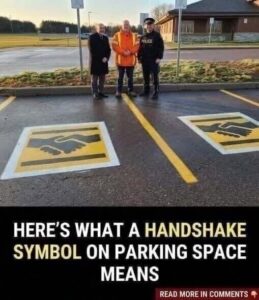
That’s where a small but meaningful detail is starting to make a difference: a simple handshake symbol painted onto parking spaces.
At first glance, it might seem insignificant. But behind it lies a thoughtful idea designed to address a growing concern in modern communities.
In places like Pembroke, Ontario, these handshake-marked parking spots are being introduced as designated safe exchange zones. Often located outside police stations, such as those operated by the Ontario Provincial Police, they provide a neutral, public, and well-monitored space where buyers and sellers can meet to complete transactions arranged online.
The concept is straightforward. Instead of meeting a stranger in a secluded parking lot, private residence, or unfamiliar neighborhood, people now have a clearly marked location where safety is prioritized. It’s a small behavioral shift—but one that can make a significant difference.
The Hidden Risks of Convenience
Online marketplaces have transformed how people buy and sell everything from furniture and electronics to everyday household items. With just a few clicks, users can connect, negotiate prices, and arrange meetups.
But that convenience comes with vulnerabilities.
Stories of scams, theft, and even physical harm have made many users more cautious. The handshake symbol serves as a direct response to those concerns—a visual cue that safer options exist and that communities are adapting to the realities of digital commerce.
These zones are typically placed in well-lit, highly visible areas, often near law enforcement facilities. While officers are not directly involved in transactions, their proximity provides reassurance and acts as a deterrent.
It sends a clear message: this is a space where accountability is expected.
More Than a Location—A Signal of Trust
What makes these zones effective is not just where they are, but what they represent.
The handshake symbol itself carries meaning. Universally associated with agreement, trust, and mutual respect, it communicates the purpose of the space instantly—no explanation required.
In an era where many interactions happen behind screens, this simple visual helps restore clarity to real-world exchanges.
When both parties agree to meet in such a location, there’s an unspoken understanding that the interaction should remain honest and straightforward. This shared expectation can influence behavior in subtle but powerful ways.
In essence, these spaces act as both physical safeguards and social signals.
A Proactive Approach to Safety
Often referred to as “safe exchange zone” initiatives, programs like these reflect a broader shift in how communities approach safety.
Rather than reacting after incidents occur, they aim to prevent problems before they happen.
By encouraging people to meet in safer environments, these zones reduce opportunities for wrongdoing. They make good decisions easier—and risky ones less likely.
Of course, they are not a complete solution on their own. They work best alongside common-sense precautions:
- Meeting during daylight hours
- Bringing a friend or informing someone of your plans
- Keeping communication records
- Trusting your instincts
The goal isn’t to eliminate risk entirely—it’s to reduce it in practical, accessible ways.
Psychological Impact and Social Behavior
One of the most interesting aspects of these spaces is their psychological effect.
Meeting in a designated safe zone creates a subtle sense of accountability. People are more likely to act honestly when they know they are in a recognized public space designed specifically for secure exchanges.
This shared awareness can:
- Reduce tension
- Encourage transparency
- Minimize misunderstandings
Buyers feel more comfortable inspecting items. Sellers can demonstrate products without pressure. Both parties benefit from a calmer, more neutral environment.
Standardizing Safety in a Growing Marketplace
As online marketplaces expand, so does the diversity of their users.
Teenagers selling old gadgets, families decluttering their homes, students searching for affordable furniture, and small entrepreneurs flipping items for profit all participate in these platforms.
Not everyone has the same level of experience or awareness when it comes to safety.
Designated exchange zones help bridge that gap by offering a standardized, recognizable option that anyone can use. Instead of negotiating where to meet, users can default to a trusted location.
This not only improves safety but also simplifies the process.
Community Impact and Shared Responsibility
These initiatives also reflect a broader cultural shift toward shared responsibility.
Safety is no longer seen as solely the role of individuals or authorities—it becomes a collective effort supported by community design.
By creating and promoting safe exchange zones, local organizations signal that:
- Safety matters
- Prevention is possible
- Everyone plays a role
This approach strengthens trust between residents and institutions, reinforcing a sense of collective care.
Adaptability and Future Integration
Another reason these zones are gaining traction is their flexibility.
They can be implemented in a variety of locations:
- Police stations
- Municipal buildings
- Shopping centers
- University campuses
Their simplicity makes them easy to adopt and scale.
Looking ahead, technology may further enhance their effectiveness. Online platforms could integrate features that:
- Suggest nearby safe exchange zones
- Highlight them on maps
- Provide built-in safety reminders
By linking digital tools with physical infrastructure, the entire buying and selling experience could become more seamless—and more secure.
A Small Symbol, A Bigger Meaning
Despite their simplicity, handshake-marked parking spaces represent something larger.
They are a response to the rapid shift toward digital transactions—a way of aligning real-world habits with online behavior.
They show that meaningful innovation doesn’t always require complex systems. Sometimes, it takes a clear signal, a shared understanding, and a thoughtfully designed space.
For individuals, these zones encourage more mindful decisions. For communities, they demonstrate proactive care. And for society as a whole, they highlight how small ideas can adapt to big changes.
Conclusion
As digital marketplaces continue to grow, so too does the need for practical safety solutions.
The handshake symbol—painted quietly onto parking spaces—offers exactly that.
It turns ordinary locations into trusted meeting points. It reduces risk without adding complexity. And it builds confidence between strangers in a world where trust can sometimes feel uncertain.
In the end, it’s a reminder that progress doesn’t always come in dramatic breakthroughs. Sometimes, it appears in simple, thoughtful adjustments—small changes that make everyday life just a little safer, and a little better for everyone.