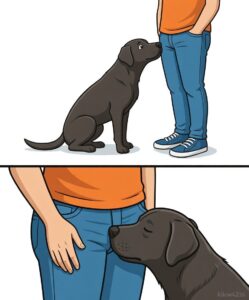
It’s a moment many people have experienced—and often felt embarrassed by. A dog approaches, seems friendly enough, and then suddenly directs its attention to a person’s groin area. From a human perspective, it feels awkward or even inappropriate. But from a dog’s point of view, this behavior is completely normal—and surprisingly informative.
Rather than being rude, a dog is simply using one of its most powerful tools: its sense of smell.
A Nose Built for Information
Dogs experience the world very differently from humans. While we rely heavily on sight, dogs rely primarily on scent. Their noses contain up to hundreds of millions of olfactory receptors, far more than humans, allowing them to detect incredibly subtle chemical signals.
Part of this system includes the Vomeronasal organ, a specialized structure that detects pheromones—chemical signals related to biology and social communication. This organ helps dogs gather information that goes far beyond simple smells.
Why That Area?
Humans have scent-producing glands across the body, but certain areas—like the armpits and groin—contain a higher concentration of apocrine glands. These glands release compounds that carry strong chemical signals.
To a dog, this area provides a kind of “information hub.” By sniffing it, the dog can detect:
- Biological sex
- Hormonal changes
- Emotional state
- General health cues
In other words, it’s the fastest and most efficient way for a dog to understand who you are.
What Dogs Are Actually Detecting
Dogs don’t just smell “odor”—they analyze chemical patterns.
Through scent, they may pick up on:
- Stress hormones like cortisol
- Changes linked to illness or infection
- Hormonal shifts (such as during pregnancy or menstruation)
- Differences in diet or lifestyle
This ability is closely related to how trained dogs can detect medical conditions, sometimes even before symptoms are obvious to humans.
It’s a Social Behavior, Not Bad Manners
In the canine world, sniffing is a standard greeting. Dogs often sniff each other’s rear areas because that’s where scent glands provide the most information.
When a dog does the same to a human, it’s simply applying the same instinct. It doesn’t understand human social boundaries—it’s just gathering data in the way it naturally would.
Why Some People Get More Attention
You might notice dogs focus more on certain individuals. That’s usually because something about their scent has changed or stands out.
Common reasons include:
- Hormonal changes (pregnancy, menstrual cycle)
- Strong emotional states (stress, anxiety)
- New products like perfumes or detergents
- Medical conditions or medications
To a dog, anything “different” is worth investigating.
How to Handle It
Even though the behavior is natural, it’s understandable that people may want to limit it—especially in social settings.
The best approach is calm redirection:
- Step back gently without reacting strongly
- Offer your hand as an alternative for sniffing
- Use simple commands like “sit” or “off”
- Reward calm, appropriate greetings
Avoid punishment or yelling, as dogs won’t understand why their natural behavior is being rejected.
A Window Into Canine Intelligence
This behavior highlights just how advanced a dog’s sensory system is. What feels like an awkward moment is actually a complex biological process—one that allows dogs to interpret the world in ways humans simply can’t.
Dogs aren’t being intrusive—they’re communicating.
The Bigger Picture
Understanding this behavior helps shift perspective. Instead of seeing it as embarrassing or inappropriate, it becomes an example of how differently dogs experience reality.
They don’t rely on visual impressions or social etiquette. They rely on scent—rich, detailed, and constantly changing.
Final Thoughts
When a dog sniffs your private area, it’s not misbehaving—it’s learning about you.
With proper training, the behavior can be managed in a polite way. But at its core, it reflects something remarkable: a sensory ability so refined that it can detect changes in your body, emotions, and health without a single word being spoken.
What feels awkward to us is, to a dog, simply a way of saying, “I’m getting to know you.”