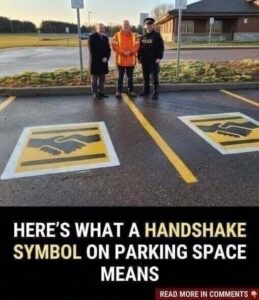
How a Simple Handshake Symbol in Parking Lots Is Transforming Online Transactions and Building Safer Community Exchange Spaces
Introduction: The Missing Piece Between Online and Offline Transactions
Online marketplaces have reshaped how people buy and sell goods, making it possible to connect with strangers instantly and complete transactions with unprecedented convenience. Yet despite this digital ease, one critical moment remains unpredictable: the in-person exchange.
It is at this point—when money, goods, and strangers meet in the real world—that uncertainty, risk, and vulnerability often appear. To address this gap, communities have begun introducing a simple but powerful solution: designated public exchange zones marked with a handshake symbol.
At first glance, the symbol may look like nothing more than a painted icon on pavement. In practice, however, it represents a growing effort to redesign how trust is built in everyday commerce.
1. What Handshake Exchange Zones Actually Are
Handshake-marked parking spaces are designated safe meeting points where individuals can complete online transactions in person. These zones are typically located in highly visible, well-lit public areas such as:
- Police station parking lots
- Municipal buildings
- Community centers
- Shopping center lots with surveillance
The handshake symbol serves as a universal indicator that the space is intended for safe exchanges between strangers.
In some communities, these zones were introduced directly outside law enforcement facilities, providing added reassurance through proximity to official oversight.
Importantly, officers are not involved in the transactions themselves. Their presence nearby simply enhances visibility and discourages misconduct.
2. Why These Spaces Are Becoming Necessary
The rise of peer-to-peer platforms has created enormous convenience, but it has also introduced new risks. While most transactions occur without issue, reports of scams, theft, and unsafe encounters have increased awareness of the dangers involved in meeting strangers for exchanges.
Common risks include:
- Fake payments or counterfeit cash
- Misrepresented items
- Personal safety concerns in isolated meeting locations
- Last-minute changes to unsafe meeting spots
Handshake zones are designed to reduce these risks by offering a neutral, controlled environment where both parties feel more secure.
Rather than relying on enforcement after a problem occurs, these spaces aim to prevent issues before they arise.
3. How Environment Shapes Behavior
One of the most important aspects of handshake exchange zones is psychological rather than physical.
When individuals meet in a designated safe space, the environment itself communicates expectations:
- Transparency
- Accountability
- Respectful conduct
The presence of signage, lighting, and visibility creates a subtle but powerful behavioral influence. People are generally less likely to engage in dishonest or aggressive behavior when they know they are in a recognized safe zone.
The handshake symbol reinforces this effect. As a universally understood gesture of agreement and trust, it sets the tone for cooperation before any words are exchanged.
4. Reducing Uncertainty in the Transaction Process
Beyond safety, handshake zones simplify logistics. One of the most common challenges in peer-to-peer transactions is deciding where to meet. This often involves negotiation, inconvenience, or discomfort for one or both parties.
Safe exchange zones remove that uncertainty by providing a clear default option.
Instead of debating locations, users can simply agree:
“Let’s meet at the handshake spot.”
This reduces friction in communication and allows both parties to focus on the actual exchange rather than planning it.
Over time, as awareness grows, these spaces may become the standard expectation for in-person marketplace interactions.
5. The Role of Visibility and Design
The effectiveness of handshake zones depends heavily on environmental design. Key features typically include:
- Bright lighting
- Open visibility from public areas
- Surveillance cameras where available
- Clear signage marking the exchange point
These elements work together to create a space where safety is reinforced through design rather than enforcement.
Even without active monitoring, the combination of openness and visibility significantly reduces the likelihood of unsafe behavior.
The simplicity of the design is part of its strength—it requires minimal infrastructure while delivering meaningful impact.
6. Expanding Access Across Communities
One of the most promising aspects of the concept is its adaptability. Handshake exchange zones can be implemented in a wide variety of locations without significant cost or complexity.
Potential sites include:
- Retail parking lots
- University campuses
- Residential complexes
- Public service buildings
Because the concept relies primarily on signage and designated space, it can be scaled easily across different communities, regardless of size or budget.
This flexibility allows the idea to spread organically as awareness increases.
7. The Future: Integrating Digital Platforms with Physical Safety
As online marketplaces continue to evolve, there is growing potential for integration between digital tools and physical safety infrastructure.
Future developments could include:
- Marketplace apps suggesting nearby handshake zones automatically
- Navigation systems highlighting safe exchange points
- Built-in reminders encouraging users to choose public meeting locations
- Verified listings that recommend official safe zones for transactions
Such integration would bridge the gap between online convenience and offline safety, making secure behavior the default rather than the exception.
This would represent a major step forward in aligning digital commerce with real-world responsibility.
8. Trust as a Community Design Principle
Handshake exchange zones reflect a broader shift in how communities think about trust. Instead of treating safety as a personal responsibility alone, these spaces embed it into physical environments.
This approach acknowledges a simple reality: while most people act in good faith, systems can still be designed to reduce risk and increase confidence for everyone.
The handshake symbol becomes more than just a marker—it becomes a signal of shared expectations between strangers.
In this way, trust is not assumed; it is supported by design.
9. Why Small Solutions Can Have Large Impacts
What makes this concept particularly powerful is its simplicity. It does not rely on complex technology, enforcement systems, or major infrastructure investment.
Instead, it uses:
- A symbol
- A designated space
- A shared understanding
Yet these small elements combine to influence behavior in meaningful ways.
This demonstrates an important principle: not all solutions need to be complicated to be effective. Sometimes, the most impactful changes are the ones that quietly adjust how people interact in everyday situations.