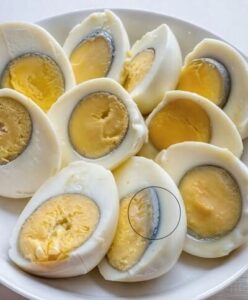
The Mystery Behind the Green Ring in Hard-Boiled Eggs
Hard-boiled eggs are one of the simplest foods to prepare, yet they manage to confuse even experienced home cooks.
They require only water, heat, and time—three of the most basic elements in cooking. And yet, despite this simplicity, many people still encounter an unexpected result when slicing into them: a pale green or grayish ring circling the yolk.
It looks unappetizing.
It raises questions.
And for some, it even causes concern about whether the egg is still safe to eat.
The good news is straightforward: the green ring is not harmful. It is not a sign of spoilage or contamination. Instead, it is the visible outcome of a natural chemical reaction that occurs when eggs are exposed to certain cooking conditions.
Understanding this reaction transforms what seems like a cooking mistake into something far more useful—a lesson in timing, temperature, and control.
What You’re Really Seeing
To understand the green ring, it helps to understand what an egg actually is.
A hard-boiled egg consists of two main parts: the white (albumen) and the yolk.
Each has a different chemical composition.
- The egg white contains proteins that include sulfur.
- The yolk contains iron and various fats.
Under normal conditions, these two components remain separate and stable.
But when heat is applied for too long or at too high a temperature, something changes.
The balance breaks.
And chemistry takes over.
The Chemistry Behind the Color Change
When an egg is overcooked, the sulfur compounds in the egg white begin to break down. This process releases a gas called hydrogen sulfide.
At the same time, the yolk remains rich in iron.
As the hydrogen sulfide gas moves inward toward the yolk, it meets the iron.
When these two elements combine, they form iron sulfide.
Iron sulfide is what creates the greenish or grayish ring you see around the yolk.
It is a simple reaction.
Sulfur + iron + heat = discoloration.
Importantly, this reaction only occurs under specific conditions—mainly prolonged heat exposure and high temperature.
Why Timing and Temperature Matter So Much
Cooking is often thought of as straightforward: apply heat until food is done.
But with eggs, small changes in temperature and time have a big impact.
A rolling boil may seem efficient, but it exposes eggs to excessive heat. Similarly, leaving eggs in hot water after turning off the stove allows residual heat to continue cooking them beyond the ideal point.
This is where the green ring begins to form.
The longer the egg remains at high temperature, the more hydrogen sulfide is produced, and the greater the chance it will react with iron in the yolk.
In other words, the green ring is not a mystery—it is a timing issue.
Are Green-Ringed Eggs Safe to Eat?
Yes.
Despite its appearance, iron sulfide is not harmful.
Hard-boiled eggs with a green ring are completely safe to eat.
However, there are minor differences in quality:
- The yolk may be slightly drier
- The flavor may have a faint sulfur-like note
- The texture may be less creamy
These are not safety concerns—only culinary ones.
Most people prefer a bright yellow yolk because it looks fresher and tastes smoother, but the nutritional value of the egg remains unchanged.
The Key to Prevention: Controlling Heat
The simplest way to prevent the green ring is to control heat more carefully.
Many cooking problems come from using too much heat for too long.
Instead of maintaining a strong rolling boil throughout the cooking process, a gentler approach produces better results.
A more controlled method works like this:
Start with cold water.
Place eggs in the pot before heating begins.
Gradually bring the water to a boil.
Once boiling, reduce the heat to a gentle simmer.
This reduces stress on the egg structure and limits excessive sulfur breakdown.
Gentle heat is the key.
Timing: The Second Critical Factor
Even with perfect temperature control, timing still matters.
Eggs are sensitive to overcooking, and even a few extra minutes can change the final result.
For most medium to large eggs, the ideal cooking range is:
- 9 to 12 minutes for fully set yolks
Shorter times produce softer yolks.
Longer times increase the risk of discoloration.
The important principle is not to guess, but to be consistent.
Once you find a timing that works for your stove and your eggs, repeating it ensures reliable results.
The Importance of Rapid Cooling
One of the most overlooked steps in preventing the green ring happens after cooking.
Even when removed from heat, eggs continue to cook internally.
This is called carryover cooking.
If eggs are left in hot water or allowed to cool slowly, the residual heat continues the chemical reaction that leads to iron sulfide formation.
To stop this process, rapid cooling is essential.
The best method is simple:
Place cooked eggs into an ice bath immediately.
Or run them under cold water for several minutes.
This sudden temperature drop halts cooking instantly.
It also improves peeling, making the process smoother and cleaner.
Why Freshness of Eggs Matters
Interestingly, the age of eggs also plays a role in how they behave during boiling.
Fresh eggs have a lower pH level, which causes the inner membrane to cling tightly to the shell. This makes them more difficult to peel.
As eggs age, their pH increases, and the membrane separates more easily from the shell.
Older eggs are therefore often preferred for boiling.
While this doesn’t directly affect the green ring, it improves overall usability and presentation.
Cooking Methods Beyond Boiling
While traditional boiling is most common, it is not the only method available.
Alternative techniques can reduce the risk of overcooking:
Steaming:
Eggs are placed in a steamer basket above boiling water. This method provides more controlled heat and often results in more consistent yolks.
Pressure cooking:
Using a pressure cooker can significantly reduce cooking time and minimize overexposure to heat.
These methods demonstrate an important principle: precision matters more than intensity.
Why Small Adjustments Make a Big Difference
Cooking eggs is a simple task, but it teaches an important lesson.
Small changes in time and temperature can produce noticeably different results.
A slightly hotter pot.
A few extra minutes.
A delay in cooling.
Each of these factors influences the final outcome.
The green ring is simply a visible reminder of that sensitivity.
The Role of Observation in Cooking
One of the most valuable skills in cooking is observation.
Paying attention to how eggs behave during cooking allows you to adjust your method over time.
Do they crack?
Do they overcook?
Do they peel easily?
Each result provides feedback.
Cooking becomes less about following instructions and more about understanding patterns.
Beyond Eggs: A Broader Cooking Lesson
The green ring phenomenon is not just about eggs.
It reflects a broader truth in cooking:
Heat must be controlled.
Time must be respected.
And even simple ingredients respond to subtle changes.
Many cooking challenges—overcooked vegetables, dry meats, or uneven textures—come from the same root cause: uncontrolled heat exposure.
Why Simplicity Still Matters
In a world full of complex recipes and advanced cooking tools, it is easy to overlook simple techniques.
But eggs remind us that simplicity is powerful.
You don’t need expensive equipment.
You don’t need advanced skills.
You only need attention to detail.