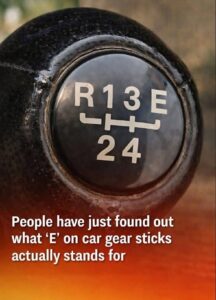
For most drivers, the language of a car feels almost universal. Whether stepping into a compact hatchback, a family sedan, or a larger SUV, the layout of controls tends to follow familiar patterns. Manual transmissions rely on numbered gears and reverse, while automatic vehicles simplify the experience into recognizable letters: Park, Reverse, Neutral, and Drive.
Because of this consistency, anything that deviates from the norm immediately stands out.
That’s exactly what happened when some drivers—particularly those encountering older European vehicles—noticed something unusual on the gear selector: the letter “E.”
At first glance, it looked out of place. It didn’t fit into the standard sequence of letters most people had learned. For younger drivers especially, it seemed like an error or an unfamiliar symbol from another system. Naturally, curiosity followed.
What did “E” mean?
The Mystery That Sparked Curiosity
The confusion surrounding the “E” marking wasn’t limited to a handful of drivers. It quickly became a topic of discussion, especially online, where people began sharing photos and asking for explanations.
Speculation came quickly.
Some assumed it meant “Emergency,” suggesting it might be used in urgent driving situations. Others guessed it stood for “Extra,” perhaps offering additional power or performance. A few even believed it might be related to electric functionality, especially given how modern vehicles increasingly use “E” to represent electric systems.
But none of these guesses were correct.
The real answer was much simpler—and far more practical.
“E” stood for Economy.
What “Economy Mode” Really Did
In older vehicles equipped with this feature, selecting “E” activated a driving mode designed to reduce fuel consumption. It didn’t dramatically change how the car felt, nor did it require the driver to relearn how to operate the vehicle. Instead, it worked quietly in the background.
The goal was efficiency.
When engaged, Economy mode encouraged the engine to run at lower revolutions per minute (RPM). Instead of allowing the engine to rev higher—something that increases fuel usage—the system prioritized smoother, more controlled performance.
In practical terms, this meant:
- Earlier gear shifts in automatic transmissions
- Reduced engine strain during steady driving
- Lower fuel consumption over time
- A calmer, more relaxed driving experience
On highways or long-distance drives, this could make a noticeable difference. Even small reductions in fuel use added up over time, especially when fuel costs were a significant concern for many drivers.
At a time when efficiency depended heavily on driver behavior, this feature provided a helpful assist.
A Hands-On Era of Driving
To understand why the “E” gear existed, it’s important to look at the broader context of driving during that period.
Older cars required more active involvement from the driver. Managing fuel efficiency wasn’t something the vehicle handled automatically—it depended on how you drove.
Drivers needed to:
- Shift gears at the right time
- Maintain steady speeds
- Avoid excessive acceleration
- Pay attention to engine sound and behavior
The “E” mode acted as a guide. It nudged the car toward more efficient operation without removing control from the driver entirely.
In many ways, it reflected a balance between human input and mechanical assistance.
This was an era when understanding your car wasn’t optional—it was part of the driving experience.
Why the “E” Gear Disappeared
As automotive technology evolved, the need for a dedicated Economy mode began to fade.
Modern vehicles introduced a range of innovations that made manual efficiency adjustments unnecessary:
- Electronic fuel injection systems
- Advanced onboard computers
- Intelligent transmission control
- Real-time engine monitoring
These systems could analyze driving conditions instantly and adjust performance accordingly. Instead of relying on the driver to select an efficiency mode, the car could optimize itself automatically.
For example:
- Gear shifts became smoother and more precise
- Engines adjusted fuel delivery dynamically
- Driving patterns were analyzed in real time
The result was a more seamless experience.
Efficiency didn’t disappear—it became invisible.
The “E” gear, once a helpful tool, became redundant.
From Visible Feature to Hidden Intelligence
One of the most interesting aspects of this transition is how visible controls gradually gave way to hidden systems.
In older vehicles, features like Economy mode were tangible. You could see them, select them, and feel their effect. They were part of the physical interface between driver and machine.
In modern cars, many of these functions still exist—but they operate behind the scenes.
Drivers no longer need to think about fuel efficiency in the same way. The car manages it automatically, adjusting performance based on speed, terrain, and driving style.
This shift represents a broader trend in technology: moving from manual control to automated optimization.
While this increases convenience, it also changes the relationship between driver and vehicle.
A New Meaning for “E” in the Modern Era
Interestingly, while the original meaning of “E” faded, the letter itself did not disappear from the automotive world.
Instead, it returned with a completely different meaning.
Today, “E” is most commonly associated with Electric.
In modern vehicles—especially electric and hybrid models—the letter “E” often appears in dashboards, driving modes, or branding. But its meaning has shifted dramatically.
It no longer represents a way to make gasoline engines more efficient.
It represents a move away from gasoline altogether.
The Rise of Electric Vehicles
Electric vehicles have fundamentally changed how cars operate.
Unlike traditional combustion engines, electric cars:
- Use electric motors instead of engines
- Deliver instant torque
- Operate with minimal noise
- Often rely on single-speed transmissions
Because of this, the entire concept of gear shifting has been simplified—or even eliminated.
In many electric vehicles, the traditional gear stick has been replaced with:
- Buttons
- Dials
- Digital interfaces
The driving experience itself feels different. Acceleration is smoother. Power delivery is immediate. And efficiency is built into the system at a fundamental level.
In this context, “E” no longer stands for a mode within the system—it represents the system itself.
A Symbol of Technological Evolution
The journey of the letter “E” reflects a larger story about technological progress.
It began as:
- A practical feature for improving fuel efficiency
- A visible control that drivers could engage manually
Then it became:
- Unnecessary as automation improved
- Absorbed into more advanced systems
And now, it represents:
- A complete shift in how vehicles are powered
- A new era of transportation focused on sustainability
This transformation highlights how innovation builds on itself. What starts as a small improvement can eventually lead to a complete rethinking of the system.
Nostalgia and Mechanical Awareness
For drivers who remember the “E” gear, it often carries a sense of nostalgia.
It represents a time when driving required more awareness—when the connection between driver and machine was more direct.
You could feel the difference between gears. You could hear the engine respond. You understood how your actions affected performance and efficiency.
Modern cars, while more advanced, often abstract these details away. They prioritize ease and convenience over mechanical engagement.
Neither approach is inherently better—they simply reflect different eras of technology.
What Younger Drivers Can Learn
For newer drivers, the story of the “E” gear offers an interesting perspective.
It shows that:
- Even small details in a car can have meaningful history
- Features we take for granted today were once innovations
- Technology evolves by simplifying and automating past solutions
It also serves as a reminder that not everything unfamiliar is new. Sometimes, it’s a remnant of an earlier design philosophy.
Understanding these details can deepen appreciation for how far automotive technology has come.
The Broader Lesson: Evolution Through Simplicity
The disappearance of the “E” gear is not a story of failure—it’s a story of success.
The feature achieved its goal so effectively that it no longer needed to exist as a separate function.
Efficiency became standard.
What was once optional became automatic.
And what was once visible became invisible.
This pattern appears across many areas of technology. Features start as distinct tools, then gradually integrate into larger systems until they are no longer noticed.