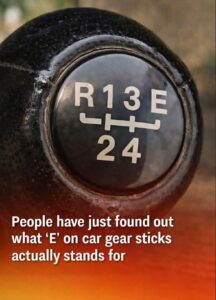
The Forgotten “E” on Gear Sticks: From Economy Mode to Electric Future
For many drivers, especially those who grew up around older automatic cars, gear sticks were a familiar and almost universal language: Park, Reverse, Neutral, Drive. That simple layout made driving intuitive, even for beginners. But occasionally, a strange detail would appear that disrupted this sense of familiarity—a small but mysterious letter “E.”
To younger drivers, it looked like a mistake. Something misplaced. A forgotten marking from a different system. But for those who had driven older European or early automatic vehicles, that “E” had a very specific meaning. And once understood, it revealed an interesting chapter in automotive history that most modern drivers have never encountered.
The Mystery of the “E” That Confused Drivers
As cars evolved and older models slowly disappeared from the roads, the “E” marking became increasingly rare. When it did appear, it sparked confusion. Drivers on forums and social media would ask the same question: what does it mean?
Theories varied widely. Some assumed it stood for “Emergency.” Others guessed “Extra gear” or even “Electric mode.” The ambiguity made it more intriguing, especially as people compared notes and realized not everyone had the same explanation.
Eventually, experienced drivers stepped in with the answer.
The “E” stood for Economy.
What “Economy Mode” Actually Did
In vehicles equipped with this feature, selecting “E” changed how the transmission behaved. Instead of allowing the engine to rev freely or shift aggressively, the system prioritized fuel efficiency.
It encouraged:
- Earlier gear shifts
- Lower engine RPMs
- Smoother acceleration
- Reduced fuel consumption during steady driving
In practice, it functioned like a fuel-saving driving mode long before modern electronics made such systems automatic.
On highways, the difference could be noticeable. The engine would feel calmer, less strained, and more conservative in its power delivery. It wasn’t about speed—it was about efficiency.
At a time when fuel prices mattered significantly and onboard computer systems were limited or nonexistent, this simple “E” setting gave drivers a level of control that felt both practical and innovative.
Why It Disappeared from Modern Cars
As automotive technology advanced, the need for a manual “Economy” gear began to fade.
Several key innovations made it obsolete:
- Electronic fuel injection replaced carburetors
- Automatic transmissions became smarter and adaptive
- Engine control units began optimizing fuel use in real time
- Driving modes became fully integrated into onboard systems
Instead of a separate gear position, efficiency became something the car managed continuously in the background.
Modern vehicles no longer need a driver-selected “E” mode because they automatically adjust performance based on speed, load, terrain, and driving style.
In other words, economy didn’t disappear—it became invisible.
What the “E” Represented in Its Time
The presence of an “E” gear symbolized a very different era of driving.
Back then, cars required more attention from the driver. Fuel efficiency wasn’t fully automated. Understanding how to drive economically meant learning when to shift, how hard to accelerate, and how to maintain steady speeds.
The “E” mode acted as a helper for those who wanted simplicity. It reduced the mental effort required to conserve fuel and made efficiency accessible to everyday drivers, not just experts.
It was a bridge between fully manual driving habits and the automated systems we rely on today.
The Shift Toward Invisible Technology
One of the biggest changes in modern automotive design is how technology has become hidden rather than visible.
Where older cars offered physical controls for different driving behaviors, modern vehicles embed those decisions into software.
Today’s systems can:
- Predict gear shifts
- Adjust throttle response
- Manage fuel or energy distribution
- Optimize performance in real time
Drivers no longer select “economy mode” through a gear lever marked with a letter. Instead, they might toggle a digital drive mode—or not even think about it at all.
The result is smoother driving, but also less direct interaction with the machine.
A New Meaning for the Letter “E”
While the original “Economy” gear has faded into history, the letter “E” has returned in a completely new form.
In today’s automotive world, “E” is far more likely to stand for Electric.
Electric vehicles have redefined how we think about driving entirely. Instead of multiple gears, most electric cars use a single-speed system. There is no need for economy gear shifts because efficiency is built into the motor itself.
Electric motors:
- Deliver instant torque
- Operate efficiently across a wide range of speeds
- Require minimal mechanical gearing
- Optimize energy use electronically
As a result, driving an electric vehicle feels fundamentally different from driving traditional combustion-engine cars.
The gear stick itself is often gone or replaced by buttons, rotary selectors, or touch interfaces. In some vehicles, even those controls are disappearing entirely.
So while “E” once meant saving fuel, it now often represents replacing fuel altogether.
How One Letter Reflects Automotive Evolution
The story of the “E” gear is more than just a forgotten feature—it reflects the broader transformation of automotive technology.
It shows how:
- Simple mechanical solutions gave way to electronic systems
- Driver-controlled efficiency became automated efficiency
- Physical gear selections evolved into software-driven decisions
- Traditional engines are being replaced by electric propulsion
What was once a practical tool for fuel savings has become a historical curiosity, and in some ways, a symbol of how far the industry has come.
Why People Still Remember It
Even though the “E” gear has disappeared from modern cars, it remains a point of fascination for enthusiasts and long-time drivers.
For some, it brings nostalgia for a time when driving felt more hands-on. Every decision mattered—when to shift, how to accelerate, how to conserve fuel.
For others, it represents a transitional moment in automotive design, when manufacturers were first experimenting with ways to make driving more efficient without overwhelming the driver.
And for younger drivers discovering it today, it feels like a hidden piece of automotive history—something unexpected tucked into the evolution of something as familiar as a gear stick.
From Forgotten Feature to Future Symbol
What makes the “E” especially interesting is how its meaning has changed without ever being formally reintroduced.
- In the past: Economy mode for fuel efficiency
- In the present: Electric vehicles redefining mobility
- In the future: Possibly a blend of both efficiency and electrification
The same letter, two entirely different eras of technology.
Final Reflection
The forgotten “E” on older gear sticks is more than a curiosity. It is a reminder that even the smallest details in everyday objects carry history.
It represents a time when drivers actively managed efficiency, a transition into automated intelligence, and a future where efficiency is built into the core of electric mobility.
What once confused drivers as a strange marking on a gear lever now tells a larger story about innovation, adaptation, and progress.