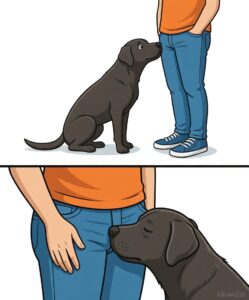
Did you know that when a dog sniffs your private area, it isn’t being rude at all? Instead, it’s engaging in a highly sophisticated biological process—one rooted in evolution, chemistry, and communication.
Dogs possess one of the most advanced sensory systems in the animal kingdom. What feels awkward or embarrassing to humans is, for dogs, a completely normal way of gathering information. In fact, this behavior reveals just how deeply dogs can “read” us—not through words or expressions, but through scent.
To understand why dogs do this, we need to explore the science behind their sense of smell, the role of pheromones, and how the human body naturally emits chemical signals.
The Dog’s Nose: A Biological Superpower
A dog’s sense of smell is not just better than ours—it’s in an entirely different league.
Humans have roughly 5 to 6 million olfactory receptors. Dogs, depending on the breed, can have between 100 million and 300 million. Even more impressive, a much larger portion of a dog’s brain is dedicated to processing smells.
This extraordinary system allows dogs to detect scents at concentrations thousands of times lower than what humans can perceive. What we experience as a single odor is, to a dog, a layered composition of chemical signals.
Additionally, dogs have a specialized structure called the vomeronasal organ (also known as Jacobson’s organ). This organ is specifically designed to detect pheromones—chemical messengers that carry information about identity, mood, and biological state.
Why Certain Areas Attract More Attention
The human body releases scent from various regions, but some areas are far more chemically active than others.
The groin and armpits contain a high concentration of apocrine sweat glands. These glands produce a thicker secretion than regular sweat, which bacteria break down into strong-smelling compounds. These compounds carry a wealth of biological information.
To a dog, these areas act like “data hubs.” When a dog sniffs there, it’s essentially scanning for:
- Hormonal changes
- Emotional state
- Reproductive status
- Health indicators
- Individual identity
So while humans interpret this behavior through a social lens, dogs are simply following their strongest sensory instinct.
The Language of Pheromones
Pheromones are a form of chemical communication used widely across the animal kingdom. They can signal readiness to mate, mark territory, indicate stress, or reinforce social bonds.
Dogs rely heavily on this system. In fact, when dogs greet each other, they typically sniff each other’s rear ends—an area rich in scent glands. This is their equivalent of exchanging introductions.
Humans also produce pheromones, although we rely less on them socially. Still, our bodies continuously emit chemical signals that dogs can easily detect and interpret.
When a dog sniffs a human’s private area, it’s applying the same instinctive greeting behavior it uses with other dogs.
What Dogs Can Learn From a Single Sniff
To a dog, every person has a unique scent profile—a chemical fingerprint. By investigating it, dogs can gather an astonishing amount of information:
Hormonal Signals:
Dogs can detect differences between males and females and even notice hormonal fluctuations caused by puberty, menstruation, pregnancy, or menopause.
Emotional State:
Changes in hormones like cortisol (stress) and adrenaline subtly alter body odor. Dogs can “smell” anxiety, fear, or calmness.
Health Conditions:
There is growing evidence that dogs can detect illnesses such as certain cancers, infections, and metabolic disorders through scent changes.
Identity and Familiarity:
Dogs use scent the way humans use faces. Sniffing helps them confirm who you are and how recently they’ve encountered you.
Diet and Lifestyle:
What you eat, drink, or even medications you take can influence your scent—details that dogs can pick up easily.
Why Some People Attract More Sniffing
You might notice that dogs are more interested in certain individuals. This isn’t random.
People undergoing hormonal changes—such as menstruation or pregnancy—often emit stronger or altered chemical signals. Similarly, illness, medications, or even a new hygiene product can change your scent profile.
Dogs are naturally curious about anything unfamiliar or different. If your scent changes, they’ll investigate to update their internal “record” of you.
The Social Disconnect: Humans vs. Dogs
Humans view this behavior through the lens of social norms and personal boundaries. Dogs do not.
In the canine world, sniffing is polite, expected, and essential. There is no concept of “private” areas—only areas rich in information.
So when a dog greets a human this way, it isn’t being inappropriate. It’s simply using the most efficient method it knows to understand you.
How to Respond Without Reinforcing the Behavior
Even though the behavior is natural, it can still be uncomfortable—especially in social settings. Fortunately, dogs can learn alternative ways to greet people.
Here’s how to handle it calmly and effectively:
- Stay relaxed—sudden movements can excite the dog
- Gently redirect attention (offer your hand instead)
- Use simple commands like “sit” or “off”
- Reward calm, appropriate behavior
- Be consistent with training
Avoid punishment or yelling. Dogs don’t understand embarrassment—they respond best to clear, calm guidance.
The Medical Science Behind It
The same ability that drives this behavior has serious real-world applications.
Dogs have been trained to detect conditions like:
- Cancer (including breast and prostate)
- Diabetes (through blood sugar changes)
- Epileptic seizures (before they occur)
- Bacterial and viral infections
This is possible because diseases often alter the body’s chemical composition—changes that are invisible to humans but obvious to a dog’s nose.
Emotional Connection Through Scent
Dogs don’t just smell physical states—they also respond to emotional ones.
If you’re stressed, your body releases different chemicals. Your dog can detect this instantly and may respond by staying close, becoming protective, or acting differently.
This is one reason dogs are such effective emotional support animals—they are constantly “reading” your internal state through scent.
Common Myths Debunked
“It’s bad behavior.”
No—it’s instinctive. Training can guide it, but it’s not disobedience.
“Only certain dogs do this.”
All dogs have this ability. Some are simply more curious or social.
“It’s dominance.”
Sniffing is about information, not control.
“It’s inappropriate attraction.”
Dogs are not interpreting humans in that way. They’re responding to chemical signals.
A Different Way of Seeing the World
Dogs experience reality through scent the way humans experience it through sight.
Every person they meet is a complex chemical story—one that changes throughout the day. From their perspective, sniffing is simply reading that story.
When you understand this, the behavior becomes less awkward and more fascinating.
Final Thoughts
What feels embarrassing to us is, to a dog, a natural and meaningful interaction. It’s a reminder of how differently animals perceive the world—and how advanced their senses truly are.
The next time a dog gets a little too curious, remember: it isn’t being rude. It’s gathering information, building familiarity, and connecting in the only way it knows how.
In that moment, you’re not just a person to the dog—you’re a rich, ever-changing landscape of scents, emotions, and biological signals.