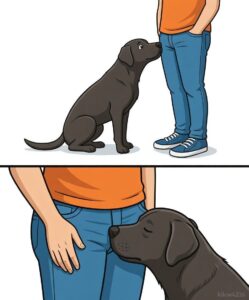
It’s one of those awkward moments almost everyone has experienced: a dog approaches, seems friendly enough—and then suddenly directs its attention somewhere very personal. For humans, the reaction is usually embarrassment or confusion. For dogs, however, this behavior is completely natural, deeply instinctive, and surprisingly meaningful.
What feels socially inappropriate to us is, in reality, a sophisticated biological process. Dogs are not being rude, invasive, or mischievous. They are doing exactly what evolution designed them to do: gathering information through scent.
To truly understand this behavior, you have to step into a dog’s world—a world where smell is not just one sense among many, but the primary way of interpreting reality.
A World Built on Scent
Humans are visual creatures. We rely on sight to recognize faces, read emotions, and navigate our surroundings. Dogs operate differently. Their understanding of the world is dominated by smell.
The canine nose is a biological marvel. While humans have around 5–6 million scent receptors, dogs can have up to 300 million. But it’s not just about quantity—it’s about processing power. The part of a dog’s brain dedicated to analyzing smells is proportionally far larger than in humans.
To put it simply: what we perceive as a single scent, a dog experiences as a layered, detailed composition of information.
When a dog smells you, it’s not just identifying your presence. It’s gathering data—about who you are, how you feel, and what’s happening inside your body.
The Role of the vomeronasal organ
One of the most fascinating tools in a dog’s sensory system is the vomeronasal organ, also known as Jacobson’s organ. This specialized structure is designed specifically to detect pheromones—chemical signals that carry biological and emotional information.
Unlike regular smells, pheromones are subtle and often undetectable to humans. But for dogs, they are incredibly rich sources of insight.
This organ allows dogs to “read” hormonal changes, emotional states, and even reproductive signals. It’s like having access to a hidden layer of communication that humans don’t consciously perceive.
Why That Specific Area?
The reason dogs often focus on the groin area comes down to biology.
Humans have sweat glands all over the body, but certain areas—particularly the armpits and groin—contain apocrine glands. These glands release a thicker type of sweat that carries more complex chemical compounds.
When bacteria on the skin break down this sweat, they produce strong, information-rich odors. To a dog, this area is essentially a hotspot of biological data.
By sniffing there, a dog can quickly gather:
- Your biological sex
- Hormonal fluctuations
- Emotional state
- General health indicators
- Even aspects of your recent activity or diet
It’s not random. It’s efficient.
The Language of pheromones
Pheromones are the invisible language of the animal kingdom. They communicate things like attraction, stress, dominance, and readiness to mate.
While humans rely more on verbal and visual communication, we still produce pheromones. Dogs, with their heightened senses, are simply better equipped to detect and interpret them.
When a dog sniffs you, it’s essentially “reading” your pheromone profile. This profile changes constantly based on your internal state.
For example:
- Stress increases cortisol levels, altering your scent
- Hormonal cycles create detectable shifts
- Illness can produce subtle chemical changes
- Even emotions like fear or excitement have a scent signature
To a dog, these aren’t abstract concepts—they’re concrete information.
A Social Greeting, Not Misbehavior
Among dogs, sniffing is a standard greeting. When two dogs meet, they often sniff each other’s rear ends. This is not random or inappropriate in their world—it’s the fastest way to exchange information.
Think of it as a detailed introduction.
When a dog does something similar to a human, it’s applying the same logic. It doesn’t understand human social boundaries. It simply uses the most effective method it knows.
From the dog’s perspective, it’s being thorough, not rude.
What Dogs Can Actually Detect
A dog’s sense of smell is so advanced that it can detect things humans would never notice.
Research has shown dogs can identify:
- Changes in blood sugar levels
- Certain types of cancer
- Hormonal shifts during pregnancy
- Stress and anxiety markers
- Infections and metabolic changes
This is why some dogs are trained as medical detection animals. Their ability to sense internal changes is not just impressive—it’s life-saving.
So when a dog shows unusual interest in a person, it may simply be detecting something different or new.
Why Some People Get More Attention
Not everyone attracts the same level of curiosity from dogs. Some people seem to be “sniff magnets,” and there are reasons for that.
Dogs are more likely to focus on individuals who:
- Are experiencing hormonal changes (e.g., menstruation, pregnancy)
- Have recently exercised or are sweating more
- Are using new hygiene products
- Are under stress or emotional strain
- Have medical conditions that alter body chemistry
Dogs are naturally curious about novelty. If your scent profile changes, even slightly, they notice—and investigate.
The Emotional Dimension
Dogs don’t just detect physical states—they respond to emotional ones as well.
If you’re anxious, your body releases stress hormones that subtly change your scent. Dogs pick up on this instantly. That’s why they may become more attentive, protective, or even clingy when you’re upset.
In this way, their sniffing behavior is not just analytical—it’s relational.
They are constantly checking in, gathering information, and adjusting their behavior accordingly.
Human Reactions vs. Canine Reality
Here’s where the disconnect happens.
Humans interpret behavior through the lens of social norms. Dogs operate purely on instinct and biology.
To us, the behavior feels intrusive.
To them, it’s logical and necessary.
Reacting strongly—yelling, pushing, or panicking—can confuse a dog. It doesn’t understand why its natural behavior is being rejected.
How to Handle It Gracefully
If you want to discourage this behavior, the goal is not punishment, but redirection.
Effective approaches include:
- Staying calm and neutral
- Gently guiding the dog away
- Offering your hand as an alternative
- Using simple commands like “sit” or “leave it”
- Rewarding appropriate behavior
Dogs are highly trainable. With consistency, they can learn more socially acceptable ways to greet people.
A Glimpse Into Evolution
This behavior is rooted in thousands of years of evolution.
Dogs evolved from wolves, animals that relied heavily on scent for survival. Identifying friend from foe, detecting reproductive status, and sensing danger all depended on smell.
Even though domestication has changed many aspects of dogs, their olfactory instincts remain largely intact.
In a modern home, those instincts still operate—just applied to humans instead of other animals.
The Bigger Picture: Communication Without Words
What makes this behavior fascinating is what it reveals about communication.
Humans communicate through language, tone, and facial expressions. Dogs communicate through scent, body language, and energy.
When a dog sniffs you, it’s engaging in a form of communication that is incredibly detailed—just not one we’re used to interpreting.
It’s learning about you in ways that go far beyond what we can see.
From Awkwardness to Appreciation
It’s easy to feel embarrassed when a dog behaves this way, especially in public. But understanding the science behind it changes the perspective.
This isn’t misbehavior.
It’s intelligence in action.
It’s a reminder that dogs experience the world in a fundamentally different way—one that is richer in scent than we can imagine.
Final Thought
The next time a dog gets a little too curious, remember: you’re not being judged—you’re being analyzed, in the most literal and biological sense.
To that dog, you are not just a person.
You are a complex combination of signals, emotions, and chemical messages.