The Psychological Meaning of Letting Gray Hair Go Natural
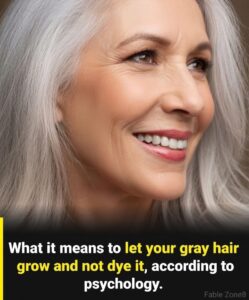
Choosing to let gray hair grow naturally is often interpreted on the surface as a style decision, but psychologically it can represent something far more layered and meaningful. In many cases, it reflects an internal shift in how a person relates to identity, time, aging, and social expectation. It is not simply about hair color—it is about the evolving relationship between self-perception and external validation.
For decades, gray hair has been culturally coded as something to hide. In many societies, especially those influenced by commercial beauty industries, youth has been positioned as the standard of attractiveness and relevance. Aging, by contrast, has often been framed in negative terms—associated with decline, loss, or reduced visibility. Within that framework, covering gray hair becomes less about preference and more about compliance with a cultural narrative that equates worth with youthfulness.
Against that backdrop, allowing gray hair to remain visible can become a quiet but intentional act of psychological independence.
Identity and the Symbolism of Hair
Hair has always carried symbolic meaning across cultures. It is one of the most visible aspects of identity and is often used—consciously or unconsciously—to communicate age, personality, social belonging, and even emotional state. Because of this, changing hair color is never purely cosmetic. It is tied to how individuals present themselves to the world and how they believe they are perceived in return.
Letting gray hair grow naturally can coincide with a deeper identity shift. This often occurs during midlife transitions, but it is not limited to age. It can happen during periods of emotional reevaluation, burnout, recovery, or personal reinvention. At its core, it reflects a reassessment of priorities: a move away from external approval and toward internal coherence.
In psychological terms, this may represent a reduction in what is called “appearance-based self-worth”—the tendency to evaluate one’s value primarily through physical appearance. As individuals grow more secure in other dimensions of identity—such as competence, relationships, emotional insight, or lived experience—the need to control external appearance often decreases.
Emotional Relief and Reduced Cognitive Load
One of the less discussed psychological aspects of embracing gray hair is the emotional relief it can bring. Maintaining dyed hair requires ongoing effort: scheduling appointments, managing root growth, correcting color fade, and maintaining consistency. While these tasks may seem routine, they can contribute to a subtle but persistent cognitive load.
For some individuals, this maintenance cycle reinforces the idea that aging must be actively managed or corrected. Over time, this can create an undercurrent of anxiety or self-surveillance—an ongoing awareness of what needs to be “fixed.”
Allowing gray hair to grow naturally interrupts that cycle. Many people describe experiencing a sense of psychological release when they stop dyeing their hair. This is not simply about convenience; it reflects a deeper acceptance of natural change. The body is no longer treated as a problem to be managed but as a process to be lived with.
This shift can reduce internal conflict, particularly the tension between how a person looks and how they feel internally. Psychologists often refer to this as a reduction in cognitive dissonance—the discomfort that arises when external appearance and internal identity feel misaligned.
Aging, Acceptance, and Emotional Maturity
Aging is one of the most universal human experiences, yet it remains one of the most culturally resisted. In many modern societies, youth is idealized not only aesthetically but symbolically, associated with energy, opportunity, and desirability. This creates pressure to resist visible signs of aging for as long as possible.
Choosing to embrace gray hair can reflect a different psychological orientation—one that is more accepting of time as a natural and unavoidable process rather than an adversary. This acceptance is often linked with emotional maturity. It does not imply resignation or loss of care for appearance, but rather a shift in what is considered worth prioritizing.
Instead of focusing on preventing visible aging, individuals may begin to focus on how they feel, how they live, and how they engage with the world. This can lead to a more grounded sense of self, where identity is not contingent on maintaining a specific external image.
In this sense, gray hair becomes symbolic of lived experience. Each strand represents continuity, change, and time passed. Rather than being interpreted as a sign of decline, it can be reframed as a visible record of resilience and personal history.
Gender, Social Pressure, and Cultural Conditioning
The psychological meaning of gray hair is not experienced equally across genders. For many women, the pressure to conceal gray hair has historically been far stronger than for men. Men with gray or white hair are often described as distinguished or experienced, while women are more likely to face expectations of youthfulness.
This difference reflects broader cultural conditioning around gender and appearance. As a result, choosing to go gray naturally can carry additional psychological weight for women. It may involve confronting internalized expectations about attractiveness, desirability, and social value.
In this context, embracing gray hair can become an act of quiet resistance. It is not necessarily a political statement, but it can still function as one psychologically. It reflects a decision to prioritize self-definition over external validation.
Over time, this can strengthen internal boundaries. Individuals may become more confident in other areas of life as well, such as communication, decision-making, and interpersonal relationships. The act of accepting one visible aspect of aging can reinforce broader self-acceptance.
Reframing Time and the Body
One of the most profound psychological shifts associated with going gray naturally is a change in how time is perceived. Modern culture often promotes the idea that aging can be delayed, corrected, or cosmetically managed. This creates an implicit narrative that time is something to resist.
However, resistance to time is psychologically exhausting. It requires continuous effort to maintain an image that contradicts natural biological processes. Over time, this can contribute to dissatisfaction or a sense of falling behind an idealized standard.
By contrast, embracing gray hair can represent alignment with time rather than opposition to it. This does not mean passivity—it means acceptance of reality as it is, rather than as it is idealized. Psychologically, this can foster greater emotional stability and reduce anxiety related to appearance.
Time, in this framework, is no longer an enemy. It becomes part of identity formation. The visible signs of aging are interpreted not as loss, but as evidence of continuity and survival through different life stages.
Self-Perception and Internal Validation
A key psychological benefit of embracing natural gray hair is the shift from external validation to internal validation. When appearance is heavily managed to meet external standards, self-worth can become dependent on feedback from others. Compliments, approval, or perceived attractiveness may play a central role in emotional stability.
When individuals choose to let gray hair grow naturally, they often begin to rely less on external reinforcement. This does not mean they stop caring about appearance, but rather that appearance is no longer the primary source of self-evaluation.
This shift can increase emotional resilience. Instead of fluctuating based on external opinions, self-worth becomes more stable and internally anchored. Over time, this can influence other areas of life, including confidence in decision-making and resistance to social pressure.
Lifestyle Simplicity and Psychological Space
There is also a practical dimension to this choice that feeds back into psychological well-being. Reducing or eliminating hair dye routines frees up time, financial resources, and mental energy. While this may seem minor, small reductions in routine obligations can accumulate into a greater sense of autonomy.
This additional space can be redirected toward relationships, hobbies, rest, or personal development. Psychologically, this contributes to a sense of agency—the feeling that one’s time and energy are self-directed rather than externally constrained.
In this way, embracing gray hair can become part of a broader lifestyle shift toward intentional living.
Conclusion: Authenticity Over Performance
Ultimately, letting gray hair grow naturally is not about rejecting beauty or abandoning self-care. Instead, it reflects a redefinition of what beauty means. It suggests that beauty does not have to be maintained through concealment or correction, but can also be expressed through authenticity and acceptance.
Psychologically, this choice can represent emotional maturity, identity integration, and reduced dependence on external validation. It can signal a willingness to live in alignment with time, rather than in opposition to it.
In a culture that often equates youth with value, choosing to embrace gray hair can be a quiet but powerful statement: that worth is not defined by appearance at a single moment, but by the depth of experience accumulated over time.
It is, in essence, a shift from performing identity to inhabiting it.
And in that shift, many people find not loss—but a more grounded and honest sense of self.