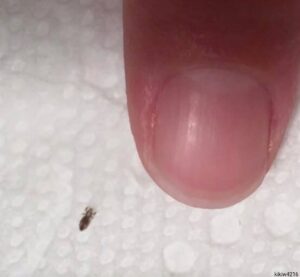
Wife found this in our toddler’s hair. Anything we should worry about? He goes to daycare three times a week.
The small insect found in a toddler’s hair after daycare is the kind of moment that can instantly trigger alarm in any parent. At first glance, the immediate fear is usually head lice. That reaction is understandable—daycare environments involve close contact between children, shared toys, nap mats, and frequent head-to-head interaction during play. These conditions are exactly why head lice outbreaks are most common in preschool-aged groups.
But not every tiny insect found in hair is actually a parasite. In fact, many of these discoveries turn out to be harmless environmental bugs that simply wandered onto the child’s head.
Understanding what you’re looking at is the key to responding correctly—and avoiding unnecessary stress.
The First Question: Is It Really Head Lice?
Head lice (Pediculus humanus capitis) are small parasitic insects that live exclusively on the human scalp and feed on blood. They are typically:
- About the size of a sesame seed (2–3 mm)
- Tan, grayish-white, or light brown
- Flat and elongated
- Equipped with claw-like legs for gripping hair strands
They do not fly or jump, but they spread easily through direct head-to-head contact, which is common among toddlers.
However, the insect described in your situation—and often seen in similar photos—does not always match this profile. Many non-lice insects can accidentally end up in hair, especially in active children who play on carpets, outdoors, or around shared daycare environments.
Common “False Alarms” Parents Often Mistake for Lice
Several harmless insects are frequently mistaken for head lice:
1. Carpet beetles (larvae or adults)
- Often found indoors
- Can appear dark, small, and slightly oval
- Do not live on humans or feed on blood
2. Fleas
- Dark brown and very small
- Capable of jumping (key difference from lice)
- Usually associated with pets or upholstered furniture
3. Gnats or tiny flying insects
- May land temporarily in hair
- Do not stay or reproduce on humans
4. Outdoor debris or soil insects
- Can be brought in from playgrounds or daycare outdoor areas
- Typically accidental and isolated findings
If only a single insect is found and there is no itching, no scalp irritation, and no visible eggs (nits), lice become less likely.
Key Signs That Point Toward Head Lice
Instead of focusing only on the insect, parents should check for patterns. Head lice are rarely a one-time sighting.
Look for:
- Persistent scalp itching (especially behind ears or neck)
- Small red bite marks on the scalp
- Tiny white or yellow “nits” stuck firmly to hair shafts
- Multiple insects found during combing
- Restless sleep or frequent head scratching in toddlers
Nits are especially important—they do not flake off like dandruff and are strongly attached to the hair near the scalp.
A simple wet-combing test using a fine-toothed lice comb under bright light is often the fastest way to confirm or rule out infestation.
Daycare and Exposure: What Parents Should Know
Because your toddler attends daycare several times a week, exposure to lice is statistically more likely than in home-only environments.
Head lice spread primarily through:
- Direct head-to-head contact
- Shared pillows, hats, or costumes (less common but possible)
They do not spread through poor hygiene, dirtiness, or unclean homes. In fact, lice often prefer clean hair because it is easier to attach to.
Importantly, modern pediatric guidelines (including those from the CDC and American Academy of Pediatrics) emphasize that:
- Head lice are not dangerous
- They do not spread disease
- Children do not need to be excluded from school once treatment begins
Many schools and daycares now discourage “no-nit” policies because they are outdated and unnecessarily disruptive.
What You Should Do Right Now
If you’ve found a single small insect:
Step 1: Don’t panic
One insect alone is not enough to diagnose anything.
Step 2: Perform a careful scalp check
Use:
- Bright light
- Fine-toothed lice comb
- Damp, conditioned hair (easier to trap insects if present)
Step 3: Look for patterns
- More insects?
- Attached nits?
- Signs of irritation?
If none are present, it is likely incidental.
Step 4: Monitor over 3–5 days
Sometimes early infestations take time to become visible.
If It Does Turn Out to Be Head Lice
If live lice or nits are confirmed, treatment is straightforward:
- Over-the-counter treatments (permethrin or pyrethrin-based)
- Repeat treatment after 7–10 days
- Daily wet combing to remove nits
- Wash bedding, hats, and recently used clothing in hot water
Avoid excessive chemical treatments or “bug bombs”—they are unnecessary and ineffective for lice.
Most cases resolve completely within 1–2 weeks with consistent care.
Emotional Reality for Parents
One of the hardest parts of this situation is not the bug itself—but the emotional reaction it triggers.
Parents often feel:
- Anxiety about cleanliness
- Fear of judgment from daycare or other parents
- Guilt, even though lice are unrelated to hygiene
It’s important to reframe this:
Head lice are not a reflection of parenting quality.
They are a normal part of early childhood social environments.
When to Call a Doctor
Consult a pediatrician if:
- You are unsure about identification
- Itching becomes severe
- Over-the-counter treatments fail
- Your child is very young (under 2 years)
Otherwise, most cases can be handled safely at home.
Final Takeaway
Finding a tiny bug in your toddler’s hair after daycare is unsettling—but it is not automatically a reason to worry.
In many cases, it turns out to be a harmless insect that wandered in temporarily. Even when it is head lice, it is a manageable and temporary condition that does not affect long-term health.
The most important step is not panic—it is careful observation.
Check, confirm, and respond calmly.
Because in parenting, especially in early childhood years, most “alarming moments” turn out to be far more manageable than they first appear.