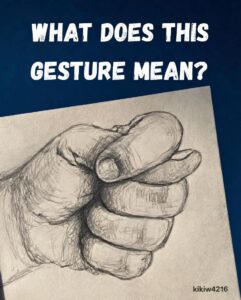
Long before smartphones, emojis, and social media transformed communication into instant digital reactions, people relied heavily on gestures to express emotions, opinions, warnings, and beliefs without speaking a single word. Across ancient civilizations, hand movements often carried meanings far deeper than modern audiences might expect. Some gestures symbolized loyalty or blessing, while others conveyed insults, resistance, or spiritual protection. Among the most fascinating of these forgotten signals is the ancient gesture known as “making a fig,” a hand sign with origins stretching back thousands of years. Though rarely recognized today, this subtle gesture once carried extraordinary significance across Europe and the Mediterranean world.
At first glance, the fig gesture appears simple: a clenched fist with the thumb tucked tightly between the index and middle fingers. To modern observers unfamiliar with its history, it may seem random or insignificant. Yet for countless generations, this gesture functioned as a complex social symbol capable of communicating rejection, mockery, protection, humor, resistance, and even spiritual defense. Known in Latin as manus fica, meaning “fig hand,” the gesture occupied a unique place in ancient and medieval life, bridging the worlds of superstition, everyday communication, and cultural identity.
The origins of the fig gesture are most strongly associated with ancient Rome, though similar symbolic hand signs existed in neighboring Mediterranean cultures as well. In Roman society, gestures formed an essential part of communication. Public speaking, politics, religion, and daily interactions all relied heavily on physical expression. Romans understood that gestures could amplify meaning, reveal social status, and communicate intentions in ways words alone could not. Within this environment, the fig gesture developed into a versatile symbol layered with multiple interpretations.
One of its earliest and most significant uses involved protection against evil. Ancient Romans believed deeply in supernatural forces, curses, and malevolent spirits capable of influencing human life. Among the most feared concepts was the “evil eye,” the belief that envy or malicious attention could bring illness, bad luck, infertility, or disaster. To defend themselves, people turned to protective symbols known as apotropaic signs — objects or gestures intended to ward off harm.
The fig gesture became one of the most recognizable of these protective signs. During the Roman festival of Lemuria, which focused on appeasing restless ancestral spirits, the paterfamilias, or head of the household, would perform rituals designed to drive away negative supernatural forces. Historical accounts suggest that gestures similar to the fig were used during these ceremonies as symbolic barriers against evil influences. The tucked thumb represented hidden power and life energy, while the overall shape carried associations with fertility, vitality, and protection.
The gesture’s name itself reveals much about its symbolic roots. The fig fruit held strong cultural and religious associations throughout the Mediterranean world. In ancient societies, figs symbolized fertility, abundance, nourishment, and sexuality. The shape of the hand gesture was believed by some scholars to resemble aspects of the human body connected to fertility and creation. As a result, the fig gesture combined spiritual protection with ideas of life force and generative power, making it particularly effective in folk belief systems.
Archaeological discoveries across former Roman territories support the widespread popularity of the gesture. Small amulets shaped like the fig hand have been uncovered in homes, marketplaces, gravesites, and personal collections throughout Italy, Greece, and other Mediterranean regions. Crafted from coral, bronze, silver, ivory, or gold, these charms were commonly worn as necklaces or bracelets by adults and children alike. Many families believed the symbols could protect against sickness, jealousy, curses, and misfortune.
Children were especially likely to wear such amulets because they were considered vulnerable to supernatural harm. Parents feared that envy from neighbors or strangers could negatively affect a child’s health or future. The fig symbol therefore served not only as decoration but also as emotional reassurance in uncertain and often dangerous times.
Roman writers occasionally referenced similar gestures in surviving texts. Pliny the Elder, known for documenting countless aspects of Roman culture and superstition, discussed protective practices involving hand signs and symbolic objects. Though interpretations vary among historians, evidence strongly suggests that the fig gesture formed part of a larger tradition of symbolic defenses woven deeply into everyday life.
As centuries passed and the Roman Empire transformed into medieval Europe, the fig gesture survived and evolved. During the Middle Ages, Europe became a world shaped by strict social hierarchies, religious authority, and political instability. Openly challenging those in power could lead to punishment, imprisonment, or social exclusion. In this environment, subtle forms of communication became increasingly valuable.
The fig gesture gradually developed into a quiet expression of refusal or defiance. A quick movement hidden behind one’s back or performed discreetly at waist level could silently communicate disagreement, mockery, or resistance without provoking direct confrontation. This subtlety made the gesture especially useful among ordinary people navigating relationships with landlords, officials, merchants, or religious authorities.
Peasants, laborers, and traders often relied on coded gestures and indirect communication to avoid conflict while still expressing personal opinions. The fig became one of these tools. It allowed individuals to preserve dignity and independence in societies where open dissent carried real risks. Unlike aggressive insults, the gesture maintained an element of humor and ambiguity, making it easier to deny or dismiss if challenged.
Folk traditions across Southern and Eastern Europe kept the gesture alive for generations. In villages throughout Italy, the Balkans, Greece, Portugal, and parts of Spain, the fig remained both playful and protective. Grandparents taught children how and when to use it, often presenting it as harmless fun mixed with practical wisdom. In some communities, making a fig behind one’s back became a common response to teasing, unwanted demands, or suspicious individuals believed to carry bad luck.
Its meaning varied depending on context. Among friends, it could serve as lighthearted mockery. In tense situations, it became a subtle refusal. During moments of fear or uncertainty, it transformed into spiritual protection. This flexibility made the gesture remarkably resilient across changing centuries and cultures.
The Renaissance period further expanded Europe’s fascination with symbolism, hidden meanings, and gestures. Art, theater, and literature frequently incorporated coded body language recognizable to contemporary audiences. Though less prominent than some other symbols, the fig gesture appeared in folk stories, satirical works, and visual art, reflecting its continued place in social life.
In certain regions, however, the gesture also developed mildly obscene associations. Like many hand signs throughout history, meanings shifted depending on cultural norms and local traditions. In some Mediterranean societies, the fig carried sexual symbolism connected to fertility imagery and bodily references. Yet unlike more aggressively offensive gestures, it generally retained a playful or defensive quality rather than purely hostile intent.
This dual nature helped preserve the gesture’s popularity. It could simultaneously amuse, protect, and challenge authority without escalating into outright confrontation. Such versatility reflects humanity’s longstanding creativity in nonverbal communication. Before modern freedoms of speech and digital expression, subtle gestures often provided safer and more effective ways to navigate complicated social environments.
The protective dimension of the fig gesture remained especially strong in Mediterranean and Balkan cultures well into the nineteenth and early twentieth centuries. Belief in the evil eye persisted across rural communities even as industrialization transformed cities and economies. Many families continued teaching children to discreetly make a fig when encountering suspicious strangers, hearing disturbing news, or entering unfamiliar places.
Women frequently played important roles in preserving these traditions. Grandmothers and mothers passed down folk practices involving gestures, charms, prayers, and rituals designed to safeguard family members from envy and misfortune. In wedding ceremonies, fertility celebrations, and childbirth customs, the fig symbol sometimes appeared as a protective blessing intended to ensure prosperity and healthy offspring.
Interestingly, similar beliefs existed beyond Europe as well. Variations of protective hand signs can be found across cultures worldwide, from the Middle East to parts of Latin America. Although the exact fig gesture remained most closely associated with Mediterranean traditions, its underlying themes — protection, resistance, fertility, and hidden power — reflected universal human concerns.
The Industrial Revolution and modernization gradually weakened the role of such symbolic gestures in everyday life. As urban populations expanded and societies became increasingly literate and centralized, direct verbal communication gained greater importance. Mass education promoted standardized languages and reduced dependence on regional folk customs.
Technological innovations also transformed communication habits. Telegraphs, telephones, newspapers, radio broadcasts, and eventually television reshaped how people shared ideas and emotions. Traditional gestures rooted in local culture slowly lost relevance in rapidly modernizing societies. Younger generations growing up in cities often viewed older superstitions as outdated or irrational.
Scientific thinking further contributed to the decline of protective folk gestures. As medicine, psychology, and secular education spread, belief in curses and supernatural harm weakened in many parts of Europe. Practices once considered essential for protection increasingly became associated with rural traditions or elderly relatives.
By the mid-twentieth century, the fig gesture had largely disappeared from mainstream daily life in many countries. It survived mostly in isolated folk traditions, historical references, and regional memories. Some older individuals continued using it casually or teaching it to grandchildren, but its meanings became increasingly obscure to younger generations.
Today, most people encountering the gesture would not recognize its historical significance. Some might confuse it with modern offensive hand signs, while others would simply see an unusual fist position without understanding its symbolism. Yet despite its fading visibility, the fig gesture remains an extraordinary example of humanity’s rich nonverbal heritage.
Historians, anthropologists, and folklorists continue studying gestures like the fig because they reveal how earlier societies navigated power, fear, identity, and communication. Gestures provide unique insight into emotions and social realities often absent from official historical records. While kings, wars, and laws dominate traditional history books, small everyday actions like making a fig offer glimpses into ordinary human experience.
The gesture also highlights the emotional complexity of premodern life. Ancient and medieval people lived in worlds shaped by uncertainty, disease, superstition, rigid hierarchies, and limited freedoms. Within those environments, symbolic gestures became practical tools for expressing resistance, humor, solidarity, and hope. A simple hand movement could communicate what words could not safely express.
Modern digital culture ironically echoes some aspects of these older traditions. Emojis, reaction images, memes, and internet slang function as contemporary forms of symbolic shorthand. Like ancient gestures, they compress emotions and ideas into instantly recognizable visual signals. The difference lies mainly in speed and technology rather than the underlying human impulse.
In some ways, rediscovering forgotten gestures like the fig encourages reflection on how communication evolves while preserving timeless patterns. Humans have always searched for creative methods to express identity, emotion, and belief beyond spoken language. Whether through carved amulets, secret hand signs, or digital icons, symbolic communication remains deeply woven into social life.
The fig gesture also carries broader philosophical lessons about subtlety and resilience. Unlike aggressive displays of power, it represented quiet confidence and hidden resistance. It allowed individuals to reject, protect, or mock without open violence or confrontation. In highly controlled societies, such subtle acts could preserve personal autonomy and emotional dignity.
This quiet strength perhaps explains why the gesture endured for so many centuries across vastly different cultures and historical periods. It adapted continuously while retaining core symbolic meanings tied to protection and defiance. Few gestures survive so long with such layered interpretations.
Art and literature occasionally preserve traces of the fig’s cultural legacy even today. Museums displaying Roman amulets or medieval artifacts often include examples of fig-shaped charms. Academic studies of folklore and body language continue documenting its historical significance. In some Mediterranean communities, elderly individuals still remember stories or superstitions involving the gesture, though actual use has become increasingly rare.
As society grows ever more dominated by fast-moving digital communication, forgotten gestures like the fig offer valuable reminders of humanity’s cultural depth and ingenuity. They reveal how much meaning people once packed into the smallest movements and how communication has always extended far beyond words alone.
The story of “making a fig” is ultimately not just about an old hand gesture. It is about human creativity, adaptation, and emotional survival across centuries of changing civilizations. It reflects our enduring desire to protect ourselves, challenge authority, express individuality, and connect with others through shared symbols.
Though the gesture itself may have faded from everyday use, its legacy survives as a fascinating chapter in the history of human expression. In a world increasingly filled with noise, instant reactions, and endless digital chatter, the quiet confidence of the fig gesture reminds us that some of history’s most powerful messages were delivered silently — hidden within the smallest movements of the human hand.