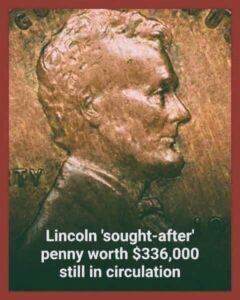
Among the countless objects that pass through human hands every day, few are as easily overlooked as pocket change. Coins jingle in wallets, sit forgotten in jars, or slip between couch cushions without much thought. Yet within this ordinary stream of currency lies a fascinating possibility: that something seemingly insignificant could, in rare cases, hold extraordinary historical and financial value. One of the most famous examples of this phenomenon is the 1943 Bronze Lincoln Cent—a coin so rare and unexpected that it has become a legend in American numismatics, captivating collectors, historians, and casual observers alike.
Its story begins not with wealth or intention, but with wartime necessity. During the early 1940s, the United States was deeply involved in World War II, and nearly every aspect of industry was adjusted to support the war effort. Metals such as copper became critically important for military production, especially for ammunition, wiring, and communication systems. As a result, the U.S. Mint was instructed to conserve copper by changing the composition of the one-cent coin. In 1943, the traditional bronze penny—composed primarily of copper—was replaced with a new version made of zinc-coated steel.
This change created a dramatic visual and physical shift in American currency. For the first time in decades, pennies no longer had their familiar warm copper tone. Instead, they appeared silver-gray and slightly industrial in feel. While the transition was meant to be efficient and temporary, it also set the stage for one of the most famous minting accidents in history.
Despite the transition to steel planchets, a small number of leftover bronze blanks from 1942 remained in minting equipment at facilities in Philadelphia, Denver, and San Francisco. These stray bronze discs were not intended to be used, and under normal circumstances, they would have been removed during cleaning and preparation of the presses. However, a handful of them were accidentally struck with the 1943 design and released into circulation.
The result was the creation of the 1943 Bronze Lincoln Cent—a coin that should not have existed at all.
At first, no one noticed. In the vast circulation of wartime currency, these few anomalies blended in with millions of other coins. It wasn’t until years later, in the late 1940s, that collectors began to realize something unusual had occurred. When the first suspected bronze 1943 pennies surfaced, they sparked immediate skepticism. The U.S. Mint initially denied their existence, assuming the coins were either altered or counterfeit.
But as more examples appeared, curiosity grew. Collectors began testing the coins using simple methods, including magnets. The steel pennies from 1943 were magnetic, while the suspected bronze versions were not. This distinction became one of the earliest identification tools. Eventually, advanced metallurgical testing confirmed what many had hoped—or feared—to be true: a small number of genuine bronze 1943 pennies did exist.
Once authenticated, these coins became some of the most sought-after objects in numismatic history.
What makes the 1943 Bronze Lincoln Cent so remarkable is not just its rarity, but the conditions that produced it. Experts estimate that fewer than 20 genuine examples exist across all U.S. mints combined. Each known specimen carries its own subtle differences depending on where it was struck. Coins without mint marks originated in Philadelphia, while those marked with a small “D” or “S” came from Denver and San Francisco respectively. These distinctions add layers of complexity and interest for collectors who study every detail.
The composition of these rare coins is another key factor in their value. Unlike the steel cents of 1943, which were coated in zinc and prone to rust, the bronze versions retained the traditional pre-war alloy of approximately 95% copper, with small amounts of tin and zinc. This composition gave them a distinctive reddish-brown appearance that set them apart visually and chemically from their steel counterparts.
Over time, their scarcity and historical significance transformed them into legendary collectibles. One authenticated example sold at auction for over $1 million, while others have reached hundreds of thousands of dollars depending on condition and provenance. Each sale reinforces their reputation as one of the most valuable small-denomination coins ever produced in the United States.
The fascination surrounding these coins also led to widespread public interest. In the decades following their discovery, stories circulated about individuals who had unknowingly possessed one of these rare pennies. Many people began searching through old jars of coins, family collections, and inherited change in hopes of discovering a hidden treasure.
This phenomenon reflects a deeper human attraction to the idea of accidental wealth. The notion that something so small and ordinary could be worth a fortune taps into a universal sense of possibility. It transforms everyday objects into potential artifacts of discovery.
However, this widespread interest also led to confusion and deception. Many counterfeit versions of the 1943 bronze cent were created by coating steel pennies with copper or altering the date on later coins, particularly the 1948 penny, where the “8” was modified to resemble a “3.” These fakes have made authentication a critical part of numismatic evaluation. Professional grading services now use advanced tools such as X-ray fluorescence and precise weight analysis to confirm authenticity.
Despite the presence of counterfeits, genuine specimens remain some of the most carefully documented coins in existence. Museums, private collections, and institutions such as the Smithsonian hold verified examples, ensuring their preservation for historical study.
Beyond their monetary value, these coins carry symbolic meaning. They represent a moment in time when global conflict influenced even the smallest aspects of daily life. The shift from bronze to steel pennies was not merely a technical adjustment; it was a reflection of national priorities during wartime. Every coin minted in 1943 tells part of that story, but the bronze errors add an unexpected twist—an artifact of imperfection within a system designed for precision.
This interplay between order and error is what gives the 1943 Bronze Lincoln Cent its enduring fascination. It demonstrates how large-scale industrial processes, even when carefully controlled, can produce rare anomalies that become historically significant. In this case, a few overlooked bronze blanks managed to escape detection and enter circulation, creating one of the most famous minting mistakes in history.
As the years passed, the legend of the coin continued to grow. It became a staple of coin collecting literature, television programs, and educational discussions about rare currency. Alongside other iconic rarities like the 1913 Liberty Head nickel and the 1804 silver dollar, it is often cited as one of the most valuable and mysterious coins in American history.
One of the most famous stories associated with the 1943 bronze cent involves a teenager who discovered one in his school cafeteria change shortly after World War II. Unaware of its value, he kept it for years before it was eventually authenticated and sold decades later for a substantial sum. Stories like this continue to fuel public imagination, reinforcing the idea that extraordinary value can sometimes hide in plain sight.
At the same time, experts caution that such discoveries are exceedingly rare. The overwhelming majority of pennies in circulation are ordinary, with no unusual value beyond their face amount. Nevertheless, the possibility—however small—keeps interest alive.
The enduring appeal of the 1943 Bronze Lincoln Cent lies not only in its price but in what it represents: chance, history, and the intersection of human error with lasting significance. It reminds collectors and casual observers alike that even the most controlled systems are not immune to unpredictability.
In a broader sense, the coin symbolizes how value is often defined not just by material composition, but by story. A simple piece of metal becomes extraordinary because of the circumstances of its creation and survival. It is this narrative layer that transforms it from currency into cultural artifact.
Today, as digital payments replace physical cash in many parts of the world, coins like the 1943 Bronze Lincoln Cent take on an even greater sense of historical importance. They represent a tangible link to a time when money was physical, everyday, and deeply connected to national identity and global events.
Collectors continue to search for undiscovered specimens, although most experts agree that any remaining examples are likely already known or held in private collections. Still, the dream persists. Somewhere, in a forgotten jar or inherited collection, there is always the possibility—however remote—that another extraordinary coin might be waiting to be found.
And that possibility is what keeps the story alive.
The 1943 Bronze Lincoln Cent is more than a rare coin. It is a reminder that history often hides in the smallest places, that mistakes can become treasures, and that even the most ordinary objects can carry extraordinary significance when viewed through the lens of time.
In the end, its legacy is not just about value or rarity, but about curiosity itself—the human instinct to look closer, question what we see, and wonder whether something remarkable might be hiding in plain sight, waiting patiently in the everyday world we often overlook.