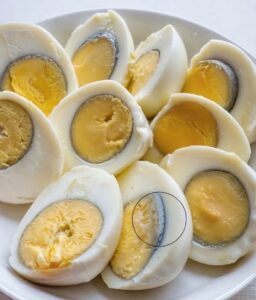
Hard-boiled eggs are often treated as one of the simplest foods to prepare, requiring nothing more than water, heat, and a timer. Yet despite their simplicity, they are also one of the most commonly overcooked foods in home kitchens. One of the clearest signs of this is the appearance of a pale green or gray ring around the yolk. While harmless to eat, this visual change carries important information about what has happened during cooking and how easily heat and time can alter food at a chemical level.
This green ring is not a sign of spoilage or danger. Instead, it is a visible reminder that the egg has been exposed to excessive heat or cooked for too long. Understanding why it forms reveals not only how eggs behave under heat, but also how small adjustments in cooking technique can dramatically improve texture, flavor, and overall quality.
What the Green Ring Actually Is
The green-gray ring that sometimes forms around a hard-boiled egg yolk is the result of a chemical reaction between two naturally occurring components in the egg: iron in the yolk and sulfur in the egg white.
Under normal cooking conditions, these compounds remain separated. The yolk stays bright yellow, and the white remains clean and firm. However, when eggs are overheated or cooked for too long, the conditions inside the egg change. Heat causes sulfur compounds in the egg white to break down and release hydrogen sulfide gas. At the same time, iron in the yolk becomes more reactive under sustained heat.
When hydrogen sulfide gas comes into contact with iron, it forms a compound called iron sulfide. This compound is what produces the greenish or grayish ring that appears around the yolk.
In simple terms, the ring is not contamination—it is chemistry.
Why Overcooking Causes the Reaction
The formation of iron sulfide depends on both temperature and time. Eggs that are boiled too vigorously or left in hot water for too long are more likely to develop the ring.
There are two main reasons for this:
First, excessive heat accelerates chemical reactions inside the egg. Boiling at high intensity increases the breakdown of sulfur compounds, creating more hydrogen sulfide gas.
Second, residual heat continues to cook the egg even after it has been removed from boiling water. If the eggs are not cooled quickly, the internal temperature remains high enough for the reaction to continue forming iron sulfide.
This is why timing alone is not enough—cooling is just as important as cooking duration.
Texture Changes Caused by Overcooking
The green ring is only one visible effect of overcooking. The internal texture of the egg is also significantly affected.
A properly cooked egg yolk should be smooth, slightly creamy, and rich in texture. However, when overcooked, the yolk becomes dry, crumbly, and chalky. The proteins tighten excessively, squeezing out moisture and creating a dense structure.
The egg white also changes in an undesirable way. Instead of remaining tender and slightly soft, it becomes rubbery and firm. This happens because prolonged heat causes proteins in the egg white to over-coagulate, tightening the structure beyond the ideal point.
These texture changes can drastically affect the eating experience, especially in dishes like egg salad, sandwiches, or deviled eggs where smooth consistency is important.
Flavor Impact and Sensory Quality
Although eggs remain safe to eat after overcooking, their flavor profile is noticeably altered.
Properly cooked eggs have a mild, slightly buttery taste with a clean finish. Overcooked eggs, however, often develop a stronger, sulfur-like aroma and a slightly metallic aftertaste. This is directly related to the same chemical reactions that create the green ring.
The formation of hydrogen sulfide not only affects appearance but also contributes to flavor changes. In extreme cases, overcooked eggs may produce a faint smell reminiscent of rotten eggs, even though they are not spoiled.
This is why precise cooking is important—not for safety, but for sensory quality.
Nutritional Considerations
Eggs remain highly nutritious even when overcooked, but prolonged exposure to high heat can slightly affect certain heat-sensitive nutrients.
Proteins in eggs remain largely intact and still provide essential amino acids. However, some vitamins, particularly those sensitive to heat such as certain B vitamins, may degrade slightly during extended cooking.
While these losses are not usually significant in everyday diets, they highlight the importance of avoiding unnecessary overcooking when possible.
In most cases, the biggest impact of overcooking is not nutritional—it is textural and sensory.
Common Misconceptions About the Green Ring
Many people mistakenly believe that a green ring around the yolk means the egg is old, spoiled, or unsafe to eat. This is incorrect.
The presence of a green ring has nothing to do with egg freshness. Even very fresh eggs can develop the ring if they are cooked improperly. Likewise, older eggs can remain perfectly yellow inside if cooked correctly.
Another common misconception is that the green color indicates contamination. In reality, it is purely the result of internal chemical reactions involving heat, not external bacteria or spoilage.
These misunderstandings often lead to unnecessary food waste or confusion in home kitchens. Recognizing the true cause helps remove anxiety and encourages better cooking practices.
The Importance of Temperature Control
One of the most effective ways to prevent the green ring is controlling temperature during and after cooking.
Rapid boiling is often a mistake when preparing eggs. High, aggressive heat increases the likelihood of overcooking the outer layers before the center is properly set.
A more controlled method involves gently bringing water to a boil and then reducing or removing heat once the eggs are added. This allows for more even cooking.
However, even more important than cooking temperature is cooling. Once eggs are finished cooking, they should be immediately placed in cold water or an ice bath. This rapidly lowers internal temperature and stops ongoing chemical reactions.
Without this step, residual heat continues to cook the egg, increasing the likelihood of iron sulfide formation.
Timing and Cooking Precision
Timing plays a crucial role in achieving perfectly cooked eggs.
Even a difference of one to two minutes can determine whether the yolk remains creamy or becomes dry and overcooked. Egg size, starting temperature, altitude, and water temperature can all influence cooking time.
Because of these variables, rigid timing alone is not always reliable. Successful egg preparation often requires observation, adjustment, and consistency rather than exact numbers alone.
This is why experienced cooks often rely on technique and cooling methods in addition to timing.
Why Cooling Is Just as Important as Cooking
Cooling eggs immediately after cooking is one of the most overlooked but essential steps in preventing the green ring.
When eggs are transferred into cold or ice water, the internal temperature drops rapidly. This halts the chemical reaction between sulfur and iron, preventing iron sulfide from forming.
Cooling also improves texture by stabilizing the proteins inside the egg, helping maintain a cleaner separation between yolk and white.
Additionally, rapid cooling makes eggs easier to peel by loosening the membrane between the shell and the egg white.
The Science Behind a Simple Kitchen Lesson
What makes the green ring particularly interesting is that it represents a clear, visible example of food chemistry in everyday cooking.
It demonstrates how heat transforms proteins, how minerals react under temperature stress, and how small changes in process can produce noticeable differences in food quality.
It also highlights an important principle in cooking: precision matters, even in simple tasks.
Boiling an egg may seem basic, but it involves controlled chemical reactions that respond to time, temperature, and environment.
Beyond Eggs: A Broader Lesson in Cooking Awareness
Understanding the green ring is not just about improving eggs—it is about improving cooking awareness in general.
Many cooking issues arise from similar causes:
- excessive heat
- incorrect timing
- lack of cooling or resting steps
- misunderstanding of food chemistry
Learning how eggs respond to heat helps build a foundation for better cooking habits across other foods as well.
It encourages patience, attention to detail, and respect for process—qualities that improve nearly every aspect of cooking.
Conclusion
The green or gray ring around an egg yolk is a simple but meaningful indicator of overcooking. It results from a natural chemical reaction between iron in the yolk and sulfur in the egg white, forming iron sulfide under prolonged heat exposure.
While harmless to eat, it signals changes in texture, flavor, and overall quality that reduce the enjoyment of the egg. Overcooking transforms creamy yolks into dry, crumbly centers and soft whites into rubbery textures, diminishing the culinary experience.
Fortunately, preventing this issue is straightforward. Careful temperature control, precise timing, and immediate cooling are enough to consistently produce perfectly cooked eggs without discoloration.
Ultimately, the green ring serves as more than a kitchen mistake—it is a reminder that even the simplest foods respond to science. With a small adjustment in technique, a basic breakfast staple can shift from average to excellent, reinforcing the idea that attention to detail is often what separates good cooking from great cooking.