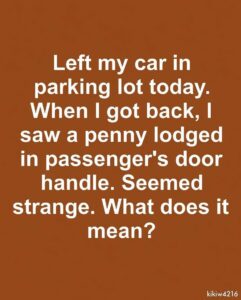
A single penny lodged in a car door handle can feel strangely unsettling. What should be a meaningless detail suddenly becomes a focal point for suspicion, curiosity, and even mild paranoia. Many people encountering it for the first time instinctively pause, scanning their surroundings, wondering whether it signals something intentional or dangerous.
Is it a prank? A coincidence? A coded marker? Or simply debris from an ordinary day in a crowded parking lot?
The truth is far less dramatic—but the psychology behind why this tiny object feels significant is far more interesting than the object itself.
The Moment of Discovery: Why It Feels “Off”
Finding something unusual on your vehicle disrupts expectation. A parked car is supposed to be unchanged when you return. Any deviation—especially something placed with apparent intention—creates cognitive friction.
A penny in a door handle is particularly noticeable because:
- It is small but clearly artificial
- It appears “placed,” not naturally occurring
- It is associated with human action
- It sits in a highly visible functional space
This combination triggers the brain’s pattern-detection system, which is constantly scanning for meaning, intent, and potential threats.
In evolutionary terms, this system is useful. It helps humans notice real dangers. But in modern environments filled with randomness, it often overinterprets harmless anomalies.
The Most Likely Explanation: Pure Coincidence
Despite viral theories, the simplest explanation is usually the correct one.
Parking lots are chaotic environments where thousands of small interactions happen every hour:
- People drop loose change while walking
- Coins fall from pockets or bags
- Wind moves lightweight objects
- Children or passersby playfully toss items
- Vehicles vibrate, shifting debris around
Modern door handles—especially recessed or angled designs—contain small grooves where objects can accidentally lodge.
A penny is:
- Lightweight
- Flat
- Easily displaced
- Commonly found in pockets and vehicles
It does not require intent to end up in a handle. It only requires chance.
Multiply this by millions of vehicles and daily parking activity, and such occurrences become statistically inevitable.
The Viral Theory: “The Thief Marker” Myth
One of the most widespread interpretations online is that a penny in a door handle is a deliberate signal used by criminals.
The theory claims:
- A thief inserts a coin into the passenger handle
- The car fails to lock properly or is flagged as targeted
- The thief returns later to steal from the vehicle
This narrative spreads easily because it feels plausible in a world already anxious about car theft.
However, law enforcement explanations consistently debunk this mechanism.
Modern vehicles:
- Use electronic locking systems independent of handle obstructions
- Automatically confirm lock status via sensors
- Often re-lock if a door is not fully secured
- Are unaffected by small foreign objects in a single handle
There is also no verified pattern of thefts linked specifically to coins used in this way.
In real-world crime data, car theft typically involves:
- Unlocked doors
- Relay attacks on keyless systems
- Broken windows
- Opportunistic access
Not subtle symbolic markers like pennies.
The myth persists not because it is true, but because it is emotionally compelling.
Why the Brain Treats It as a Signal
Human cognition is wired to interpret ambiguity as meaningful rather than random. This tendency is known as apophenia—the perception of patterns in unrelated data.
When someone sees a penny in an unusual place, the brain automatically asks:
- “Who put this here?”
- “Why this specific object?”
- “Is this connected to me?”
This search for meaning is not irrational—it is protective. The brain prefers false alarms over missed threats.
But in modern environments, this system often misfires.
A penny becomes:
- A “marker”
- A “message”
- A “warning sign”
- A “coded signal”
Even when it is simply litter moved by chance.
The Role of Social Media Amplification
Online platforms significantly amplify rare or unusual incidents.
A typical pattern looks like this:
- Someone posts a photo of a penny in a car handle
- The post gains attention due to curiosity and fear
- Others share similar stories, real or imagined
- A narrative forms around “a new trick criminals use”
- The theory spreads faster than corrections
This creates a feedback loop where:
- Rare coincidences appear common
- Ordinary events are reframed as threats
- Emotional reactions outpace factual verification
Importantly, corrections rarely spread as widely as the original claim.
Psychological Impact: Why It Feels Personal
One of the most striking aspects of this phenomenon is how personal it feels.
People often report:
- Looking around more cautiously
- Rechecking car locks repeatedly
- Feeling watched or targeted
- Questioning recent activity in the area
This happens because the brain interprets unexplained objects near personal property as potential boundary violations.
A parked car is an extension of personal space. Anything “placed” on it feels intentional—even when it is not.
This activates:
- Heightened vigilance
- Threat assessment mode
- Memory scanning for recent suspicious events
Even though no actual threat exists.
Cultural Symbolism of Coins
Coins carry symbolic meaning across many cultures, which further intensifies reactions.
Common associations include:
- Luck or fortune (“lucky penny”)
- Messages from fate or loved ones
- Protection or blessing
- Financial change or transition
Because of these associations, a penny is not perceived as neutral. It already carries emotional weight before context is even considered.
So when it appears unexpectedly:
- Some interpret it positively
- Others interpret it as a warning
- Others see hidden intent
The object stays the same, but meaning changes completely based on belief.
Real Parking Lot Risks (What Actually Matters)
While pennies themselves are harmless, parking lots do have legitimate risks—but they are much more straightforward.
Common real issues include:
- Unlocked vehicles being entered opportunistically
- Visible valuables attracting break-ins
- Poor lighting increasing vulnerability
- Keyless entry relay theft in some areas
- Minor vandalism or scratching
None of these require symbolic markers or coins.
Most incidents occur because of opportunity, not planning complexity.
The simplest preventative measures are also the most effective:
- Lock doors immediately
- Keep valuables out of sight
- Park in well-lit areas
- Stay aware while approaching the vehicle
How to Respond Rationally
If you ever find a penny or similar object on your car, the most effective response is calm inspection, not escalation.
A practical approach:
- Observe the object without immediate assumptions
- Check surrounding context (wind, foot traffic, debris)
- Inspect for actual signs of tampering (scratches, broken seals, open doors)
- Remove the object if it seems harmless
- Proceed normally unless additional evidence appears
This approach balances awareness with rational interpretation.
When It Could Be Intentional (Rare Cases)
While extremely unlikely, intentional placement cannot be completely ruled out in every situation.
Possible but rare scenarios include:
- A prank by someone nearby
- Random curiosity behavior
- Non-criminal tampering without follow-up intent
However, even in these cases, the coin itself is not functional evidence of danger—it is only an object placed without consequence.
Intent matters less than impact. And in almost all cases, there is no impact at all.
Why the Myth Won’t Disappear
Stories like the “penny in the door handle” persist because they combine:
- Everyday objects
- Mild uncertainty
- Fear of theft
- Social media amplification
- Simple narrative structure
They are easy to remember and easy to retell.
More importantly, they provide a sense of control. If something unusual has a known meaning, even a scary one, it feels less random than uncertainty.
But reality is often simpler: most strange objects are just accidents of environment.
Final Perspective: Meaning vs. Randomness
The penny in the car door handle is not a coded message, a widespread criminal tactic, or a hidden warning system.
It is usually:
- A dropped coin
- A chance placement
- A momentary coincidence
What gives it power is not the object itself, but the interpretation applied to it.
Human beings are meaning-making creatures. We prefer stories over randomness, patterns over chaos, and intention over chance.
But in this case, the simplest explanation remains the correct one.
A penny is still just a penny—even when it shows up in an unexpected place.
And most of the time, the only real mystery is why something so small can feel so significant at all.