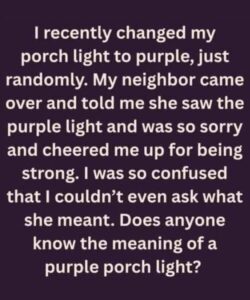
If you have ever walked through a neighborhood after sunset and noticed a home glowing softly with purple light, you may have paused for a moment without fully understanding why. The color immediately feels different from the standard warm white porch lights most homes use. It is noticeable without being harsh, unusual without seeming aggressive. Purple carries a calm, almost reflective quality that naturally draws attention in a subtle way. It invites curiosity rather than demanding it.
Over the past several years, purple porch lights have appeared more frequently across neighborhoods, apartment complexes, rural communities, and suburban streets. At first glance, some people assume the color is simply decorative or seasonal. During autumn, purple often appears alongside orange and black as part of Halloween decorations, making it easy to dismiss the light as part of a festive trend.
But for many households, the meaning goes much deeper.
Behind that quiet purple glow is often a message of awareness, empathy, support, and solidarity. In many cases, the light represents recognition of domestic violence survivors and serves as a silent statement against abuse that too often remains hidden behind closed doors. In other situations, it may symbolize support for mental health awareness, epilepsy awareness, Alzheimer’s advocacy, or other deeply personal causes connected to healing and resilience.
What makes purple porch lights especially powerful is not their brightness but their quietness.
They do not shout.
They do not force conversations.
Instead, they create space for reflection and awareness in a gentle and approachable way. A simple change in color transforms an ordinary porch light into a symbol carrying emotional and social meaning far beyond decoration.
One of the most widely recognized associations with purple porch lights is Domestic Violence Awareness Month, observed each October. During this time, many people intentionally replace their standard porch bulbs with purple ones to show solidarity with survivors of domestic abuse and to raise awareness about an issue that often remains invisible to the outside world.
Domestic violence differs from many public social issues because it frequently happens in private spaces hidden from public view. Victims may continue everyday routines while carrying fear, emotional pain, physical harm, or psychological trauma unknown even to close neighbors and friends. Shame, isolation, financial dependence, fear of retaliation, or emotional manipulation often prevent people from seeking help openly.
This silence makes awareness critically important.
Purple porch lights serve as visual reminders that abuse exists even when it cannot be seen directly. They communicate that communities recognize the issue and stand with survivors rather than ignoring or minimizing their experiences.
The symbolism may seem small, but small gestures can carry enormous emotional significance.
For survivors of domestic violence, seeing visible support in their environment can create feelings of recognition and validation. It reminds them that they are not completely alone and that other people acknowledge both the reality of abuse and the importance of compassion and safety.
Sometimes support matters precisely because it is quiet.
Not every survivor feels ready for public discussions or dramatic displays of attention. A purple light offers something gentler: a silent message saying, “People care. People understand. You are seen.”
These lights also create opportunities for conversation that might otherwise never happen.
A child may ask why a neighbor’s porch light is purple. A visitor may notice the unusual color and express curiosity. Friends, family members, or neighbors may begin discussing domestic violence awareness after noticing several purple lights throughout a neighborhood.
Those conversations matter because silence often protects harmful systems.
Many social problems persist partly because people feel uncomfortable discussing them openly. Domestic violence, mental health struggles, addiction, grief, trauma, and emotional abuse frequently remain hidden behind social politeness and private suffering. Visible symbols like purple lights help gently break that silence without forcing confrontation.
The color itself also carries important emotional and psychological symbolism.
Historically, purple has long been associated with depth, transformation, dignity, spirituality, and reflection. In ancient times, purple dye was rare and expensive, making it closely connected to royalty and status. Over centuries, the color gradually became linked not only to power but also to introspection, wisdom, and emotional complexity.
Psychologically, purple combines elements of blue and red.
Blue often represents calmness, stability, and peace, while red symbolizes energy, strength, emotion, and intensity. Purple therefore sits between these emotional qualities, balancing softness with resilience and reflection with strength.
This balance makes purple particularly meaningful for causes connected to healing and survival.
Domestic violence survivors often embody both vulnerability and incredible resilience simultaneously. Mental health advocacy similarly involves acknowledging pain while encouraging hope and recovery. Purple captures those emotional contradictions in a way few other colors can.
Although Domestic Violence Awareness Month remains the most recognized reason for purple porch lights, the symbolism has expanded into other areas as well.
Some communities use purple lighting to support epilepsy awareness campaigns. November, for example, often includes initiatives encouraging people to wear purple or illuminate homes and buildings to support individuals living with epilepsy and neurological conditions.
Purple also appears in Alzheimer’s and dementia awareness efforts. Families caring for loved ones with memory-related illnesses sometimes use purple lights as symbols of support, remembrance, and advocacy for research and treatment.
In certain contexts, purple may even represent military recognition, particularly related to Purple Heart recipients who were wounded or killed during military service.
Mental health awareness has also become increasingly connected to purple symbolism in some communities. Because mental health struggles are frequently invisible to outsiders, purple lights can symbolize compassion for those experiencing depression, anxiety, trauma, grief, or emotional isolation.
This versatility demonstrates how colors function as emotional language within society.
Humans naturally attach meaning to visual symbols because symbols communicate quickly and emotionally. Flags, ribbons, lights, flowers, clothing colors, and artwork all become tools through which communities express shared values, grief, support, remembrance, or solidarity.
Purple porch lights belong to this larger tradition of symbolic communication.
What makes them especially impactful is their placement at the edge of private homes.
Porches occupy a unique social space between public and private life. They represent the boundary where households meet the outside world. A porch light therefore becomes more than illumination; it becomes a visible expression of what a home values and chooses to communicate outwardly.
A purple porch light says something without words.
It suggests awareness.
It suggests empathy.
It suggests that the people inside the home recognize struggles many others overlook.
For some families, the meaning becomes deeply personal.
Homes affected directly by domestic violence, addiction, mental illness, grief, or trauma may keep purple lights year-round as reminders of survival, healing, or remembrance. In these cases, the light is not merely symbolic activism but part of the family’s lived emotional reality.
A parent may install the light to honor a child lost to addiction or suicide.
A survivor may use it to mark personal healing after escaping abuse.
A family may choose purple to support a loved one battling epilepsy or dementia.
In these situations, the light transforms into something intimate and deeply human.
At the same time, many people use purple porch lights simply because they believe communities should visibly support kindness, safety, and compassion even when no direct personal experience exists. Public solidarity matters because social change often begins with visible cultural shifts.
When entire neighborhoods glow purple during awareness campaigns, the effect becomes collective rather than individual.
One house may seem easy to overlook.
Ten houses create a pattern.
Entire streets filled with purple light communicate something larger: a shared willingness to acknowledge difficult realities instead of pretending they do not exist.
This collective visibility carries emotional power.
It reassures survivors that support exists beyond isolated individuals. It normalizes conversations around issues traditionally hidden by shame or silence. It encourages communities to think about care, protection, and emotional wellbeing not as private burdens but as shared social responsibilities.
Importantly, symbols alone are not enough.
A purple porch light cannot replace shelters, counseling, legal protections, mental health treatment, emergency services, or real social support systems. Awareness must eventually connect to action if meaningful change is going to happen.
However, awareness still matters deeply because social action often begins with visibility.
People are more likely to support causes they recognize emotionally and culturally. Public symbols help transform invisible struggles into acknowledged realities deserving empathy and attention.
The popularity of purple porch lights also reflects a broader cultural shift toward quieter forms of advocacy.
Not everyone participates in activism through protests, speeches, or public campaigns. Many people express values through small daily choices: displaying flags, planting memorial gardens, supporting local causes, donating privately, volunteering quietly, or changing a light bulb outside their home.
These gestures may seem modest individually, but collectively they shape social atmosphere and cultural awareness over time.
There is something profoundly human about wanting to communicate support even in simple ways.
Sometimes people feel powerless against large social problems like domestic violence or mental illness. Symbols offer one accessible way to participate in awareness and solidarity. They remind individuals that compassion does not always require grand gestures. Sometimes care begins with visibility, acknowledgment, and the willingness to say quietly, “This matters.”
The purple porch light captures that idea perfectly.
It glows softly rather than aggressively.
It invites curiosity rather than confrontation.
It creates opportunities for reflection without demanding attention.
And in doing so, it demonstrates that meaningful symbols do not need to be loud to be powerful.
The next time you notice a purple porch light glowing in the evening, you may see it differently. Instead of simply decorative lighting, you may recognize it as part of a larger emotional and social language — one rooted in empathy, awareness, healing, and the quiet hope that even small acts of visibility can help people feel less alone.