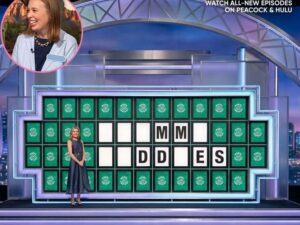
What should have been a routine high-stakes moment on Wheel of Fortune instead became one of the most divisive episodes of the season, after contestant Ally Metcalf narrowly missed a Bonus Round puzzle that revealed the phrase “Chummy Buddies.” The result not only cost her a major prize, but also triggered a wave of online debate questioning whether the puzzle was a fair test of skill or an unnecessarily obscure linguistic trap.
Metcalf, who had performed strongly throughout the main game rounds, entered the Bonus Round with confidence after accumulating $19,200 in winnings. The episode itself featured competitive gameplay and a familiar structure, with returning champion Jim Spallina building momentum earlier in the broadcast. By the time Metcalf reached the final puzzle, she appeared calm and focused, selecting the “People” category—typically considered one of the more approachable classifications in Bonus Round play.
But the puzzle that appeared on the board quickly disrupted expectations.
With most letters hidden, the structure “_ _ MM _ _DD_ES” offered limited immediate clarity. Even experienced viewers struggled to identify the phrase in real time. While Metcalf correctly inferred the second word as “buddies,” the first portion remained elusive under pressure. As the clock ticked down, she was unable to complete the solution.
The answer—“Chummy Buddies”—instantly became the center of controversy.
For some viewers, the phrase felt valid but unusually constructed. For others, it seemed unnatural enough that even skilled contestants would be unlikely to arrive at it within seconds. The split reaction quickly escalated across social media platforms, where fans debated not only the difficulty of the puzzle but also broader questions about how the game defines fairness in its most high-pressure segment.
Critics argued that “chummy” is not commonly used in everyday speech, especially in combination with “buddies,” making the phrase feel artificially assembled rather than organically linguistic. One widely shared post claimed, “Nobody says ‘chummy buddies’—it sounds like something designed to trick you, not test you.”
Defenders of the puzzle countered that Bonus Round challenges are intentionally designed to push contestants beyond common phrases, requiring rapid pattern recognition rather than familiarity alone. In this view, difficulty is not a flaw but the defining feature of the format.
The disagreement highlighted a long-standing tension in Wheel of Fortune design philosophy: whether puzzles should reflect natural language patterns or incorporate less common phrasing to preserve unpredictability and competitive balance.
Adding to the discussion was host Ryan Seacrest, who acknowledged during the reveal that the puzzle was “not an easy one.” While his comment was brief and professionally delivered, viewers interpreted it in different ways—some as subtle validation of the puzzle’s difficulty, others as standard commentary typical of Bonus Round reveals.
The emotional weight of the moment was amplified by what was at stake: a car prize tied to the Bonus Round. Although Metcalf still left with her accumulated winnings, the visible disappointment of narrowly missing a high-value reward resonated strongly with audiences, many of whom expressed sympathy online.
Clips of her reaction circulated widely, showing a mix of disbelief and frustration as the solution was revealed. For viewers at home, the moment felt less like a routine loss and more like an abrupt emotional shift after an otherwise strong performance.
As discussion intensified, social media platforms became a battleground of interpretations. Some users broke down the puzzle linguistically, arguing over whether “chummy” qualifies as sufficiently common vocabulary under timed conditions. Others emphasized that Bonus Round puzzles are designed to be solved instantly or not at all, leaving little room for gradual deduction.
Former contestants and game show analysts also weighed in, noting that Bonus Round difficulty has always relied on compressed time pressure and incomplete information. According to this perspective, success depends less on familiarity with phrases and more on the ability to recognize patterns immediately under stress.
Psychologists familiar with decision-making under pressure have long observed that time constraints significantly reduce working memory capacity, making even familiar words harder to process. In Metcalf’s case, the partially revealed structure likely compounded that effect, narrowing cognitive flexibility in the final seconds.
The controversy also revived a broader debate about modern game show design. Some fans argue that contemporary puzzles increasingly rely on obscure or awkward phrasing, while others believe nostalgia influences perceptions of past difficulty levels, making earlier episodes seem more intuitive than they actually were.
Within this broader conversation, “Chummy Buddies” quickly became a symbolic reference point—less about a single puzzle and more about the subjective line between challenge and fairness.
Even unrelated moments surrounding the show added to its cultural visibility. Reports of co-host Vanna White attending the Coachella Valley Music and Arts Festival during a production break circulated online, creating a contrast between lighthearted celebrity coverage and the intense analytical scrutiny surrounding the episode itself.
Despite the debate, one point of consensus emerged: Metcalf’s overall performance throughout the episode was strong, and her loss in the Bonus Round did not reflect a lack of skill. Instead, many viewers framed the outcome as an example of how fine the margins are in high-stakes game show formats.
Still, disagreement remains over whether the puzzle itself crossed an invisible threshold of difficulty. For some, it represents standard Bonus Round unpredictability. For others, it reflects a growing disconnect between natural language expectations and constructed puzzle design.
In the end, the episode has become more than a single moment of gameplay. It has evolved into a broader cultural discussion about how entertainment balances skill, chance, and audience perception.
And as future contestants step into the Bonus Round, one phrase from this episode continues to echo across fan discussions:
Was it fair game design—or an unnecessarily difficult twist hidden in plain sight?