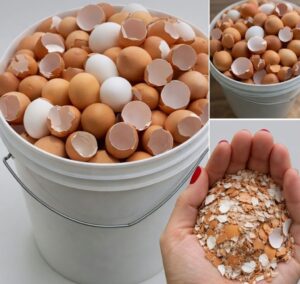
Most people crack them open, use the contents, and discard the shells without a second thought. They go straight into the trash as if they have no further purpose. Yet beneath their fragile appearance lies a surprisingly versatile natural material rich in calcium carbonate and trace minerals that can be reused in practical, creative, and environmentally friendly ways.
When properly cleaned, prepared, and stored, eggshells can become a sustainable alternative to multiple household products—supporting gardening, cleaning, personal care, crafts, and even pest management.
What makes them especially valuable is not just their composition, but their accessibility. They are already being produced daily in most homes. Instead of buying additional products, you are essentially repurposing something you already have.
The process begins with preparation.
Before reuse, eggshells should be thoroughly cleaned. A brief boiling step helps remove residue and reduce odors, making them safer for storage and use. After boiling, they should be dried completely. Once dry, they can be crushed by hand or ground into a fine powder depending on the intended purpose.
This simple transformation turns kitchen waste into a reusable household resource.
Here are six practical and surprisingly effective ways eggshells can be reused.
1. Natural Soil Booster for Healthier Plants
One of the most popular uses for eggshells is in gardening.
Crushed eggshells can be added directly to soil or compost, where they slowly release calcium over time. Calcium plays an essential role in plant structure, helping strengthen cell walls and supporting steady growth.
Plants such as tomatoes, peppers, and eggplants often benefit significantly from added calcium, especially in soils where deficiencies may exist.
Over time, eggshells break down naturally, improving soil quality without synthetic additives. This makes them a simple, low-cost way to support healthier, more resilient plants.
Even small amounts added consistently can contribute to long-term soil improvement.
2. Gentle, Chemical-Free Pest Deterrent
Eggshells can also help with garden pest control.
When crushed into larger, jagged pieces and scattered around plants, they create a rough surface that deters soft-bodied pests such as slugs and snails. These creatures tend to avoid crossing sharp or uncomfortable textures, making eggshells a natural barrier.
This method does not rely on chemicals or commercial repellents, making it safer for organic gardens, pets, and beneficial insects.
Some gardeners also create liquid infusions by soaking crushed eggshells in water. This calcium-rich water can then be used to hydrate plants, adding another layer of natural support.
3. Natural Cleaning and Light Abrasive Power
When finely ground, eggshells become a gentle abrasive material suitable for cleaning tasks.
Mixed with soap or natural cleaning ingredients like lemon juice or vinegar, eggshell powder can help remove stubborn residue from cookware, sinks, and durable surfaces. The fine particles provide scrubbing action without the harshness of synthetic abrasives.
This makes it a useful alternative for people looking to reduce chemical cleaners in the home.
It is especially helpful for removing grease buildup or light stains where extra scrubbing power is needed.
4. Odor Control and Drain Maintenance Support
Crushed eggshells may also assist in reducing minor household odors.
When flushed carefully with hot water down drains, they can help loosen soft buildup and reduce unpleasant smells over time. While not a replacement for deep cleaning, they can serve as a natural maintenance aid.
Some households also use dried eggshell powder in combination with other natural cleaning ingredients as part of broader eco-friendly cleaning routines.
Their usefulness lies in their simplicity rather than industrial strength.
5. Natural Beauty and Skin Care Applications
Finely processed eggshell powder can be used in homemade exfoliating treatments.
When ground into an extremely fine texture and mixed with natural ingredients like honey, yogurt, or oils, it can gently help remove dead skin cells and leave skin feeling smoother.
However, caution is essential.
Eggshell powder must be extremely fine to avoid irritation, and it should never be used on sensitive, damaged, or inflamed skin. Hygiene is also critical, as improper preparation can introduce unwanted bacteria.
For those who prefer natural skincare routines, it offers a low-cost, customizable alternative to store-bought exfoliants.
6. Creative Crafts and Decorative Uses
Beyond practical applications, eggshells also have artistic value.
Whole shells, especially when carefully cleaned, can be painted, dyed, or decorated for craft projects. They can be used in handmade ornaments, seasonal decorations, or unique art pieces.
Crushed eggshells add texture when incorporated into mixed-media artwork, candle designs, or decorative frames. Their natural cracked patterns create visual interest that is difficult to replicate with manufactured materials.
For families, they also provide simple and engaging craft activities for children, turning waste into creativity.
Small shells can even be used as miniature plant pots or decorative holders for tiny arrangements.
Bonus Uses Around the Home
Eggshells have additional practical applications that extend beyond the six main categories.
Some gardeners use them in compost systems to enrich organic waste.
Others return cleaned shells to chickens as a calcium source, supporting healthier egg production.
In certain cases, finely crushed shells may even provide light traction on icy surfaces during winter conditions, though they are not a replacement for proper de-icing materials.
These secondary uses reinforce the same principle: eggshells are far more versatile than they appear.
Storage and Long-Term Use
To make the most of eggshell reuse, proper storage is important.
Once cleaned, boiled, and fully dried, eggshells should be stored in an airtight container to prevent moisture buildup and odors. Over time, collecting shells from daily cooking can create a steady supply for ongoing household use.
This turns a passive waste product into an active household resource.
The habit itself becomes part of a more sustainable lifestyle.
Why Eggshell Reuse Matters
What makes eggshell reuse so compelling is not just its practicality, but its mindset shift.
It challenges the assumption that value ends once a product has served its primary purpose.
Instead of discarding something immediately, it encourages reevaluation:
What else could this become?
This simple question leads to reduced waste, lower spending, and more creative problem-solving in everyday life.
It also fosters a stronger connection to natural materials and household awareness.
In a world dominated by disposable products and constant consumption, small habits like this quietly restore balance.
Final Reflection
Eggshells may appear insignificant at first glance, but they represent something larger than kitchen waste.
They demonstrate how everyday materials can be repurposed with creativity and intention.
They reduce dependence on commercial products.
They support sustainable living.
And they remind us that usefulness does not always end where we expect it to.
Sometimes, the most valuable resources are not the ones we buy.
They are the ones we overlook.
And in the case of eggshells, what once went straight into the trash can quietly become a tool for gardening, cleaning, crafting, and everyday life improvement—all from something we were already throwing away.