The Viral Cow Math Puzzle That Left Thousands Confused About Profit, Logic, and Transaction Thinking
At first glance, the viral cow math puzzle appears to be one of those simple arithmetic riddles that should take seconds to solve. It involves only a single asset—a cow—and a sequence of buying and selling actions. Yet despite its simplicity, it has sparked widespread disagreement across social media, comment sections, classrooms, and group chats. The confusion does not come from the numbers themselves, but from how people interpret the flow of transactions over time.
Many people instinctively arrive at different answers: some say $0 profit, others say $200, and many confidently insist on $400. The disagreement is so common that it has become a classic example used to demonstrate how easily human intuition can misinterpret financial logic when multiple steps are involved.
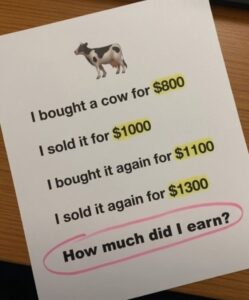
The puzzle reads as follows:
You buy a cow for $800.
You sell it for $1,000.
You buy it back for $1,100.
You sell it again for $1,300.
The question is simple: What is your total profit?
The correct answer is $400, but understanding why requires breaking the problem down carefully and separating emotional intuition from structured financial reasoning.
Why the Puzzle Feels Confusing at First
The main reason people struggle with this puzzle is that they treat the cow as a single continuous object instead of a series of independent financial transactions. The human brain naturally tries to track ownership as a single storyline:
“I had a cow… then I sold it… then I got it back…”
This storytelling approach is intuitive, but it is not financially accurate. Accounting does not track emotional continuity. It tracks completed transactions.
The confusion usually comes from one key mistake: people assume the second purchase somehow cancels the first profit. That assumption feels reasonable in a narrative sense, but it is incorrect in financial terms.
Each buy-and-sell cycle is its own closed loop. Once a cycle ends, its profit is locked in and cannot be undone by future transactions.
Breaking Down the First Transaction
Let’s analyze the first cycle step by step:
- You buy the cow for $800
- You sell it for $1,000
Now calculate profit:
$1,000 − $800 = $200 profit
At this point, the first transaction is complete. The money is realized. The cow is no longer part of this cycle. The profit exists independently of anything that happens later.
This is where many people mentally pause incorrectly. They feel like the story is still ongoing, but financially, it has already ended.
Breaking Down the Second Transaction
Now we begin a completely separate cycle:
- You buy the cow again for $1,100
- You sell it again for $1,300
Now calculate profit again:
$1,300 − $1,100 = $200 profit
Just like the first cycle, this is a self-contained transaction. It has its own cost, its own revenue, and its own outcome.
Adding the Two Independent Profits
Once both cycles are separated correctly, the final step is simple:
- First transaction profit: $200
- Second transaction profit: $200
Total profit:
$200 + $200 = $400
This is the correct and final answer.
The key insight is that profit is additive across completed transactions. Each cycle contributes independently to the total result.
The Cash Flow Method (The Cleanest Way to Understand It)
Another way to solve the puzzle is to ignore the cow entirely and focus only on money movement.
Step 1: Track money spent
- $800 (first purchase)
- $1,100 (second purchase)
Total spent:
$1,900
Step 2: Track money received
- $1,000 (first sale)
- $1,300 (second sale)
Total received:
$2,300
Step 3: Subtract
$2,300 − $1,900 = $400 profit
This method removes all emotional interpretation and focuses purely on financial flow. It is the same method used in real-world bookkeeping and business accounting.
Why People Commonly Get the Wrong Answer
There are three main reasons for incorrect answers:
1. Treating ownership as continuous
People think:
“I bought a cow, made money, then bought it again… so everything should balance out.”
But accounting does not work on ownership continuity—it works on transaction closure.
2. Thinking the second purchase cancels the first profit
This is the most common mistake. People assume:
- First profit = +$200
- Second purchase = -$1,100 (so it “erases” gains)
But the second purchase is not a correction. It is the start of a new trade.
3. Mixing capital with profit
Some people confuse money flow with profit flow. Spending money again does not erase earlier gains unless explicitly recorded as a loss on the same closed transaction.
The Accounting Principle Behind the Puzzle
The puzzle is secretly testing one of the most important fundamentals in finance:
Each transaction must be evaluated independently unless explicitly linked as part of the same financial cycle.
In accounting terms, this is known as separating realized gains from ongoing operations.
Once a transaction is completed (buy → sell), its profit becomes “realized.” It no longer changes based on future activity.
A More Intuitive Way to Think About It
Imagine you run two separate mini-business deals:
Deal 1:
- Buy cow for $800
- Sell for $1,000
- Profit: $200
Deal 2:
- Buy cow for $1,100
- Sell for $1,300
- Profit: $200
Now imagine these are two different days, or even two different traders. Nobody would combine them into a single confusing narrative.
The total remains:
$400 profit
What Would Make the Answer Zero? (Common Misconception)
Some people argue the answer is $0 because:
- You “bought twice”
- You “sold twice”
- Therefore everything cancels out
But this is incorrect because buying and selling are not symmetrical in that way. Profit depends on price differences per cycle, not the number of actions.
You would only get $0 if:
- You sold at the same price you bought both times
Example:
- Buy $800 → Sell $800 = $0
- Buy $1,100 → Sell $1,100 = $0
But that is not the case here.
Real-World Applications of This Logic
This puzzle is not just a mental game. It reflects real business principles used in:
- Stock trading
- Retail inventory turnover
- Crypto trading
- Commodity markets
- Small business operations
Traders constantly execute multiple buy/sell cycles, and each one is tracked independently. Profits are not merged into a single emotional story—they are recorded per transaction.
Understanding this distinction is essential for financial literacy.
Why the Puzzle Went Viral
The cow math puzzle became popular online because it exposes a gap between:
- Human intuition (story-based thinking)
- Financial logic (transaction-based thinking)
It feels like a trick question, but it is actually a logic alignment test. It reveals how easily people merge separate events into a single narrative without realizing it.
That is why even smart and experienced individuals sometimes disagree—they are applying different mental models to the same problem.
A Simple Rule to Remember
If you ever see a similar problem in the future, remember this rule:
Profit is calculated per completed transaction, not across mixed sequences of buying and selling.
Once a cycle ends, its result is final.
Final Explanation in One Sentence
You made $200 profit in the first trade and $200 profit in the second trade, giving a total of $400 profit overall.
Conclusion
The viral cow math puzzle is not really about cows or arithmetic—it is about how the human brain interprets sequences of financial events. It shows how easily we can confuse narrative flow with accounting structure.
Once the transactions are separated properly, the confusion disappears completely. What initially feels like a tricky or deceptive puzzle becomes a straightforward demonstration of basic financial logic.