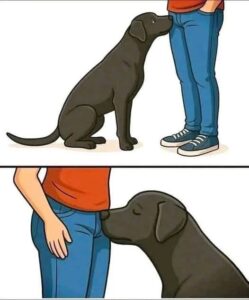
Dogs experience the world through scent in much the same way humans rely on sight, speech, and facial expression. Their sense of smell is so advanced that it is difficult for most people to truly imagine what daily life feels like from a dog’s perspective. While humans primarily gather information visually, dogs interpret the world through invisible scent signals constantly surrounding them.
Every smell carries meaning.
Every person leaves behind chemical information.
Every environment tells a story.
To dogs, scent is not just one sense among many—it is the center of how they understand life itself.
That is why certain canine behaviors that seem awkward or embarrassing to humans are actually completely natural forms of communication in the animal world. One of the most misunderstood examples occurs when dogs approach people and sniff areas like the groin or underarms. While this behavior can create discomfort in social situations, the explanation behind it is surprisingly scientific and deeply connected to how dogs gather information.
Humans have specialized sweat glands called apocrine glands located primarily in areas such as the groin and armpits. These glands release pheromones and other chemical compounds that contain biological information. Although humans are not consciously aware of these scent signals most of the time, dogs can detect them instantly.
And not just detect them—interpret them.
A dog’s nose contains hundreds of millions of scent receptors, far more than the human nose. The portion of a dog’s brain dedicated to analyzing smell is also dramatically more powerful than our own. This allows dogs to recognize subtle chemical changes that humans would never notice.
Through scent alone, dogs may gather information about a person’s:
- Emotional state
- Stress levels
- Hormonal changes
- Age
- Biological sex
- Health condition
- Familiarity
- Mood shifts
- Fear or anxiety
To a dog, approaching and sniffing someone closely is not rude behavior. It is a form of greeting and identification. In canine social behavior, scent functions almost like conversation. Dogs naturally investigate one another this way because scent gives them immediate insight into identity and emotional condition.
What humans experience as awkward, dogs experience as informative.
In many ways, it is similar to how humans shake hands, exchange names, or make eye contact when meeting someone new. Dogs simply communicate differently because their strongest sense is smell rather than language.
This difference between human social expectations and canine instinct is what often creates misunderstanding.
People may assume the behavior is inappropriate or intentionally invasive, but dogs have no social understanding of embarrassment in the human sense. Their actions are guided by curiosity, instinct, and sensory information rather than social etiquette.
That said, feeling uncomfortable with the behavior is completely understandable.
Not everyone enjoys being greeted this way, especially in public settings or around unfamiliar dogs. Fortunately, dogs are highly trainable and respond well to gentle boundaries. Teaching alternative greeting behaviors is possible through calm consistency and positive reinforcement.
Commands such as “sit,” “stay,” or “down” can redirect attention while rewarding calmer interactions. Over time, dogs learn which behaviors receive praise and which ones are discouraged.
Importantly, this training should not be based on punishment or anger.
Dogs are not trying to offend people.
They are simply following instinct.
Responding harshly may confuse them because, from their perspective, they are engaging in normal social behavior. Gentle correction works far more effectively because it preserves trust while teaching boundaries.
Interestingly, the same extraordinary sense of smell responsible for these awkward encounters is also what makes dogs such emotionally intelligent companions.
A dog’s nose allows it to detect far more than identity alone.
Dogs can often sense emotional changes in humans before people consciously recognize those changes themselves. They may detect shifts in breathing patterns, sweat chemistry, heart rate, cortisol levels, or subtle physical reactions associated with stress, sadness, fear, or illness.
This ability explains many behaviors dog owners notice during emotionally difficult moments.
Dogs often stay physically close when someone feels upset.
They may rest beside a person silently during periods of sadness.
They sometimes become unusually attentive during illness or emotional stress.
Many people describe their dogs as “just knowing” when something is wrong.
Scientifically, there is truth behind that feeling.
Dogs are constantly reading chemical and behavioral signals humans unknowingly produce. Their emotional responsiveness is partly rooted in this incredible sensory awareness.
This is one reason dogs have become invaluable in fields involving emotional and medical support. Certain dogs are trained to detect seizures, diabetic emergencies, anxiety attacks, and even some forms of illness through scent detection alone.
Their noses are powerful enough to notice tiny chemical changes long before humans recognize symptoms themselves.
What appears to humans as emotional intuition is often a remarkable combination of scent analysis, observation, and deep social bonding.
That bond between dogs and humans has evolved over thousands of years.
Over time, dogs became uniquely skilled at understanding human behavior, emotion, and communication. Unlike many animals, dogs naturally seek connection with people. They observe facial expressions, body language, tone of voice, movement, and scent all at once to interpret emotional situations.
This is why dogs often seem deeply emotionally connected to their owners.
Their relationship with humans is not superficial.
It is sensory, emotional, and instinctive.
And scent plays a central role in that connection.
To dogs, smell is closely tied to memory and familiarity. A person’s scent becomes associated with comfort, safety, routine, and emotional attachment. That is why dogs often sleep on clothing, wait near familiar scents, or become calmer when exposed to an owner’s smell during separation.
Scent reassures them.
It tells them who belongs in their world.
Even puppies rely heavily on scent immediately after birth. Before vision fully develops, smell helps them identify their mother, locate warmth, and recognize safety. Throughout life, dogs continue relying on scent as one of their primary forms of emotional orientation.
Humans, by contrast, often underestimate the emotional importance of smell because vision dominates our own perception of reality.
Yet for dogs, scent is identity itself.
It carries information, memory, emotion, and connection simultaneously.
Understanding this can completely change the way people interpret canine behavior. What initially appears strange or awkward often reflects something far more meaningful beneath the surface.
Curiosity.
Recognition.
Trust.
Connection.
When dogs investigate scent, they are not judging appearance or social status. They are gathering authentic information about who someone is in that exact moment.
There is something surprisingly sincere about that process.
Dogs respond to chemical truth rather than social performance.
They recognize nervousness, calmness, fear, excitement, sadness, and familiarity through scent in ways humans cannot consciously hide.
Perhaps that is one reason people often feel emotionally safe around dogs. Animals respond honestly and instinctively rather than through social masks or expectations.
At the same time, healthy relationships with dogs still require communication and boundaries. Understanding why a behavior occurs does not mean every behavior must always be encouraged. Responsible pet ownership involves balancing instinct with training so dogs can interact safely and comfortably in human environments.
Fortunately, dogs adapt remarkably well when guided patiently.
Training works best when built around understanding rather than punishment. Recognizing that behaviors are rooted in natural instinct allows owners to respond calmly instead of reacting with frustration.
That approach strengthens trust between humans and animals rather than weakening it.
Ultimately, moments like these remind people just how different the canine experience of the world truly is.
Humans walk through life visually.
Dogs move through life chemically.
Where humans notice appearance first, dogs notice scent.
Where humans focus on words, dogs focus on emotional signals carried invisibly through breath, sweat, movement, and chemistry.
And in many ways, that difference is exactly what makes dogs such extraordinary companions.
Their sensitivity allows them to connect with humans on a level that often feels deeply intuitive and emotionally supportive. The same nose responsible for awkward greetings is also the reason dogs stay beside people during heartbreak, illness, loneliness, and fear.
It is the same instinct that draws them close when comfort is needed most.
So while the behavior may occasionally feel embarrassing or inconvenient, its meaning is rooted in something surprisingly powerful.
Recognition.
Familiarity.
Connection.
In a dog’s world, scent is truth.
It carries identity, emotion, memory, and belonging all at once.
And when a dog leans in close, even in ways humans sometimes misunderstand, it may simply be expressing something deeply sincere:
“I know you.”
“I recognize you.”
“And I feel connected to you.”