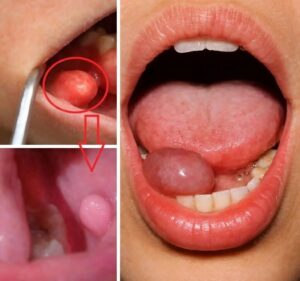
Discovering a Sudden Translucent, Bluish, or Fluid-Filled Bump Inside Your Mouth
Finding a smooth, shiny, or fluid-filled bump inside your lower lip or mouth can be unsettling. It often appears suddenly, may look translucent, bluish, pinkish, or slightly purple, and naturally triggers concern. Many people immediately worry about serious conditions. However, in most cases, this type of lesion is a common and harmless condition known as an oral mucocele, also referred to as a mucous cyst.
Despite its alarming appearance, a mucocele is typically benign and results from a simple mechanical or functional issue within the small salivary glands of the mouth.
What an Oral Mucocele Actually Is
An oral mucocele forms when a small salivary gland duct becomes blocked or damaged. Saliva, instead of flowing normally into the mouth, leaks into surrounding soft tissue and becomes trapped.
This creates a small, dome-shaped swelling filled with fluid, often resembling a blister.
Although it may look unusual, it is essentially the body’s response to minor injury or obstruction.
Why It Often Appears Suddenly
One of the most confusing aspects of a mucocele is how quickly it seems to appear. In reality, it often develops gradually after a small, unnoticed injury such as:
- Accidentally biting the lip or cheek
- Repeated friction from teeth
- Irritation from braces or dental appliances
- Habitual lip or cheek chewing
- Minor trauma during eating or speaking
The lower lip is the most common location simply because it is more exposed to repeated minor injury.
Appearance and Common Characteristics
Mucoceles can vary in size and color, but they usually share some common features:
- Smooth, round, and soft texture
- Fluid-filled or bubble-like appearance
- Translucent, bluish, or pink coloration
- Slight mobility when touched by the tongue
- Usually painless or only mildly irritating
Some remain very small, while others can grow large enough to interfere with speaking, chewing, or comfort.
Because they are often painless, many people only discover them by chance.
Are Mucoceles Dangerous?
In almost all cases, no.
Mucoceles are:
- Not contagious
- Not caused by poor oral hygiene
- Not cancerous
- Not typically dangerous
However, any oral lesion that persists, grows, bleeds, becomes painful, or repeatedly returns should always be evaluated by a dentist or healthcare professional. This is important because several oral conditions can appear similar at first glance.
How They Are Diagnosed
Diagnosis is usually straightforward. A dentist or oral specialist can typically identify a mucocele based on:
- Appearance
- Location
- Texture
- Patient history (such as lip biting or trauma)
In most typical cases, no advanced testing is required. If the lesion is unusual or persistent, further examination or biopsy may be recommended to confirm the diagnosis.
Treatment Options and What to Expect
Many mucoceles resolve naturally without treatment, especially if the source of irritation is removed.
Mild or Small Mucoceles
These may:
- Shrink on their own
- Rupture naturally
- Reappear temporarily before healing
Helpful Home Care
While not a cure, supportive care includes:
- Avoiding biting or irritating the area
- Avoiding spicy or sharp foods
- Practicing good oral hygiene
- Using warm saltwater rinses
Importantly, the bump should not be squeezed or popped, as this can worsen irritation or lead to recurrence.
When Medical Treatment Is Needed
If a mucocele persists, grows, or repeatedly returns, a dental professional may recommend removal.
Common treatment options include:
- Surgical excision
- Laser removal
- Cryotherapy (in selected cases)
In many cases, the associated minor salivary gland may also be removed to prevent recurrence.
These procedures are typically quick, done under local anesthesia, and have a short recovery time.
Preventing Future Mucoceles
Prevention mainly focuses on reducing repeated trauma inside the mouth.
Helpful strategies include:
- Avoiding habitual lip or cheek biting
- Addressing sharp teeth or dental irregularities
- Adjusting braces or dental appliances if needed
- Managing stress-related oral habits
- Maintaining consistent oral hygiene
Identifying the trigger is often the most important step in preventing recurrence.
Why It Feels More Serious Than It Is
One of the most important psychological aspects of mucoceles is perception.
Because they:
- Appear suddenly
- Look fluid-filled
- Change size
- Sit in a highly sensitive area
They often feel more alarming than they actually are.
The brain tends to interpret unfamiliar changes in the body as threats, especially in visible or sensitive areas like the mouth.
In reality, most mucoceles are minor and temporary.
Final Thoughts
A sudden translucent or bluish bump inside the mouth can be surprising, but in most cases, it is a harmless oral mucocele caused by minor trauma or a blocked salivary duct.
While they may look dramatic, they are typically benign, manageable, and often self-resolving.
The key is balance:
- Don’t panic
- Don’t ignore persistent changes
With simple care and professional evaluation when needed, mucoceles usually resolve without complications.
What begins as a worrying discovery often turns out to be one of the most common and least serious oral conditions.