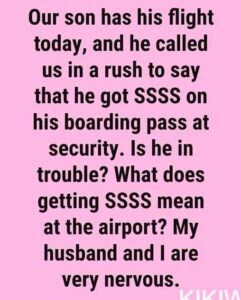
Daniel had been planning his vacation for months.
After weeks of anticipation, he finally arrived at the airport early on the morning of his departure. Everything seemed to be going perfectly. He checked his luggage, confirmed his gate information, grabbed a coffee, and settled into a seat near the departure area.
While casually reviewing his boarding pass, however, he noticed something unusual.
Printed near the bottom of the ticket was a code he had never seen before:
SSSS
At first, he assumed it was some routine airline abbreviation. Boarding passes contain countless numbers, letters, and codes that most passengers never think about. Seat assignments, flight information, reservation details, and airport identifiers are all represented through various combinations of characters.
Still, something about these four letters caught his attention.
Curious, Daniel searched online and discovered that many travelers had encountered the same mysterious marking. What he found surprised him.
The letters were not related to his seat assignment.
They were not connected to his boarding group.
And they certainly were not random.
Instead, the code indicated something that would affect his airport experience before he even reached the plane.
What Does SSSS Mean?
The abbreviation SSSS stands for Secondary Security Screening Selection.
It is a security designation used on certain airline passengers’ boarding passes that indicates additional screening procedures will be conducted before boarding.
When airport security personnel see the code, they know the traveler has been selected for enhanced security measures.
The screening process may include additional identity verification, inspection of carry-on luggage, swabbing for explosive residue, questioning regarding travel plans, or more detailed examinations of personal belongings.
The procedures vary depending on the airport, destination, and security requirements in place at the time.
For most travelers, the process adds extra time rather than creating major complications.
However, receiving the designation can still be surprising, especially for passengers encountering it for the first time.
Daniel’s Experience
As Daniel approached the security checkpoint, he initially noticed nothing unusual.
His identification was checked normally.
His luggage moved through the scanner.
Everything appeared routine.
Then an airport employee scanned his boarding pass.
The employee briefly paused.
A message appeared on the screen.
Moments later, Daniel was politely directed to a separate screening area.
Although the staff remained professional and courteous, it quickly became clear that additional procedures would be required before he could proceed to his gate.
His carry-on bags underwent a more detailed inspection.
Several items were examined individually.
Security officers performed additional screening tests and asked standard verification questions.
The process took extra time but was completed without issue.
Only afterward did Daniel fully understand the significance of the four letters printed on his boarding pass.
Why Do Some Travelers Receive SSSS?
One of the most common questions surrounding the designation is simple:
Why are certain passengers selected while others are not?
The exact criteria used by security authorities are not publicly disclosed in full detail.
However, travel experts and government agencies have identified several factors that may contribute to additional screening selections.
These may include:
- International travel itineraries
- Last-minute ticket purchases
- One-way flight bookings
- Travel to or from certain destinations
- Unusual reservation patterns
- Random security selections
- Security-related database matches
- Travel histories that trigger additional review
Importantly, receiving an SSSS designation does not automatically mean a traveler is suspected of wrongdoing.
In many cases, passengers are selected as part of routine security procedures designed to maintain aviation safety.
Random selections are a recognized component of airport security programs.
Is SSSS Common?
While most passengers never encounter the designation, it is not especially rare.
Frequent international travelers often report receiving the code at least once during their travel experiences.
Some travelers encounter it repeatedly, while others may never see it at all.
Because many security measures operate behind the scenes, travelers are often unaware of the screening selection process until the code appears on a boarding pass.
The increasing use of automated reservation systems and security screening technologies means selections can occur quickly and without advance notice.
What Happens During Secondary Screening?
The specific procedures vary by airport and destination.
However, travelers selected for secondary screening may experience some or all of the following:
Additional Bag Inspection
Security personnel may manually inspect carry-on luggage rather than relying solely on X-ray screening.
Items inside the bag may be examined individually.
Explosive Trace Detection
Officers may use swabs on luggage, electronic devices, clothing, or personal items.
The swabs are analyzed for traces of prohibited materials.
Enhanced Identity Verification
Travelers may be asked to provide identification again or answer routine questions regarding their travel plans.
Additional Electronic Device Inspection
In some cases, laptops, tablets, cameras, or other electronics may receive closer examination.
Extra Time at the Gate
Certain passengers may undergo final screening procedures immediately before boarding begins.
Although the process can feel inconvenient, airport personnel typically aim to complete screenings efficiently while maintaining security requirements.
Can Travelers Avoid Receiving SSSS?
Because the selection process involves security protocols that are not fully public, there is no guaranteed method for avoiding the designation.
However, travel experts often recommend several practices that may reduce the likelihood of complications:
- Book flights using accurate personal information.
- Arrive at the airport early.
- Maintain consistent travel documentation.
- Ensure names match identification exactly.
- Use trusted traveler programs when eligible.
- Avoid last-minute booking changes when possible.
Even travelers who follow every recommendation may still receive secondary screening due to random selection procedures.
Common Misconceptions
Several myths surround the SSSS designation.
One common misconception is that the code automatically indicates a traveler is under suspicion.
Security experts emphasize that this is not necessarily true.
Many passengers are selected through automated or random processes.
Another misconception is that receiving the designation prevents someone from flying.
In reality, most travelers complete the additional screening successfully and continue their journeys without further issues.
Some people also assume the code appears only on international flights.
While it is most commonly discussed in relation to international travel, security procedures can vary based on numerous factors.
Why Aviation Security Uses Additional Screening
Air travel remains one of the most heavily secured forms of transportation in the world.
Airport security systems are designed to identify potential risks while allowing millions of passengers to travel safely every day.
Additional screening programs serve multiple purposes:
- Verifying passenger identities
- Detecting prohibited materials
- Supporting aviation safety measures
- Maintaining unpredictable security procedures
- Strengthening overall airport security
Security experts frequently note that unpredictability is itself an important element of effective screening systems.
Because selection criteria are not fully disclosed, the process becomes more difficult for bad actors to anticipate or exploit.
How Travelers Typically React
The first reaction to seeing SSSS on a boarding pass is often confusion.
Many travelers have never heard of the designation before encountering it themselves.
Others report feeling nervous when airport personnel direct them toward additional screening.
In most cases, however, the process ends up being far less dramatic than passengers initially expect.
Travelers who cooperate with instructions and allow extra time generally complete screening without major problems.
Experienced travelers often recommend remaining calm and viewing the process as a routine security measure rather than a personal issue.
The Importance of Arriving Early
One practical lesson from Daniel’s experience is the importance of arriving at the airport with sufficient time before departure.
Passengers selected for additional screening may spend extra minutes—or occasionally longer—completing required procedures.
Those who arrive at the last possible moment could risk unnecessary stress if secondary screening occurs.
Allowing extra time provides flexibility and helps ensure that unexpected delays do not interfere with travel plans.
The Final Answer Behind the Four Letters
After completing his screening and reaching the gate, Daniel finally understood why airport staff had reacted differently to his boarding pass.
The mysterious code was not an error.
It was not an airline promotion, boarding category, or computer glitch.
The four letters stood for Secondary Security Screening Selection, a designation indicating that additional security checks would be required before travel.
Although the experience added time to his journey, it ultimately served as a reminder of the extensive security systems operating behind the scenes at airports every day.
For travelers who discover “SSSS” printed on a future boarding pass, the message is usually straightforward:
Arrive early, follow instructions, remain patient, and expect some additional screening before boarding.
Most importantly, remember that the designation is often simply part of routine aviation security procedures—not necessarily a sign that anything is wrong.
The next time someone notices those four mysterious letters on a boarding pass, they will know exactly what they mean and why airport staff may be paying a little extra attention.