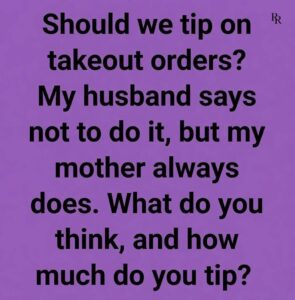
For many people, ordering takeout is meant to be the simplest way to enjoy restaurant food. You place an order online or by phone, stop by the restaurant, pick up your meal, and head home. Yet in recent years, one small moment has made the process surprisingly complicated: the payment screen asking whether you would like to leave a tip.
Whether you’re paying at a cash register or tapping through a touchscreen kiosk, it’s common to see suggested gratuities of 15%, 20%, or even 25%. For some customers, selecting a tip feels like the polite thing to do. Others wonder why they’re being asked to tip when they didn’t receive traditional table service. The result is uncertainty, hesitation, and sometimes even guilt.
The reality is that there is no universal rule for tipping on takeout orders. Customs vary by region, restaurant type, and personal preference. Understanding why these prompts appear—and what happens behind the scenes—can help you make a decision that feels informed rather than pressured.
Why Tipping Has Become More Common
Digital payment systems have changed the way many businesses handle gratuities. Instead of relying on a traditional tip jar, restaurants often use point-of-sale software that automatically presents tipping options during checkout. These systems are easy to program and are commonly used for dine-in, takeout, coffee shops, bakeries, and other food-service businesses.
Because the same payment software is often used for different types of orders, customers may encounter identical tip suggestions regardless of whether they sat down for a meal or simply picked up food.
How Takeout Orders Are Prepared
Although takeout doesn’t involve table service, preparing an order still requires work. Restaurant employees typically:
- Verify the order for accuracy.
- Package food to maintain quality.
- Include utensils, napkins, sauces, and condiments.
- Label containers.
- Check for missing items.
- Coordinate pickup timing.
- Answer customer questions.
Depending on the restaurant, the employee handing you the order may also be responsible for answering phones, processing payments, organizing online orders, and helping customers waiting at the counter.
Is a Tip Required?
In most places, tipping for takeout is generally considered optional rather than expected. Unlike full-service dining, where servers often spend significant time attending to a table throughout a meal, takeout involves fewer direct interactions.
Many etiquette experts suggest that customers should never feel obligated to leave a gratuity simply because a payment screen asks for one. The prompt is an option, not a requirement.
Situations Where You Might Consider Tipping
Some customers choose to leave a tip when:
- The order is unusually large.
- The staff accommodated special requests.
- Employees corrected an issue quickly.
- Packaging required extra attention.
- The restaurant consistently provides exceptional service.
- Pickup occurred during an especially busy period.
Even a modest tip can be appreciated in these situations.
When You May Decide Not to Tip
Many people choose not to tip when:
- They simply picked up a standard order.
- Service consisted only of completing the transaction.
- They are purchasing pre-packaged food.
- The restaurant already charges service or convenience fees.
- Budget considerations make additional spending difficult.
These decisions are also reasonable, and customers should not feel pressured into tipping beyond what they are comfortable giving.
How Much Is Appropriate?
There is no universally accepted percentage for takeout gratuities. Some people round up the bill, others leave a few dollars, while some tip a small percentage for larger orders.
The important point is that takeout tipping is typically more flexible than tipping for full-service dining.
Why Payment Screens Can Feel Uncomfortable
Behavioral researchers have found that people often make decisions differently when others are watching. A payment terminal that asks for a tip while an employee waits nearby can create social pressure, even if no one explicitly expects a gratuity.
Some customers worry about appearing rude. Others fear their decision will affect future service. In reality, many restaurant employees understand that customers have different views and budgets regarding tipping.
Does the Tip Go to the Employee Who Helped You?
Not always.
Every restaurant has its own policy. In some businesses, tips are shared among front-of-house staff. Others divide gratuities among the entire team, including kitchen employees. Some restaurants allow individual workers to keep the tips they personally receive.
If you’re curious, it’s perfectly acceptable to ask how tips are distributed.
The Difference Between Takeout and Delivery
Many people distinguish between takeout and delivery because delivery drivers spend additional time traveling, locating addresses, carrying food, and dealing with traffic or weather conditions.
As a result, delivery gratuities are often viewed differently from takeout tips, where the customer performs the transportation themselves.
Coffee Shops and Cafés
Coffee shops often present similar tipping prompts, even for simple orders. Customer opinions vary widely. Some regularly tip for handcrafted drinks, while others reserve gratuities for larger or more complex purchases.
Again, there is no universal standard.
Supporting Local Restaurants
Some customers intentionally tip more at independently owned restaurants because they want to support local businesses and staff. Others may do so during holidays or particularly busy seasons when restaurant employees are working under increased pressure.
These tips are generally viewed as gestures of appreciation rather than obligations.
Budget Matters Too
Tipping should never create financial hardship. If adding an extra amount would strain your budget, it’s reasonable to decline. Restaurants set menu prices to cover the cost of preparing food, and customers are entitled to make purchasing decisions that fit their finances.
Acts of kindness toward restaurant staff don’t always have to involve money. Being patient during busy periods, communicating politely, and expressing appreciation for good service also contribute to a positive experience.
How to Decide
If you’re unsure whether to tip, consider asking yourself a few simple questions:
- Did someone provide service beyond simply handing over the order?
- Was the order prepared with special attention?
- Did the staff resolve a problem quickly and professionally?
- Would you like to recognize particularly good service?
If the answer is yes, leaving a gratuity may feel appropriate. If not, it’s also acceptable to complete the transaction without one.
The Bottom Line
Takeout tipping has become more visible because modern payment systems make the option impossible to miss. However, the presence of a tip screen does not create a universal obligation. Every customer, restaurant, and situation is different.
The best approach is one that balances appreciation for good service with your own budget and comfort level. Rather than feeling rushed by preset percentages or social expectations, make a choice based on the experience you received and what you genuinely wish to give. Thoughtful decisions—not automatic ones—are at the heart of good etiquette, and that applies just as much to tipping as it does to every other aspect of dining.