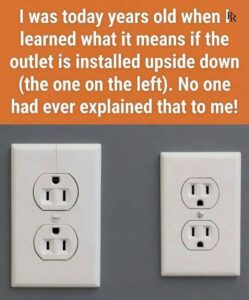
If you have ever noticed an electrical outlet with the round grounding hole positioned above the two vertical slots, you may have immediately assumed that something went wrong during installation.
Most people are accustomed to seeing receptacles installed in the opposite direction. The familiar arrangement has the two vertical openings toward the top and the grounding opening below them. So when the orientation is reversed, the first thought is often simple: someone installed it incorrectly.
But an upside-down outlet is not necessarily a mistake.
In many situations, the orientation is intentional. Electricians, builders, and homeowners may choose different orientations for practical reasons, and electrical codes do not universally require every standard receptacle to face one particular direction.
That means an unusual-looking outlet can sometimes tell you something about how a particular electrical circuit was designed.
One common explanation involves switched or split receptacles.
In older homes and many rooms without overhead lighting, it is common to use a wall switch to control a lamp. Instead of installing a separate switched outlet, an electrician can configure one portion of a duplex receptacle to be controlled by the wall switch while leaving the other portion permanently energized.
This creates two different functions within the same outlet.
For example, imagine a bedroom with a table lamp plugged into the lower portion of a receptacle. When you flip the wall switch, the lamp turns on or off. Meanwhile, an alarm clock or charger plugged into the other portion continues receiving power regardless of the switch position.
This arrangement can be convenient, especially in bedrooms, living rooms, and other spaces where a ceiling fixture may not be present.
Some electricians choose to orient such receptacles differently from standard ones so they can identify them quickly. Turning the receptacle upside down can serve as a visual clue that it may not be wired exactly like the surrounding outlets.
However, this is important: an upside-down receptacle does not automatically mean that it is a switched or split receptacle.
Orientation by itself is not a reliable electrical diagnostic tool.
Different electricians use different conventions. Some install all receptacles with the grounding opening facing upward. Others place them with the grounding opening facing downward. Some may use a particular orientation for certain applications and another orientation elsewhere.
In other words, there is no universal rule saying that an upside-down-looking receptacle must have a special circuit behind it.
This is one reason homeowners should avoid making assumptions based solely on appearance.
So why would anyone deliberately install a receptacle with the ground pin on top?
One reason relates to mechanical safety.
Consider what happens when a standard electrical plug is partially pulled out of an outlet. If the plug is hanging downward and something metallic were to fall against it, the physical orientation of the receptacle can affect how that object interacts with the exposed plug.
Some electricians prefer having the grounding pin positioned upward because they believe it can provide an additional safety advantage in certain circumstances. If a metal object were to fall onto a partially disconnected plug, the grounding pin may make contact before the energized conductors depending on the plug and circumstances.
This is one argument for the ground-up orientation.
It is not, however, a universal requirement, and the actual safety outcome depends on the equipment, plug design, installation, and circumstances involved.
Another factor is the type of plug being used.
Some electrical devices have cords that naturally extend upward, downward, or sideways depending on their design. The orientation of the receptacle can sometimes make the cord fit more conveniently behind furniture or equipment.
For commercial installations, workshops, garages, and specialized equipment, electricians may also choose orientations based on how cords, plugs, and equipment interact with the surrounding space.
The orientation can therefore be influenced by practical considerations rather than aesthetics.
There is also a common misconception that one particular orientation is required by the National Electrical Code for ordinary wall receptacles.
In reality, standard receptacle orientation is not universally dictated by a simple national rule that says the grounding hole must always face down. Local codes, adopted standards, manufacturer instructions, and specific installation requirements can affect what is permitted.
This is why two perfectly legitimate electrical installations can look different.
You might walk through one house and find every receptacle ground-down. In another home, every receptacle may be ground-up. In a third, you may find a mixture.
That does not necessarily mean one electrician knew what they were doing and the other did not.
It may simply reflect different conventions.
Builders and electricians can also have strong preferences about consistency.
Some professionals believe every receptacle in a room should have the same orientation because consistency makes the installation look cleaner. A uniform arrangement is easier for homeowners to understand and may make the electrical system appear more orderly.
Others argue that the orientation can communicate useful information.
For example, an electrician might use a different orientation to distinguish receptacles with special wiring arrangements, emergency power, isolated grounding, or other characteristics.
Again, orientation should be treated as a possible clue, not proof.
The wiring itself must be tested to determine what a receptacle actually does.
That distinction is particularly important for homeowners buying older properties.
Suppose you move into a house and notice that two outlets are upside down while all the others are installed normally. It might be tempting to assume that those two are connected to wall switches.
Perhaps they are.
But they could also have been installed that way simply because the electrician preferred ground-up receptacles.
The only reliable way to determine the circuit configuration is to test it or have a qualified professional inspect the installation.
There is another reason outlet orientation can matter: identifying potentially unusual electrical work.
If an outlet behaves differently from the others, homeowners should pay attention. A receptacle that loses power when a wall switch is turned off may be intentionally switched, but unexpected behavior can also indicate a wiring problem.
Warning signs deserve more attention than orientation itself.
These include outlets that are warm to the touch, buzzing sounds, visible scorch marks, loose receptacles, burning smells, sparks, repeated breaker trips, or plugs that do not fit securely.
Those symptoms can indicate electrical problems that should not be ignored.
An upside-down outlet without any other symptoms, however, is not automatically dangerous.
This is an important distinction because online discussions about electrical work often turn harmless differences in installation style into claims that a home is unsafe.
Electrical systems should be judged by their actual installation and condition, not simply by whether a receptacle looks familiar.
Another interesting aspect of outlet orientation is the history of electrical construction.
Older homes were sometimes designed around different lighting habits. Before modern recessed lighting and widespread ceiling fixtures became common, lamps plugged into wall receptacles were an important source of room lighting.
A wall switch controlling part of an outlet was therefore a practical design solution.
That legacy can still be found in many houses.
If you enter an older living room and discover that a wall switch appears to do nothing, there is a chance it controls one half of a receptacle somewhere in the room. Homeowners sometimes discover this only after plugging a lamp into the correct outlet.
This arrangement can seem mysterious if you have never encountered it before.
The receptacle may look completely ordinary, yet internally it can be configured differently.
A duplex receptacle normally contains two outlets that can potentially be electrically connected. In a split configuration, the connection between the two portions can be separated so they serve different functions.
That is why homeowners should never assume that both halves of a receptacle behave identically.
The same principle explains why an electrician working on an older home may need to inspect the receptacle carefully before replacing it.
A replacement outlet might look identical from the front, but the wiring configuration behind it can be different. A person unfamiliar with the circuit could accidentally change how the switch-controlled portion operates if the wiring is not identified correctly.
This is one reason electrical work should be approached cautiously.
Replacing a receptacle may look like a simple do-it-yourself project, but electrical wiring can involve energized conductors, multiple circuits, shared neutrals, grounding issues, and other hazards that are not always obvious from the front of the box.
Turning off a wall switch is not necessarily enough to make electrical work safe.
The circuit should be properly de-energized and verified before anyone works on it, and homeowners who are uncertain about the wiring should consult a qualified electrician.
The upside-down outlet itself is therefore less important than what it may represent.
It could be nothing more than an electrician’s preferred orientation.
It could identify a switched receptacle.
It could reflect a particular construction practice.
It could have been installed for a specific equipment application.
Or it could simply be the result of someone choosing a different orientation during an otherwise ordinary installation.
That is why there is no single explanation for every upside-down outlet.
Perhaps the most useful lesson for homeowners is to resist the urge to judge electrical work based purely on appearance.
Electrical installations contain many details that are not visible from the outside. Two outlets can look identical while being connected to different circuits. Conversely, two outlets can look different while performing exactly the same basic function.
The direction of the grounding hole is only one small part of the picture.
If you want to know whether a receptacle is switched, split, grounded correctly, or connected to a particular circuit, the answer comes from inspection and testing rather than orientation.
And if you encounter an outlet that looks unusual but works normally, shows no signs of damage, and is part of an otherwise properly maintained electrical system, there may be no reason to panic.
That strange-looking outlet may have been installed that way deliberately.
Ultimately, the upside-down receptacle is a good reminder that experienced tradespeople often make choices that are not immediately obvious to everyone else.
What looks like a mistake can sometimes be a convention.
What looks decorative can sometimes communicate information.
And what looks identical to every other outlet may actually have a different function hidden behind the wall.
So the next time you notice a wall outlet with the grounding hole on top, take a closer look—but do not automatically assume the electrician got it wrong.
It may simply be a small visual detail reflecting a much larger decision about how the electrical system was designed.
And if you are ever planning electrical renovations, replacing receptacles, or investigating unusual wiring, the safest approach is simple: focus on how the circuit is actually configured rather than relying on the outlet’s orientation.
After all, the most important parts of an electrical system are usually the ones you cannot see.