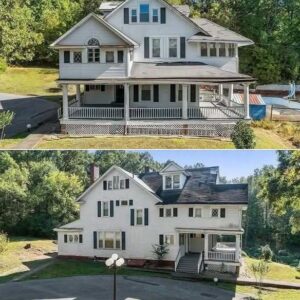
Oakmoor, a historic residence located at 315 E. Main St. in Earlington, Kentucky, presents an intriguing opportunity for anyone who appreciates historic architecture, preservation, and the character of older homes. Currently offered for $120,000, the property combines a relatively accessible asking price with the possibility of undertaking a substantial restoration project. Built in 1905 and listed on the National Register of Historic Places, Oakmoor is more than simply an old house—it is a surviving piece of Earlington’s architectural and community history.
For the right buyer, the property could become a remarkable restoration project. Its age, original architectural details, generous floor plan, and prominent location give it qualities that are increasingly difficult to find in modern homes. At the same time, Oakmoor requires considerable work, meaning that purchasing the property would be a commitment to a long-term renovation rather than a simple move-in-ready home.
The exterior immediately establishes the historic character of the residence. Period architectural details remain visible despite the effects of time and weather. Among the most notable features are the Tuscan columns and Palladian windows, elements that give the house an elegant appearance and reflect the craftsmanship and design preferences of the early twentieth century.
Tuscan columns are known for their relatively simple and classical appearance. Their presence at Oakmoor contributes to the formal character of the home without overwhelming its other architectural details. The Palladian windows add another layer of distinction. Recognizable for their balanced arrangement and classical proportions, these windows help create the sense of symmetry often associated with historic American residences.
Although the exterior has weathered over the years, the survival of these features gives a future owner something valuable to work with. Restoration does not necessarily require replacing everything that shows its age. In a historic home, original materials and architectural elements can be among the property’s most important assets. Carefully preserving those details could help Oakmoor retain the visual identity that earned it recognition as a historic property.
The home’s National Register listing further emphasizes its significance. Properties included on the National Register of Historic Places are recognized for their importance in American history, architecture, archaeology, engineering, or culture. Oakmoor’s listing makes its preservation particularly meaningful, not only for a future owner but also for the wider Earlington community.
Inside, the house offers substantial space. Oakmoor contains five bedrooms and two full bathrooms, including a bathroom located on the main floor. A layout of this size provides considerable flexibility for a future renovation. Depending on the owner’s needs and the requirements of any restoration work, the rooms could potentially accommodate a family, guest spaces, a home office, or other uses while maintaining the basic character of the historic residence.
One of the property’s most appealing interior features is its original wood trim. Historic woodwork can be difficult and expensive to reproduce convincingly, particularly when modern construction materials lack the same craftsmanship and proportions found in older homes. Preserving the existing trim could therefore make a major difference in the finished appearance of the renovation.
Original details also help tell the story of a house. Door and window casings, baseboards, moldings, stair components, and other wood features can provide visual connections to the period in which a home was built. Rather than treating these elements as obstacles to modernization, a thoughtful restoration can incorporate them into an updated living environment.
That balance between preservation and modern comfort is likely to be one of the central challenges of an Oakmoor renovation. A buyer may want modern electrical, plumbing, heating, cooling, and safety systems while also wanting to protect the features that make the house historically distinctive. Successful restoration often depends on finding ways to introduce necessary upgrades without allowing contemporary systems to dominate the appearance of the home.
Oakmoor’s five-bedroom configuration also creates opportunities for different renovation strategies. Some rooms could retain their traditional purpose, while others could be adapted to meet modern lifestyles. A large historic bedroom, for example, might serve as a home office, library, nursery, or guest room. Spacious common areas could potentially be restored as formal living and dining spaces while incorporating updated lighting, insulation, and other improvements.
However, the property is not without significant challenges. The known repair requirements make it clear that Oakmoor should be approached as a restoration project rather than a conventional residential purchase. Among the major projects identified are a new roof, an updated HVAC system, repairs to the front porch and the room above it, and attention to the in-ground pool.
The roof is perhaps one of the most important concerns for any older property. A sound roof protects virtually every other part of a house. Water infiltration can cause damage to ceilings, walls, insulation, flooring, structural components, and historic finishes. For that reason, addressing the roof would likely be an early priority for a new owner.
The front porch deserves particular attention as well. On a historic home such as Oakmoor, the porch is not simply an outdoor space. It is part of the architectural composition of the residence and contributes significantly to its appearance from the street. Repairs should therefore ideally address both structural safety and historic character.
The room above the porch adds another layer of complexity. Any damage in this area could involve both exterior and interior components, making a professional inspection especially important before restoration work begins. Determining the source and extent of any deterioration would help a buyer establish realistic renovation priorities and costs.
The HVAC system represents a different type of challenge. Modern heating and cooling are important for comfort, efficiency, and long-term livability, particularly in a large home. Yet installing contemporary equipment in an older residence can require careful planning. Ductwork, vents, equipment placement, insulation, and electrical requirements all have to be considered alongside the home’s historic features.
The in-ground pool is another feature requiring attention. While a pool can potentially become an attractive part of a restored property, an older pool may require substantial repairs or upgrades. A future owner would need to determine its condition and decide whether restoration, modernization, or another solution makes the most sense.
These projects illustrate why Oakmoor is likely to appeal most strongly to buyers who are comfortable with long-term planning. Someone searching for an inexpensive home that requires only minor cosmetic improvements may find the property overwhelming. A buyer who views restoration as an opportunity, however, may see considerable potential.
Historic homes can offer something that new construction cannot easily reproduce: authenticity. The proportions of the rooms, the craftsmanship of the woodwork, the architectural details, and the accumulated character of decades of use all contribute to a sense of place. Oakmoor’s surviving features provide a foundation upon which a new chapter in the property’s history could be built.
The $120,000 asking price may also make the project particularly interesting to buyers who are prepared to invest additional resources into restoration. Of course, the purchase price represents only the beginning of the financial commitment. Roof replacement, mechanical upgrades, structural repairs, exterior restoration, interior work, and other improvements can add significantly to the overall cost.
Before undertaking a project of this scale, prospective buyers would benefit from understanding the condition of the property as thoroughly as possible. A comprehensive inspection could help identify issues that are not immediately visible. Historic homes can contain hidden problems involving foundations, wiring, plumbing, moisture, insulation, windows, and structural components.
Because Oakmoor is listed on the National Register of Historic Places, prospective owners should also understand any applicable preservation considerations before beginning major work. Historic designation can be an important asset, but restoration projects involving historically significant properties may require additional research and careful planning. Buyers should investigate relevant local, state, and federal requirements before making assumptions about what changes can be made.
The ideal restoration would not simply make Oakmoor look new. Instead, it would aim to preserve the qualities that make the property special while making the house safe, functional, and comfortable for modern life. That could mean repairing rather than replacing original woodwork, restoring architectural details where possible, and selecting new materials that complement the home’s early twentieth-century appearance.
There is also a broader community dimension to restoring a property like Oakmoor. Historic houses contribute to the identity of towns and neighborhoods. When neglected properties are carefully restored, they can help preserve a community’s architectural heritage and demonstrate the value of maintaining older buildings. Oakmoor’s location on East Main Street gives it a visible presence that could make its restoration especially meaningful to Earlington.
A successful renovation could ultimately transform the property while keeping its historic story intact. The Tuscan columns could once again frame an inviting front entrance. The Palladian windows could become focal points of the restored facade. Original wood trim could continue to define the interior spaces. Rooms that have stood for more than a century could once again become active parts of a modern household.
There is something inherently appealing about that possibility. Instead of demolishing an old structure and replacing it with something entirely new, restoration allows a buyer to work with what already exists. Every repaired detail can preserve a small piece of the past while adapting the property for the future.
Oakmoor is therefore best viewed not simply as a house for sale, but as a project with both challenges and possibilities. Its $120,000 asking price may attract attention, but the true value of the property lies in its historic architecture and the opportunity to restore it thoughtfully. The five bedrooms, two bathrooms, original wood trim, classical exterior details, and substantial floor plan provide a strong foundation for a transformation.
For a buyer with patience, resources, and an appreciation for historic homes, Oakmoor could become an extraordinary residence. The work required is substantial, and the renovation would demand careful budgeting, professional expertise, and a clear long-term plan. Yet those challenges are also part of what makes the property compelling.
After more than a century, Oakmoor still retains many of the features that made it distinctive when it was built in 1905. Its weathered appearance tells a story of time, but its surviving architectural details suggest that the story is not finished. With the right owner and a thoughtful restoration, this historic Kentucky home could move from a period of deterioration into a new era of life and preservation.