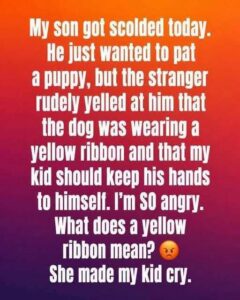
If you notice a yellow ribbon tied to a dog’s leash, collar, harness, or another visible part of its walking equipment, you might wonder what it means.
Is it simply decoration?
Is the owner trying to make the dog look different?
Or is there a message hidden behind that bright yellow color?
In many cases, the yellow ribbon is meant to communicate something important:
Please give this dog some extra space.
The idea is associated with the Yellow Dog Project, an initiative intended to encourage people to recognize that some dogs may need more distance from unfamiliar people, other dogs, or busy environments.
The ribbon isn’t necessarily a warning that a dog is dangerous.
In fact, one of the most important things to understand is that a yellow ribbon does not automatically mean a dog is aggressive.
It is better understood as a request for consideration.
The dog may be nervous.
It may be recovering from an injury.
It may be dealing with illness.
It may be frightened by unfamiliar situations.
It may be undergoing behavioral training.
Or it may simply become overwhelmed when people or animals approach too closely.
The yellow ribbon gives the owner a simple way to communicate that information without having to explain the dog’s situation to every person they encounter.
Why Would a Dog Need More Space?
Dogs, like people, have different personalities.
Some dogs happily approach strangers.
Others prefer to keep their distance.
Some love meeting other dogs.
Others become nervous when an unfamiliar animal gets too close.
A dog may also react differently depending on the environment.
A calm dog in its own home might become anxious in a crowded park.
A friendly dog might become frightened when approached suddenly.
A dog recovering from an injury might not want another animal jumping around it.
These situations don’t necessarily mean the dog is aggressive.
They may simply mean the dog has reached its comfort limit.
Giving the dog more space can make the situation easier for everyone.
The Yellow Ribbon Is a Communication Tool
Imagine you’re walking your dog and another person approaches with their pet.
Without any visible signal, they may assume your dog is comfortable meeting theirs.
They might allow their dog to come closer.
They might try to pet your dog.
They might encourage their children to approach.
If your dog is anxious, this can create a difficult situation.
The owner may have to quickly explain:
“Please don’t come closer.”
“She’s nervous.”
“He’s recovering from an injury.”
“She needs space.”
A yellow ribbon can communicate the basic message before the interaction gets that far.
It’s a visual request:
Please give us some room.
Of course, the ribbon isn’t a universal guarantee that every person will understand it.
That’s why owners may still need to communicate verbally.
But it can be an additional signal.
It Doesn’t Mean “Bad Dog”
This is an important distinction.
A yellow ribbon shouldn’t automatically cause people to label the dog as dangerous.
Dogs can need space for many reasons.
For example, a dog might be recovering from surgery.
Another might have arthritis or another painful condition.
Another could have recently experienced a stressful event.
A puppy might be learning how to behave appropriately around other dogs.
A rescue dog might still be adjusting to unfamiliar environments.
A senior dog might simply prefer not to be approached.
A dog can also become overwhelmed by crowds, loud noises, bicycles, children, or unfamiliar animals.
None of these situations automatically makes the dog “bad.”
It simply means the dog may need a different approach.
What Should You Do If You See One?
The safest and most respectful response is simple:
Give the dog extra space.
If you’re walking your own dog, create some distance.
If you’re with children, explain that the dog may not want to be approached.
Don’t assume that the dog wants to say hello.
Don’t reach out to pet it.
Don’t allow your dog to rush toward it.
Instead, give the owner room to continue walking.
This can be especially helpful when the owner is actively training their dog.
Unexpected interactions can make training more difficult.
By keeping your distance, you’re giving the owner an opportunity to work with their dog without additional pressure.
What If the Dog Looks Friendly?
This can be confusing.
A dog wearing a yellow ribbon might look happy.
It might wag its tail.
It might appear curious.
You may wonder why you should keep your distance.
But appearances don’t tell the whole story.
A dog can be friendly and still need space.
A dog can be curious but nervous.
A dog can want to investigate something while still becoming uncomfortable if someone gets too close.
Dogs communicate through body language, and interpreting that body language isn’t always easy for strangers.
That’s why respecting the owner’s request is the best approach.
The owner knows their dog.
If they are asking for distance, there is probably a reason.
Children Should Learn About the Yellow Ribbon
This can be especially important for families with young children.
Children naturally want to pet dogs.
When they see a cute dog walking down the street, they may immediately want to approach it.
Parents can use yellow-ribbon dogs as an opportunity to teach an important lesson:
Not every dog wants to be touched.
Children should learn to ask the owner before approaching any unfamiliar dog.
They should also understand that “cute” doesn’t automatically mean “comfortable with strangers.”
If a dog has a yellow ribbon, it’s particularly important to respect the extra-space request.
The lesson isn’t about being afraid of dogs.
It’s about respecting animals and understanding boundaries.
Dogs Have Personal Boundaries Too
People often understand personal space when it comes to other humans.
We know that standing inches away from a stranger can make them uncomfortable.
Dogs can have similar boundaries.
Some dogs need a wider comfort zone.
When another dog enters that space unexpectedly, the dog may become tense.
When a stranger reaches toward its face, it may become frightened.
When a child hugs it, it may feel trapped.
Even a normally relaxed dog may react if it feels cornered.
Giving a dog room allows it to make choices.
It can observe the approaching person or animal without immediately feeling threatened.
That can make the encounter calmer.
Why Space Can Help Training
Many owners use extra distance as part of their dog’s training.
For example, a dog may be learning to remain calm around other animals.
If another dog suddenly gets too close, the training opportunity may disappear.
The dog becomes overwhelmed.
The owner has to focus on managing the situation rather than teaching a calm response.
Distance can change that.
When a dog is far enough away to remain comfortable, the owner can reward calm behavior and gradually build confidence.
This process takes patience.
It isn’t something that can necessarily be fixed in one afternoon.
Respecting the yellow ribbon can therefore help the owner continue that work.
It Can Also Protect the Dog
A yellow ribbon isn’t only about protecting other people or animals.
It can protect the dog wearing it.
Suppose a dog is injured.
Another dog runs toward it.
The injured dog becomes frightened or defensive.
A stressful interaction could make the situation worse.