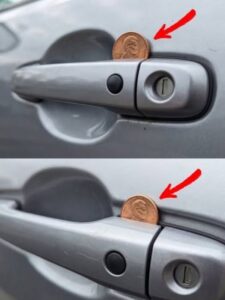
Finding a penny in your car door handle is an unusual experience. For most people, the first reaction is probably simple confusion. Why is a coin sitting there? Did someone leave it accidentally? Did it fall from a pocket? Or could there be another explanation?
While a penny by itself does not prove that someone has attempted to interfere with your vehicle, discovering an unexpected object is still a good reason to slow down and pay attention.
The safest approach is not to panic and not to immediately assume the worst. Instead, take a moment to look at the entire situation before getting inside your car.
Start by observing the vehicle from a safe position.
Look at the door handle, lock, windows, and nearby areas. Does everything appear normal? Is the door sitting properly? Is there any visible damage? Does the handle look different from the way you remember it?
If you use a physical key, check whether the key behaves normally without forcing it. If your vehicle has electronic locks, notice whether the remote or button is working as expected.
A door that suddenly refuses to open can have many ordinary explanations.
Vehicle locks and handles are mechanical systems, and mechanical systems can fail. A key may be worn or damaged. A lock can become stuck. An electronic key fob may have a weak battery. Cold temperatures, moisture, dirt, or general wear can also cause problems.
For that reason, it is important not to assume that the penny caused the problem.
There are numerous stories online suggesting that criminals deliberately place coins near vehicle door handles to interfere with locks or identify potential targets. These stories can be alarming, but a coin found near a vehicle is not, by itself, evidence of a particular criminal technique.
The object could have an innocent explanation.
Someone might have dropped it while walking through the parking lot. Another person could have accidentally placed it near the handle. The coin may have become lodged there without anyone intentionally targeting your vehicle.
The important question is whether anything else seems unusual.
That is where your surroundings become especially important.
If you return to your vehicle in the middle of a busy shopping center during daylight, you may feel comfortable simply moving away from the car and taking a closer look from a safe location.
But if you are alone in a dark parking lot, an unfamiliar neighborhood, or an isolated roadside area, the situation deserves more caution.
Before approaching your vehicle, look around.
Pay attention to nearby people, parked vehicles, entrances, lighting, and anything else that might affect your sense of safety.
You do not need to assume that a stranger nearby is dangerous. Most people you encounter are simply going about their own business. Awareness is not the same thing as suspicion.
It simply means knowing what is happening around you.
If you notice someone behaving in a way that makes you uncomfortable, do not feel obligated to approach your car just because you need to leave.
You can step away.
Find a busy and well-lit location.
A nearby business, restaurant, hotel, security office, or other public place may provide a safer place to wait while you figure out what to do.
This is especially useful if your car refuses to unlock.
Rather than standing beside the vehicle and repeatedly trying the key or door handle, move away if you are uncomfortable.
Call someone you trust.
A friend, family member, coworker, or another person can stay on the phone with you. If someone is nearby, you can ask them to meet you at the vehicle or accompany you while you determine what is happening.
Roadside assistance can also be helpful when the problem appears to be mechanical.
A professional can examine the lock, handle, or vehicle-access system and determine whether the problem is simply a malfunction.
If you notice clear signs of damage or possible tampering, avoid unnecessarily touching or moving things around the vehicle.
If it is safe to do so, you can document what you see. Depending on the circumstances, you may also contact local authorities, your insurance company, or another appropriate service.
If you believe that you are in immediate danger, contact local emergency services.
Most importantly, do not confront someone you suspect of placing an object on your vehicle.
You may be completely mistaken about their intentions, and approaching a stranger can turn an uncertain situation into a dangerous one.
There is no need to solve the mystery yourself.
Your priority should be getting somewhere safe.
This situation also highlights why drivers should pay attention when returning to their vehicles.
Simple habits can make a difference.
Whenever possible, park in an area with good lighting and reasonable foot traffic. Keep your keys accessible before reaching the vehicle, rather than standing beside your car while searching through a bag or pocket.
When walking back to the vehicle, remain aware of your surroundings.
If you notice something unusual, pause.
You do not need to conduct a detailed inspection every time you park. A quick glance around the vehicle can be enough to notice if something is obviously different.
It can also help to remember how you left the car.
If a window was closed when you parked and is suddenly open, or a door looks different, you may recognize the change immediately.
The same principle can be taught to teenagers and inexperienced drivers.
Young drivers often focus on getting into the vehicle and leaving quickly, particularly when they are tired or distracted. Teaching them to look around before entering and to avoid investigating suspicious situations alone can help establish practical safety habits.
However, it is equally important not to create unnecessary fear.
Finding a penny does not mean that something dangerous is about to happen.
There is no universal meaning attached to a coin found in a car door handle.
The internet often turns unusual situations into simple warnings. Those stories can spread quickly because they are memorable and easy to share. But real-life situations are rarely that straightforward.
A coin may be completely harmless.
A strange door problem may be caused by a faulty lock.
A person standing nearby may simply be waiting for their own vehicle.
That is why context matters.
Rather than thinking, “I found a penny, so I am definitely being targeted,” think, “I found something unusual, so I should take a moment to see whether anything else seems wrong.”
That small change in thinking can help you remain calm while still being cautious.
Your instincts are also worth respecting.
If everything appears normal and you feel comfortable, you may decide that the coin is simply an accidental object.
If something feels wrong, however, you do not need to convince yourself that you are imagining it.
You can leave.
You can ask for help.
You can wait somewhere safer.
You can return later with another person.
There is nothing wrong with choosing caution when you are uncertain.
Ultimately, the penny itself is not the most important part of the situation.
What matters is whether your vehicle or surroundings show other signs that something may be wrong.
Look for visible damage. Pay attention to unusual behavior. Consider the location and time. Notice whether the vehicle is functioning normally.
Then make a decision based on the circumstances rather than fear.
If the situation feels ordinary, the penny may have no significance whatsoever.
If several unusual details appear at once, take those details seriously and give yourself some distance.
The goal is not to become afraid of every unfamiliar object.
The goal is to remain aware enough to recognize when a situation deserves additional caution.
So if you ever find a penny in your car door handle, take a breath and look around before opening the door.
It may be nothing more than a forgotten coin.
But if your vehicle is behaving strangely or your surroundings make you uncomfortable, don’t ignore that feeling.
Move toward a safe, populated place, contact someone you trust, and get assistance when necessary.
You do not have to determine exactly what happened before protecting yourself.
A few seconds of awareness can help you avoid unnecessary risk.
And when it comes to personal safety, taking those few extra seconds is always worth it.