The afternoon had started like any other peaceful day in the woods.
The weather was warm but comfortable, sunlight filtered through the trees, and a gentle breeze moved through the leaves. The trail was quiet, with only the sounds of birds, distant insects, and footsteps against the dry ground.
Nothing seemed unusual.
Then, without warning, the peaceful walk changed.
A hiker stopped in the middle of the trail after noticing something that seemed to move beside a fallen branch.
At first, it looked like nothing more than a collection of dry leaves.
Then the shape shifted.
The hiker immediately realized that the object was a snake.
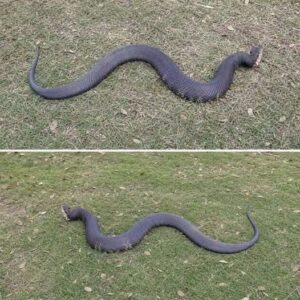
A copperhead was lying almost perfectly still only a short distance away.
Its body blended so naturally with the forest floor that it was difficult to understand how the snake had remained invisible for so long.
The hiker took several slow steps backward.
The copperhead didn’t chase.
It didn’t rush toward the trail.
It simply remained where it was.
That moment provided an important reminder about encounters with venomous snakes.
Copperheads generally do not seek out humans.
They are more likely to remain hidden or attempt to avoid people when given the opportunity.
The problem is that their camouflage can make them incredibly difficult to notice.
Their colors and markings often resemble fallen leaves, tree bark, rocks, and other natural materials.
A person can walk surprisingly close without realizing that a snake is resting nearby.
That is why people who spend time outdoors should pay attention to where they place their feet and hands.
A peaceful hike can become dangerous when someone accidentally steps too close to a hidden snake.
The same thing can happen when someone reaches beneath a rock, moves a pile of leaves, climbs over a fallen log, or places a hand into a dark space without checking first.
Snakes may interpret sudden contact as a threat.
Even though the animal may have no interest in attacking a person, it can defend itself if it feels cornered or surprised.
The safest approach is therefore not to challenge the snake.
If a copperhead is spotted, the first thing to do is remain calm.
Sudden movements can make the situation worse.
The person should create as much distance as possible and slowly move away.
There is no reason to approach the snake for a closer look.
There is certainly no reason to try to touch it, move it, or frighten it away.
Taking photographs from a safe distance may be tempting, but getting closer simply increases the risk.
The hiker who discovered the copperhead that afternoon understood this immediately.
Instead of trying to identify every detail of the snake, the hiker backed away and waited.
After several quiet moments, the copperhead began moving.
It slipped beneath the vegetation and disappeared.
Within seconds, it was almost impossible to see.
The encounter was over.
Nobody had been bitten.
But the experience changed the way the hiker viewed the trail.
The ground that had looked completely ordinary now seemed full of possibilities.
Every pile of leaves appeared worth checking.
Every fallen branch became something to step around rather than over.
That doesn’t mean people should be afraid of hiking.
It simply means that awareness is one of the best forms of protection.
Nature is full of animals that rely on camouflage.
Many are harmless.
Others can become dangerous when accidentally disturbed.
Learning to recognize that possibility allows people to enjoy the outdoors while giving wildlife the space it needs.
Copperheads are part of the natural environment in the regions where they live.
They play a role in controlling populations of small animals, and they generally want to be left alone.
For that reason, the safest encounter is often the one that never becomes an encounter at all.
Someone walking through the woods should avoid putting their hands into places they cannot see.
Before sitting on rocks or fallen logs, it is sensible to look carefully around the area.
When walking through tall grass or thick vegetation, slowing down can make it easier to notice movement.
People should also be particularly careful around areas where leaves and branches have accumulated.
Children should be taught these habits as well.
Young children may see a snake and become curious rather than cautious.
They may want to get closer or try to touch it.
A simple rule can prevent many problems:
If you see a snake, stop and tell an adult.
There is no need to approach it.
Pets can create another challenge.
Dogs often investigate unfamiliar objects immediately, and a snake may not be given enough time to move away.
Keeping dogs under control while hiking can reduce the chance of an encounter.
Even a curious dog can accidentally provoke a snake.
Unfortunately, there are situations in which someone is bitten despite taking reasonable precautions.
If a snake bite occurs, it should be treated as a medical emergency.
The person should move away from the snake and seek professional medical assistance as quickly as possible.
If it can be done safely, remembering the snake’s appearance may help medical professionals determine what type of snake was involved.
However, nobody should attempt to catch or kill the snake.
A second bite is possible, and getting close to a venomous animal creates unnecessary danger.
The bitten person should try to remain calm and limit unnecessary movement while waiting for medical care.
Rings, watches, bracelets, or other tight items near the affected area should be removed if possible, because swelling can develop.
There are also several old-fashioned methods of treating snake bites that should not be attempted.
Cutting the wound, trying to suck out venom, applying ice directly, or using a tourniquet without medical direction can cause additional problems.
The best response is professional medical treatment.
Fortunately, most people who encounter copperheads never experience a bite.
A snake may simply remain hidden until the person passes.
Another may move away quietly.
Many encounters probably happen without either side realizing the other was there.
That is one of the remarkable things about spending time in nature.
The forest may appear empty, but it is rarely empty.
Birds move through the trees.
Small mammals hide beneath vegetation.
Insects live under leaves.
And snakes can rest only a few feet away while remaining almost impossible to see.
The copperhead that afternoon had probably been there long before the hiker arrived.
It wasn’t waiting for someone to attack.
It wasn’t looking for a confrontation.
It was simply using the environment around it for protection.
Once the hiker gave it enough space, the snake continued on its way.
The entire encounter lasted only a few minutes.
Yet it left a lasting impression.
The hiker later said that the experience taught a simple lesson: respect the woods instead of assuming you can see everything around you.
That lesson applies far beyond snakes.
When people enter natural environments, they are entering the home of countless animals.
Wildlife doesn’t always behave according to human expectations.
Some creatures run away.
Some hide.
Some remain perfectly still.
And some defend themselves when they believe they are in danger.
The safest response is therefore awareness rather than fear.
Watch the trail.
Look before placing your hands somewhere hidden.
Avoid disturbing wildlife.
Keep children and pets nearby.
And when an animal is encountered, give it room.
A peaceful day in the woods doesn’t have to end in panic simply because a copperhead appears.
In many cases, the best ending is exactly what happened that afternoon.
A person notices the snake.
The person steps back.
The snake remains undisturbed.
Eventually, both go their separate ways.
The forest becomes quiet again.
And the hike continues—with a little more caution, a little more respect, and a much greater appreciation for the hidden life moving all around us.