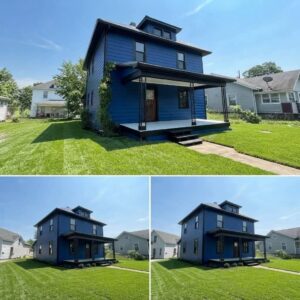
A four-bedroom house priced at just $24,900 is naturally going to attract attention. At first glance, the number seems almost unbelievably low for a property with two bathrooms, a fenced yard, a basement, and more than 1,500 square feet of living space.
But properties at this price point require a different way of thinking.
The purchase price is only the beginning.
This two-story home in Danville, Illinois, is being offered for $24,900 after a $3,000 price reduction. It provides approximately 1,560 square feet of living space on a 6,534-square-foot fenced lot.
The property includes four bedrooms, two full bathrooms, two dedicated parking spaces, and a partial unfinished basement.
It is being sold “as-is,” which makes a professional inspection particularly important. An inexpensive house can become an expensive investment surprisingly quickly if major structural or mechanical problems are discovered after closing.
The Basic Numbers
On paper, the property has several features that make the listing interesting.
The asking price is $24,900.
The home contains approximately 1,560 square feet.
There are four bedrooms and two full bathrooms.
The lot measures approximately 6,534 square feet and is fenced.
There are two dedicated parking spaces.
There is also a partial unfinished basement that provides storage space and access to mechanical systems.
The four-bedroom layout is especially notable at this price point.
All four bedrooms are located on the second floor, along with one of the bathrooms. This creates a relatively defined private sleeping area separate from the main living spaces downstairs.
The main floor includes a traditional living room, a second family room, and a large kitchen.
For a buyer interested in renovation, that layout provides several possibilities.
The Kitchen Could Become a Major Project
The kitchen appears to offer plenty of space, but its current configuration may not appeal to buyers looking for a modern open-plan layout.
Depending on the existing walls, plumbing, electrical systems, and structural design, a renovation could potentially create a more open and functional kitchen.
However, removing walls is not as simple as swinging a hammer.
Before changing the layout, a buyer would need to determine whether any walls are load-bearing and whether plumbing, electrical wiring, heating ducts, or other systems run through them.
Kitchen renovations can also become expensive because cabinets, countertops, appliances, flooring, lighting, plumbing, and electrical work can quickly add up.
A buyer should therefore decide whether the kitchen needs a cosmetic update or a complete reconstruction.
Those are very different projects.
The Basement Deserves Attention
The partial unfinished basement is another feature worth investigating.
An unfinished basement can provide useful storage and access to important mechanical systems. Depending on the property’s design and local requirements, it could potentially offer additional usable space in the future.
But basements also deserve careful inspection.
Buyers should look for signs of water intrusion, dampness, mold, foundation movement, cracks, drainage problems, and previous repairs.
A basement that looks acceptable during a dry week may tell a different story after heavy rain.
Water management is particularly important because fixing moisture problems after finishing a basement can be considerably more expensive than addressing them before renovation.
The Major Question: What Needs Repair?
The $24,900 purchase price should not be viewed as the actual cost of the project.
The real investment is the purchase price plus everything required to make the property safe, functional, and suitable for its intended use.
That means investigating the major systems before making a serious offer.
The roof should be inspected for age, leaks, damaged shingles, structural problems, and previous repairs.
The foundation should be examined for significant cracking, movement, moisture intrusion, or other warning signs.
Plumbing deserves attention as well. Older pipes, leaking fixtures, sewer problems, or outdated systems can create substantial expenses.
The electrical system is another major consideration. Buyers should determine whether the wiring and electrical panel are appropriate for the property and whether any unsafe or outdated components need replacement.
Heating and cooling systems should also be evaluated. A furnace or air-conditioning system near the end of its service life could represent a significant upcoming expense.
These aren’t the glamorous parts of a renovation.
But they can determine whether a low-priced property remains affordable.
The Yard Adds Practical Appeal
The exterior also offers some useful features.
The fenced yard provides separation from surrounding properties and could be particularly attractive to households with children or pets.
Mature trees add character and shade, while the patio provides an existing outdoor area that could potentially become an entertaining space.
Exterior improvements don’t necessarily need to be extravagant.
Cleaning, landscaping, repairing fencing, improving drainage, and refreshing the patio could make a meaningful difference to the property’s appearance.
However, buyers should also inspect the condition of the fencing, trees, grading, exterior drainage, siding, windows, and other components before assigning value to those features.
Four Bedrooms Can Create Flexibility
The four-bedroom configuration gives the property several possible uses.
A buyer could use the rooms for a larger household, designate one as a home office, create a guest bedroom, or adapt the space to changing family needs.
The second family room downstairs provides additional flexibility.
Depending on the buyer’s lifestyle, it could function as a home office, playroom, dining area, entertainment room, or additional sitting area.
This flexibility is one of the property’s more interesting characteristics.
A house doesn’t necessarily need to be redesigned from the ground up to become more functional. Sometimes thoughtful improvements to existing rooms can produce significant benefits.
Don’t Forget the Costs Beyond Renovation
One of the biggest mistakes with inexpensive properties is focusing almost entirely on the purchase price.
Even if the house costs $24,900, the buyer still has other expenses.
These may include closing costs, inspections, insurance, property taxes, utilities, permits, materials, contractor labor, financing costs, and ongoing maintenance.
There is also the possibility of unexpected repairs.
Renovation projects rarely proceed exactly according to the original plan.
A wall may reveal damaged wiring.
A floor may conceal water damage.
A plumbing problem may turn out to involve a larger section of the system.
A roof inspection may reveal structural issues that weren’t obvious from the ground.
That is why a contingency budget is so important.
Is It an Investment or a Money Pit?
That question cannot be answered from the listing price alone.
A $24,900 house could potentially become an attractive property after renovation, but it could also require far more money than initially expected.
The difference comes down largely to condition.
If the structure is sound and the major mechanical systems are functional, cosmetic improvements may produce a very different financial picture than if the roof, foundation, electrical, plumbing, HVAC, and sewer system all require major work.
For that reason, the inspection stage is arguably more important than the asking price.
A buyer should understand what they are purchasing before committing to the project.
The Bottom Line
This Danville property is an example of why low purchase prices can be both appealing and deceptive.
At $24,900, the entry cost is relatively low, and the house offers several potentially useful characteristics: four bedrooms, two bathrooms, approximately 1,560 square feet, a fenced lot, parking, a basement, and multiple living areas.
Those features create a foundation for a renovation project.
But the property is being sold as-is, and the total investment could be substantially higher once repairs, improvements, closing costs, taxes, insurance, utilities, and unexpected problems are included.
The smart approach is therefore not to ask only, “Can I afford $24,900?”
The better question is:
“What will this house actually cost me once it is safe, functional, and renovated to the standard I want?”
That answer requires an inspection, contractor estimates, local cost research, and a realistic renovation budget.
For the right buyer, the property could represent a hands-on opportunity to transform an inexpensive house into a more comfortable and valuable home.
But the low sticker price should be treated as the starting point—not the final investment.