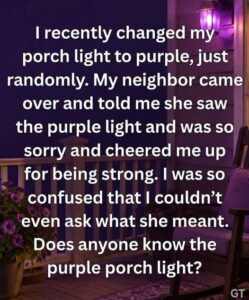
Every evening, just as the sun disappeared behind the rooftops, the woman across the street turned on a purple porch light.
At first, I thought nothing of it.
The soft violet glow looked unusual against the row of ordinary white porch lights that lined our neighborhood. It gave her house a peaceful, almost dreamlike appearance.
I assumed she simply liked the color.
Maybe she had bought the bulb because purple was her favorite.
Maybe she thought it made her porch look beautiful.
I never asked.
Then, over the following weeks, I noticed something I hadn’t expected.
Other houses began displaying purple lights too.
One appeared two streets away.
Another was outside a small brick house near the park.
Then I noticed one above a garage at the end of our street.
Suddenly, purple seemed to be appearing everywhere.
One afternoon, I mentioned it to a friend.
“Do you know why so many people are using purple lights?”
She nodded.
“It’s connected with domestic violence awareness,” she explained. “Purple is often used as a symbol of courage, hope, strength, and support for survivors.”
I remember looking at her differently after she said that.
The purple porch light across the street suddenly didn’t seem decorative anymore.
It seemed meaningful.
But my friend added something important.
“Of course, you can’t assume anything about the people living in those houses. A purple light doesn’t mean domestic violence is happening there. Some people use it to show support, remember someone, or raise awareness.”
That distinction stayed with me.
Because it is easy to look at someone’s home and believe we understand what is happening behind the front door.
We don’t.
A quiet house doesn’t necessarily mean a peaceful house.
A loud house doesn’t necessarily mean a dangerous one.
And abuse isn’t always something that leaves a visible mark.
It can involve intimidation.
Isolation.
Threats.
Controlling someone’s money.
Monitoring their communication.
Preventing them from seeing friends or family.
Constant criticism.
Making someone feel afraid of what might happen if they disagree.
Sometimes, the most difficult forms of abuse are the ones other people never see.
I thought about that for days.
Then one evening, I saw the purple light again.
It was raining lightly.
The street was almost empty.
I was walking home when I noticed something beneath the light.
A small handwritten sign had been attached to the porch railing.
I stopped.
The words were simple.
“Someone you know may need you. Listen. Believe. Support.”
I stood there for several seconds.
There was nothing dramatic about the sign.
No names.
No accusation.
No explanation.
Just those few words.
But somehow, they felt powerful.
I realized that the purpose of a symbol isn’t always to tell strangers a personal story.
Sometimes it’s simply there to remind people that an issue exists.
That someone may be struggling quietly.
That people deserve to feel safe in their own homes.
And that survivors deserve to be believed and supported.
The next day, I saw the woman across the street outside.
She was watering flowers along the edge of her porch.
For the first time, I walked over and spoke to her.
“I like your purple light,” I said.
She smiled.
“Thank you.”
I hesitated before asking, “Does it have a special meaning for you?”
She looked toward the light.
“Yes,” she said.
Then she was quiet.
I didn’t press her.
After a moment, she continued.
“My sister went through something difficult several years ago.”
She looked down at the flowers.
“For a long time, our family didn’t know what to say. We were afraid of saying the wrong thing. We thought maybe staying quiet would make things easier.”
I listened.
“Eventually,” she said, “we learned that silence wasn’t helping.”
She told me that her sister had eventually found support and was rebuilding her life.
“She’s doing well now,” she said. “But I keep the light on for her. And for anyone else who might need to know they’re not alone.”
I thanked her for telling me.
Then I went home.
That night, I looked around my own house differently.
I thought about all the people living behind closed doors.
People who might be struggling with circumstances their neighbors knew nothing about.
People who might be afraid to tell anyone.
People who might have spent years believing that nobody would understand.
And I thought about how easily we can judge someone for not leaving, without knowing what leaving might mean for them.
Safety, housing, finances, children, transportation, immigration concerns, disability, isolation, threats, and countless other circumstances can affect a person’s options.
There is rarely a single simple answer to someone’s private situation.
That is why support matters.
Sometimes support means listening without judgment.
Sometimes it means helping someone connect with a qualified professional or local support service.
Sometimes it means reminding someone that the abuse is not their fault.
And sometimes it means simply staying present.
The purple lights don’t solve those problems.
A colored bulb can’t protect someone from harm.
But symbols can start conversations.
They can remind communities that domestic violence is real.
They can honor survivors.
They can remember those who didn’t survive.
And they can communicate something quietly but clearly:
You are not invisible.
You are not alone.
Your safety matters.
Over the next few weeks, I began noticing the purple lights differently.
I stopped wondering why people had chosen that color.
Instead, I wondered what stories might exist behind each one.
Maybe someone was honoring a family member.
Maybe someone was remembering a friend.
Maybe someone simply wanted to show solidarity.
And maybe someone had never personally experienced abuse but believed that everyone deserved to live without fear.
I never assumed anything beyond that.
The lights had taught me something important about symbols.
You don’t always need to know someone’s private story to offer compassion.
You don’t need to demand an explanation.
You don’t need to turn someone’s pain into gossip.
Sometimes the most meaningful thing you can do is create an environment where people know they can ask for help.
Months later, the purple lights were still appearing around the neighborhood.
The woman across the street still turned hers on every evening.
And sometimes, when I walked past her house, I would see the small handwritten sign beneath it.