There are some household questions that seem far too small to argue about.
Then there’s toilet paper.
For years, people have debated one surprisingly important question: should the toilet paper hang over the top of the roll or underneath it?
At first, it sounds ridiculous.
It’s toilet paper. You pull it, tear it, and move on with your day.
Yet somehow, the direction of a toilet paper roll can become a serious household disagreement.
One person walks into the bathroom and sees the paper hanging over the front.
Another walks in and immediately flips it underneath.
Neither understands why the other person cares so much.
And before long, a tiny roll of paper has somehow become the center of an argument.
Over or Under?
The two basic choices are simple.
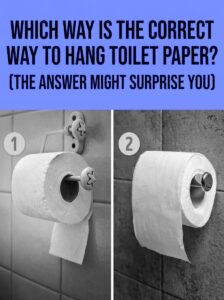
With the over position, the loose end hangs over the front of the roll. You can see the end immediately and pull the paper toward you.
With the under position, the loose end hangs behind the roll and comes up from underneath.
Both methods work.
Both allow you to use the toilet paper normally.
And neither is going to change the world.
But people often develop a strong preference for one arrangement.
Some people say the over position feels more natural because the loose end is visible and easier to grab.
Others prefer the under position because they believe it looks tidier or keeps the loose end closer to the wall.
Once someone becomes accustomed to one method, seeing the opposite arrangement can feel strangely wrong.
Why Does Such a Small Detail Matter?
The interesting thing about the toilet paper debate is that it usually isn’t really about toilet paper.
It’s about habits.
Everyone develops small routines throughout daily life.
You might have a particular way of loading a dishwasher.
You might fold towels a certain way.
You might arrange food in the refrigerator according to your own system.
You might put your shoes in a specific place when you come home.
None of these habits are necessarily important.
But when another person changes them, it can be surprisingly irritating.
That’s because familiar routines require very little thought.
You know exactly what to expect.
When something is different, even slightly, your brain notices.
That’s why someone can walk into a bathroom, see the toilet paper hanging in the opposite direction, and immediately think, “Who changed this?”
Is There Actually a Correct Way?
This is where the debate becomes complicated.
There isn’t one universal household rule that applies to every bathroom.
Different people have different preferences, and both orientations can function perfectly well.
However, there is a historical detail that often gets mentioned in discussions about the subject.
An old patent illustration for a toilet-paper roll holder is frequently cited as showing the paper hanging over the top of the roll.
That doesn’t mean everyone is required to use that arrangement today.
It simply shows that the over position has been associated with certain traditional holder designs.
Modern households can still choose whichever orientation works best for them.
Why Do People Get So Passionate About It?
Part of the reason is that household habits can become surprisingly personal.
Imagine living with someone who always puts the toilet paper underneath.
You prefer it over.
Every time you enter the bathroom, you turn the roll around.
The other person comes along later and changes it back.
Neither person considers the other person’s preference unreasonable.
Eventually, the same tiny disagreement happens again and again.
At that point, the argument isn’t really about the roll anymore.
It’s about feeling heard.
One person may think, “Why can’t you just leave it the way I like it?”
The other may think exactly the same thing.
That’s how something incredibly insignificant can become surprisingly frustrating.
Couples Know This Problem Well
Living with another person means sharing space.
That sounds obvious, but it also means sharing routines.
Two people can have completely different ideas about how a home should operate.
One person may like the kitchen perfectly organized.
The other may not care whether everything is in exactly the right place.
One person may want the bed made every morning.
The other may consider that unnecessary.
One person may squeeze the toothpaste from the bottom.
The other may squeeze it from the middle.
And, of course, one person may insist that the toilet paper should hang over.
These differences aren’t necessarily signs of a serious problem.
In many cases, they’re simply reminders that two individuals are sharing the same space.
Sometimes Compromise Is Easier
When a disagreement is genuinely unimportant, compromise can be surprisingly effective.
Maybe the person who prefers the paper over can leave it that way.
Or perhaps the other person can simply flip it around when they use the bathroom.
There’s no need to turn every preference into a principle.
Not every disagreement needs a winner.
In fact, sometimes insisting on being right creates more frustration than the original issue ever caused.
That’s an important lesson that extends far beyond toilet paper.
A household contains dozens of small decisions every day.
How lights are left.
Where keys are placed.
How dishes are loaded.
Which side of the bed someone sleeps on.
How towels are hung.
Where the remote control goes.
If every minor difference becomes an argument, everyday life can become exhausting.
The Hidden Lesson Behind the Roll
The toilet paper debate is funny because the object itself is so unimportant.
Nobody’s health, safety, or future depends on whether the loose end hangs over or under.
Yet people can still become surprisingly emotional about it.
That’s what makes the debate such an interesting example of human behavior.
Small habits give us a sense of order.
They make everyday life predictable.
When someone changes one of those habits, we notice—even when the change has no real consequence.
The solution isn’t necessarily to convince everyone that one position is correct.
Sometimes the better solution is simply recognizing that people have different preferences.
If the other person likes the opposite orientation, perhaps it isn’t worth an argument.
So, Which Way Should It Hang?
If you’re looking for one universal answer, you may be disappointed.
The over-versus-under debate is largely a matter of preference.
Some people strongly favor one position.
Others genuinely don’t care.
And many households have quietly developed their own system without ever discussing it.
The important thing isn’t necessarily which direction the paper faces.
It’s how people handle the tiny disagreements that naturally appear when they share a home.
Because if something as harmless as a toilet paper roll can start an argument, learning when to compromise can save everyone a lot of unnecessary frustration.
So the next time you walk into the bathroom and discover that someone has changed the direction of the roll, take a breath before turning it into a battle.
Flip it if you really want to.
Laugh about it if you can.
Or leave it alone.
After all, the toilet paper probably isn’t the thing that matters most.
Sometimes keeping the peace is far more valuable than proving that your way is the right way.