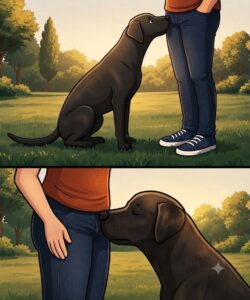
A dog suddenly walks up and sniffs your groin, and the moment can feel surprisingly awkward.
You might instinctively step backward, laugh nervously, or wonder why your dog seems so interested in a part of your body that humans generally consider private.
But from your dog’s perspective, there is nothing embarrassing about it.
Dogs experience the world through their noses in a way that humans can hardly imagine. While people primarily rely on vision to understand their surroundings, dogs gather enormous amounts of information through scent. Their powerful sense of smell allows them to detect subtle chemical differences and identify odors that are completely invisible to us.
So when your dog approaches and sniffs certain parts of your body, it is usually not behaving strangely or trying to embarrass you.
It is investigating.
Your Scent Tells Your Dog a Story
Every person has a unique scent profile created by a combination of natural body odors, skin secretions, bacteria, hormones, products, clothing, and environmental factors.
To a human, these scents may be barely noticeable.
To a dog, they can provide a wealth of information.
Dogs have specialized scent-detection abilities that allow them to distinguish odors with remarkable sensitivity. When your dog sniffs you, it may be collecting information about who you are, where you have been, and what has changed since the last time it encountered you.
This is one reason dogs frequently sniff people’s hands, clothing, shoes, and other areas of the body.
Your scent is essentially part of your identity.
Why Certain Areas Attract More Attention
Some parts of the human body naturally produce stronger or more distinctive odors than others.
The groin and underarm regions contain numerous sweat and scent-producing glands. These areas can therefore provide dogs with particularly strong chemical signals.
Dogs are not thinking about these body parts in the same social or cultural way humans do.
They don’t understand the concept of embarrassment surrounding personal space in the way people do. Instead, they are responding to an interesting concentration of scent.
This explains why a dog may appear far more interested in someone’s groin than in their arm or shoulder.
To the dog, there is simply more information available there.
Dogs Use Their Noses Like Information-Gathering Tools
Imagine walking into a room and immediately knowing who had been there, what they had eaten, and whether they had recently gone outside.
That sounds impossible to humans.
For dogs, scent can provide clues that make their environment much more informative.
When your dog sniffs you after you’ve been away, it may be investigating the unfamiliar odors you picked up during the day. Perhaps you visited another home, encountered another animal, walked through a park, or handled different objects.
Your dog may also notice changes in your normal scent.
This is why sniffing can be an important part of social interaction between dogs and humans.
Hormones and Body Chemistry Can Influence Scent
Changes in body chemistry can sometimes affect how a person smells.
Hormonal fluctuations, perspiration, stress, exercise, diet, medications, and other ordinary factors can influence body odor. Dogs may detect some of these changes because their sense of smell is much more sensitive than ours.
However, it is important not to overinterpret this ability.
A dog sniffing you does not automatically mean that it has detected an illness or medical condition.
There are many reasons a dog’s interest in a particular scent can increase, and ordinary changes in body odor are among them.
Stories about dogs detecting diseases have attracted considerable attention, and research has explored canine scent detection in various medical contexts. But a household dog’s sniffing behavior should not be treated as a medical diagnostic tool.
If you have concerns about a change in your health, a qualified medical professional is the appropriate person to consult.
Why Dogs Sometimes Sniff Guests
You may notice this behavior more strongly when someone new enters your home.
Your dog may walk directly toward a visitor and immediately investigate their clothing, hands, shoes, or body.
This is normal canine behavior.
The visitor has a scent profile that your dog doesn’t recognize, so the animal may spend extra time investigating.
In a sense, the dog is gathering background information.
Who is this person?
Have I smelled them before?
Where have they been?
Do they smell like other animals?
Have they been around other people?
Humans might answer those questions through conversation.
Dogs rely heavily on scent.
Dogs Also Sniff Because They Are Curious
Not every sniff has a complicated explanation.
Sometimes your dog is simply curious.
Dogs investigate their environment constantly. A new smell can be interesting even when it has no particular significance.
This is especially true for young dogs and puppies, which often explore the world with their noses.
A new lotion, soap, perfume, food, clothing item, or outdoor smell can suddenly attract your dog’s attention.
What seems completely insignificant to you may be highly noticeable to your pet.
Why Your Dog May Sniff You More After Exercise
Exercise and physical activity can increase sweating and change the concentration of various odors on the skin.
If you’ve just returned from a workout, a long walk, gardening, or another physical activity, your dog may become especially interested in you.
Again, this isn’t necessarily strange behavior.
Your scent has simply changed.
From your dog’s perspective, you’re temporarily carrying a collection of new smells that weren’t present earlier.
Should You Stop Your Dog From Doing It?
That depends on the situation.
If you’re at home and the behavior doesn’t bother you, there is generally no reason to panic. However, dogs should still be taught appropriate manners, particularly around guests and strangers.
A dog that repeatedly sniffs someone’s private areas can make people uncomfortable, even though the behavior is natural.
Training can help.
You can calmly redirect your dog toward another behavior, such as sitting, coming to you, or offering a toy. Rewarding calm behavior can gradually teach your dog that greeting people politely is preferable to immediately investigating them.
Avoid harsh punishment.
Your dog isn’t deliberately being rude according to human social rules. It is following a natural instinct.
Gentle redirection and consistent training are usually more effective.
The Important Difference Between Human and Canine Behavior
Perhaps the most important thing to remember is that dogs don’t interpret scent the way humans do.
People attach social meaning to certain body parts and behaviors.
Dogs don’t.
A dog sniffing someone’s groin isn’t making a social statement. It is responding to scent.
Once you understand that, the behavior becomes much less embarrassing.
Your dog is essentially doing what it does whenever it encounters something interesting: gathering information.
Your Dog May Know More About You Than You Think
The next time your dog enthusiastically sniffs your clothes, hands, shoes, or certain areas of your body, remember that its nose is doing much more than simply detecting an odor.
Your dog may be identifying your unique scent, noticing changes, investigating unfamiliar smells, or simply satisfying its curiosity.
For humans, smell is often a background sense.
For dogs, it is central to how they experience the world.
That awkward moment when your dog investigates your private areas therefore has a surprisingly simple explanation.
Your dog isn’t judging you.
It isn’t trying to embarrass you.
And it probably isn’t being weird.
It’s simply being a dog—using one of its most powerful senses to understand the person standing in front of it.