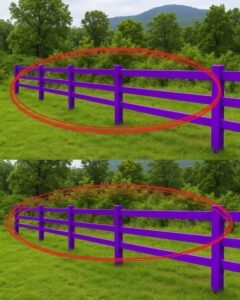
At first glance, a purple fence or a tree marked with purple paint may look unusual, decorative, or even like part of an artistic project. But in many parts of the United States, that bright color can carry a very different message.
It can mean “No Trespassing.”
For people walking through rural areas, hiking unfamiliar trails, hunting, camping, or simply exploring the countryside, recognizing this marking can be important. A purple-painted tree, fence post, or other approved surface may be used by a property owner to indicate that the land is private and that people should not enter without permission.
The system is often called a purple paint law or purple paint statute.
The basic idea is simple: instead of relying exclusively on conventional signs, property owners can use clearly visible purple markings to communicate a boundary.
Why purple?
The color is easy to distinguish from many natural surroundings. Forests, fields, and rural properties commonly contain large amounts of green and brown, while a bright purple marking stands out against those colors.
That visibility is one of the main reasons the system can be useful.
Traditional “No Trespassing” signs can deteriorate over time. They may become difficult to read, fall down, or disappear because of weather or other circumstances. Paint applied to a suitable tree, post, or fence can remain visible for considerably longer.
However, there is an important detail to remember.
Purple paint does not automatically mean exactly the same thing everywhere.
Trespassing laws and purple-marking requirements are determined by individual states. Some states recognize purple paint as an alternative method of posting private property, while the precise rules can differ.
Those rules may specify where the paint can be placed, how large the marking must be, how high above the ground it should appear, and how far apart multiple markings must be.
Because of these differences, people should not assume that a purple mark has identical legal significance in every state.
The concept became especially associated with Texas after the state adopted its Purple Paint Law in 1989. Other states subsequently established their own versions or related provisions.
States that have recognized purple paint provisions include places such as North Carolina, Missouri, Illinois, Florida, Pennsylvania, and Kansas, although the specific legal requirements and terminology vary.
In some locations, purple paint may be used on trees. In others, fences, posts, or other structures may be permitted.
The markings are generally intended to be clearly visible to someone approaching the property.
Imagine you’re hiking along a rural road.
You see an ordinary fence running through a wooded area. There is no large warning sign attached to it. As you walk closer, you notice several vertical purple marks painted on the fence posts.
That is a moment to stop.
Rather than assuming the land beyond the fence is open to the public, you should treat the markings as a possible private-property warning and check the applicable local rules or obtain permission before entering.
The same principle applies to hunters.
Hunters often travel through large rural areas where property boundaries may not always be obvious. A purple marking can serve as an additional indication that a particular area should not be entered without authorization.
The consequences of ignoring a property boundary can vary depending on the jurisdiction and circumstances. Unauthorized entry may constitute trespassing, and penalties can include fines or other legal consequences.
There can also be practical consequences that have nothing to do with a courtroom.
A private property owner may have livestock, equipment, buildings, crops, pets, or other hazards on the land. Someone entering without permission may unintentionally damage property or place themselves in danger.
For this reason, recognizing property markings is more than a matter of memorizing a strange piece of trivia.
It is part of understanding how private land is identified.
Another common misunderstanding is that every purple object near a property boundary is necessarily a legal trespassing notice.
That is not necessarily true.
Someone could use purple paint for an entirely different purpose. A fence might be painted purple for decoration. A tree could have been marked for forestry, surveying, maintenance, or another reason.
The surrounding context matters.
The safest approach is to understand the local law and respect clearly marked boundaries.
If you encounter a purple marking while traveling through an unfamiliar area, don’t assume you have permission to cross the boundary simply because there is no traditional “No Trespassing” sign.
When in doubt, stay outside the marked property and seek permission from the owner.
There is another interesting aspect to the purple paint system: it can reduce the need for excessive signage.
In large rural properties, installing signs along every boundary can be expensive and time-consuming. Paint can provide a relatively simple way of marking long stretches of property, provided the markings comply with the applicable law.
But property owners also have responsibilities.
A purple marking generally has to meet the requirements established by the relevant jurisdiction. A tiny, hidden, faded, or improperly positioned mark may not satisfy those requirements.
That is why landowners who intend to rely on purple paint should check their state’s current rules rather than assuming any purple mark will automatically provide the same legal protection as a properly posted notice.
The idea can seem unusual to people who have never encountered it.
Why purple?
Why not red?
Why not yellow?
The answer is largely practical. A distinctive color makes the boundary easier to identify without requiring someone to stop and read a sign.
It also creates a recognizable visual language.
Once you know what the markings can mean, a purple stripe on a tree may immediately catch your attention.
The next time you’re hiking, driving through the countryside, or exploring an unfamiliar wooded area, keep an eye out for unusual markings.
If you see purple paint on trees, posts, or fences, don’t automatically assume it is decoration.
It could be communicating an important property boundary.
And remember that the exact legal meaning depends on where you are.
The United States does not have one nationwide purple-paint rule that applies identically everywhere. Individual states establish their own laws, and those laws can change.
So if you’re planning to hunt, hike, camp, explore, or otherwise enter private rural property, check the applicable local regulations and obtain permission when necessary.
A bright purple mark may look small, but it can communicate a very important message:
This land may be private.
Respecting that warning can help you avoid an unnecessary confrontation, a potential trespassing violation, or an unsafe situation.
So the next time you spot a purple fence or a purple-painted tree, take a second look.
It may not be decoration at all.
It may be one of the simplest—and most recognizable—ways a landowner is telling you to stay on the other side of the boundary.