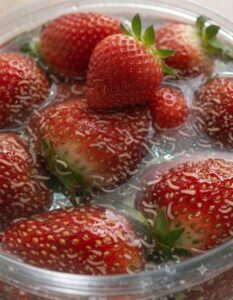
Fresh strawberries are one of those foods that seem almost impossible to distrust.
Bright red, sweet, juicy, and easy to eat, they are a popular addition to breakfast bowls, desserts, smoothies, salads, and snacks. Many people simply rinse them under running water, remove the leaves, and eat them.
But a viral food experiment has encouraged people to look at their berries a little differently.
The experiment is simple.
People place fresh strawberries or other soft fruits into water containing salt and wait.
After several minutes, some viewers claim to see tiny pale or whitish organisms moving through the water or emerging from the fruit.
The discovery can be startling.
What appears to be a perfectly clean strawberry can suddenly look very different when placed in water. Some people immediately wonder whether the objects are worms, insect larvae, dirt, or something else.
The sight can certainly be unpleasant.
But what exactly is happening?
Why Could Tiny Larvae Be Inside Fruit?
Berries grow outdoors, where they are naturally exposed to insects and other organisms.
Fruit flies and other small insects are attracted to ripening fruit. Some species can lay eggs on or in soft fruit, and their larvae may develop inside the fruit as it matures.
One insect of particular interest is the spotted-wing drosophila, a small fruit fly that can attack soft-skinned fruits. Unlike some common fruit flies that mainly use already damaged or overripe fruit, spotted-wing drosophila can lay eggs in ripening fruit.
The larvae that develop from those eggs are extremely small.
Because they can be inside the fruit, a person washing the outside of a strawberry may not notice them.
This is one reason the salt-water experiment can be surprising.
When fruit is placed into water, especially if the water changes the conditions around the fruit, organisms hidden in cracks or inside damaged areas may become easier to see.
However, seeing something emerge from a berry does not automatically prove exactly what it is.
A viral video rarely provides enough information to identify a tiny organism with certainty.
Does Salt Water “Draw Out” Worms?
Social-media videos often suggest that salt water forces hidden worms to leave the fruit.
The reality is more complicated.
Salt water can change the environment around small organisms and may cause them to move, but the exact effect depends on the species, concentration of salt, temperature, fruit condition, and length of soaking.
The creatures seen in viral videos may also be at different stages of development.
In other words, there is no universal rule that soaking every strawberry in salt water will make larvae emerge.
Some fruit may contain no larvae at all.
Others may contain insects or larvae that remain unnoticed.
And some apparent “worms” in videos may turn out to be something else entirely.
This is why it is better to view the experiment as an interesting demonstration rather than a reliable test for whether fruit is safe to eat.
Should You Throw the Strawberries Away?
Seeing a tiny organism associated with a strawberry can understandably make someone want to throw the entire container away.
Whether that is necessary depends on what was actually found and the condition of the fruit.
The presence of an insect or insect larva does not automatically mean that every berry is spoiled or dangerous. Fresh produce can occasionally contain harmless organisms simply because it is grown outdoors.
At the same time, fruit that is visibly moldy, rotten, leaking, badly damaged, or otherwise spoiled should be discarded.
A simple rinse cannot turn rotten fruit into fresh fruit.
This distinction is important.
The presence of an insect is one issue.
Spoilage is another.
What Should You Do Before Eating Berries?
The safest everyday practice is to inspect fresh berries before eating them.
Look for obvious signs of deterioration.
Discard berries that have visible mold or extensive decay. If only a small portion of a batch is damaged, separate the affected fruit from the rest rather than allowing spoiled berries to remain in contact with healthy ones.
Then rinse the berries thoroughly under clean, running water before eating.
It is generally unnecessary to use soap or household cleaning products on fruit.
Produce is porous, and substances designed for cleaning surfaces are not intended to be consumed.
Washing under running water can help remove dirt and some microorganisms from the surface.
For delicate berries, handle them gently to avoid damaging the fruit.
Why You Shouldn’t Panic Over a Viral Video
Social media is extremely good at turning ordinary observations into dramatic discoveries.
A short video showing tiny organisms emerging from fruit can be visually shocking. Viewers may immediately assume that every strawberry contains hidden worms.
That conclusion does not follow from a viral video.
The actual prevalence of larvae depends on the fruit species, growing conditions, location, agricultural practices, season, and other factors.
A single demonstration cannot establish that all strawberries have the same issue.
It is also important to remember that close-up videos can make very small organisms appear much larger or more alarming than they would be in reality.
Something almost invisible to the naked eye can look enormous when filmed close up.
What About Other Berries?
Strawberries are not the only fruits that can attract insects.
Blackberries, raspberries, blueberries, cherries, and other soft fruits can also interact with insects during cultivation.
The risk varies depending on the fruit and the particular pest species.
Soft, ripe fruit is naturally attractive to many insects because it provides food and suitable conditions for reproduction.
That does not mean berries are inherently unsafe.
It is simply part of the natural environment in which produce is grown.
Commercial growers use various agricultural practices to reduce pest damage, but no outdoor farming system can guarantee that every individual piece of fruit is completely free of tiny organisms.
Can You Prevent This?
There is no need to stop eating fresh berries simply because insects exist in agricultural environments.
Instead, focus on proper handling.
Buy berries that look fresh and intact.
Refrigerate them appropriately.
Avoid keeping damaged fruit mixed with healthy fruit.
Inspect them before eating.
Wash them under running water before consumption.
And discard fruit that shows clear signs of spoilage.
If you grow berries yourself, learning about common local pests can also help you understand what you may occasionally encounter.
Why Do People Find the Experiment So Shocking?
Part of the reaction comes from an important psychological effect.
We usually think of food as something separate from nature.
A strawberry on a plate looks clean and finished.
But before it reached the kitchen, it grew outdoors in soil, sunlight, rain, and air. Insects interacted with the plant. Birds and other animals passed nearby. Microorganisms existed on its surface.
Washing and packaging can make us forget that connection.
The salt-water experiment simply makes some of the hidden aspects of growing food more visible.
That can be unpleasant, but it is also a reminder of where food comes from.
Are the Tiny Creatures Dangerous?
The mere presence of an insect larva does not automatically mean the fruit is poisonous.
However, unidentified organisms should not be treated as proof that a particular fruit is safe either.
If you are uncertain about the condition of produce, the sensible approach is to avoid eating questionable fruit.
People with particular food-safety concerns should follow guidance from reputable food-safety authorities.
And if someone experiences significant illness after eating contaminated or spoiled food, they should seek appropriate medical advice.
The goal is not to create fear.
It is to make sensible choices.
The Bottom Line
The viral strawberry experiment has surprised millions of people because it reveals something they may never have considered: tiny organisms can sometimes be present in fresh fruit grown outdoors.
Salt water may make some small larvae more noticeable, but the experiment should not be treated as a definitive safety test.
You do not need to panic simply because you see something unexpected.
Instead, inspect your fruit carefully, discard produce that is visibly spoiled or moldy, wash fresh berries thoroughly under running water, and avoid eating anything that you cannot confidently identify or that appears unsafe.
The next time you buy a container of strawberries, there is no reason to be afraid of them.
Just remember that fresh produce comes from a living outdoor environment.
And sometimes, looking closely can reveal a side of nature that you never expected to see.