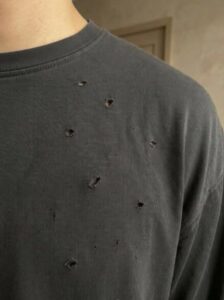
You put on your favorite shirt one morning, look down, and notice a tiny hole.
It wasn’t there yesterday.
You check another shirt.
Another hole.
Then you look through your closet and realize something strange: several of your clothes have developed small holes in almost exactly the same area.
The first thought for many people is simple.
Moths.
But fabric-eating pests are only one possible explanation.
In fact, if tiny holes keep appearing near the bottom front of your shirts, the real culprit may be something you interact with every single day.
Your clothes may simply be rubbing against something.
Why Do the Holes Keep Appearing in the Same Place?
The location of the damage can provide one of the biggest clues.
If holes repeatedly appear around the lower front of T-shirts, especially near the waist, consider what that part of your clothing touches throughout the day.
A kitchen counter.
A desk.
A workbench.
A belt buckle.
The edge of a table.
The metal button on your jeans.
Even a countertop that feels completely smooth can gradually wear away delicate fabric when the same area of a shirt repeatedly rubs against it.
Imagine leaning against your kitchen counter several times every day.
Your shirt moves slightly each time.
The fabric is pressed between your body and the edge of the counter.
Over weeks and months, those tiny movements can weaken the fibers.
Eventually, one or two threads break.
Then more follow.
What begins as microscopic damage eventually becomes a visible hole.
This is especially common with lightweight cotton shirts and other thin fabrics.
If several shirts develop holes in roughly the same location, look for a common point of contact before blaming the washing machine.
Your Jeans Could Be Part of the Problem
Sometimes the problem isn’t the furniture.
It’s what you’re wearing.
Jeans often contain metal buttons, rivets, zippers, and other hardware.
When a T-shirt sits against these areas, repeated movement can create friction.
The same thing can happen with belts.
A belt buckle can press against the fabric of a shirt throughout the day, especially when you sit, bend, or lean forward.
If the holes appear around the waistline, check your belt and the front of your jeans.
Run your fingers over the hardware.
Does anything feel sharp?
Is there a rough edge?
Is the metal damaged?
A tiny rough spot may be enough to repeatedly catch the fibers of a thin shirt.
Try wearing the same shirt without the suspected belt or pair of jeans and see whether the problem continues.
That simple experiment can help identify the source.
Your Washing Machine May Also Be Involved
Laundry is supposed to clean your clothes.
But under the wrong conditions, it can also damage them.
Zippers, hooks, Velcro, metal buttons, and other hardware can catch delicate fabric during a wash cycle.
A garment may become tangled with another piece of clothing, allowing a zipper or hook to repeatedly pull against it.
Over time, the fabric can weaken.
Before putting delicate clothes in the washing machine, close zippers and hooks.
Turn delicate garments inside out.
Use mesh laundry bags for particularly fragile items.
And avoid stuffing the machine so full that clothes have no room to move freely.
Overloading can increase friction and prevent garments from moving properly through the wash.
Separating heavy items from lightweight clothing can also help.
A pair of heavy jeans tumbling together with thin T-shirts creates a very different environment from washing similar lightweight garments together.
Don’t Forget the Dryer
The dryer can also contribute to fabric wear.
Heat and repeated tumbling put stress on clothing fibers.
A shirt that survives dozens of wash cycles may gradually become weaker after repeated exposure to high temperatures.
Check the care label before drying your clothes.
If a garment recommends low heat, don’t assume high heat is harmless.
For delicate items, air-drying can reduce mechanical and heat-related wear.
This doesn’t mean you need to stop using your dryer altogether.
It simply means that different fabrics require different treatment.
Thin shirts, delicate underwear, knitwear, and other lightweight garments may benefit from gentler drying methods.
What About Moths?
Sometimes the classic explanation really is the correct one.
Moths and other fabric pests can damage clothing, particularly items made from animal-based fibers such as wool, cashmere, fur, and silk.
But pest damage can look different from ordinary friction damage.
Instead of one predictable hole appearing in the same place on every shirt, you may notice multiple irregular holes scattered across a garment.
You might also find damage on clothing that has been sitting untouched in a closet or drawer.
Other clues can include larvae, shed skins, webbing, or small insects around storage areas.
If you suspect an infestation, don’t inspect only the damaged clothing.
Check the closet, drawers, shelves, carpets, and other nearby areas.
Clean the storage space thoroughly and examine other garments for signs of damage.
Keeping clothes clean and storing them properly can also reduce the likelihood of certain pests becoming a problem.
Your Washing Machine Itself Could Have a Rough Spot
There’s another possibility that’s easy to overlook.
The machine itself could be damaging your clothes.
A damaged drum, rough edge, loose component, or foreign object can sometimes snag fabric.
If you notice holes appearing primarily after washing and cannot find another explanation, inspect the inside of the washer carefully.
Run your hand gently around accessible areas, looking for anything unusually rough or sharp.
Don’t force your hand into areas that aren’t safe to access.
If you suspect a mechanical problem, have the machine inspected rather than continuing to wash delicate clothing in it.
Look at the Pattern
One of the easiest ways to investigate clothing damage is to study the pattern.
Ask yourself a few questions.
Where are the holes?
If they repeatedly appear in the same location, friction is worth investigating.
When do you notice them?
If they appear after laundry, examine your washing and drying routine.
What materials are affected?
If only wool or other animal-based fabrics are damaged, pests may deserve more attention.
Are the holes irregular or consistent?
Random-looking damage can have a different cause from holes appearing along the same seam or contact point.
Are other clothes affected?
If only a specific type of garment is damaged, consider what those garments have in common.
These observations can turn a frustrating mystery into a solvable problem.
A Simple Experiment Can Help
You don’t necessarily need expensive equipment to find the cause.
Take a few shirts that have developed holes.
Look at exactly where the damage occurs.
Then compare that location with the parts of your clothing, furniture, and daily environment that come into contact with it.
Try changing one thing at a time.
Wear a different belt.
Choose different jeans.
Avoid leaning against a particular countertop.
Wash delicate clothes separately.
Turn them inside out.
Use a mesh bag.
Air-dry one group while machine-drying another.
If the damage stops after one change, you’ve found an important clue.
Prevention Is Easier Than Replacing Your Clothes
Once you identify the source, preventing future damage is usually much easier.
Keep an eye on rough furniture edges.
Replace damaged belts or clothing hardware.
Close zippers and hooks before laundry.
Use appropriate wash settings.
Avoid overloading the machine.
Treat delicate fabrics gently.
Inspect closets if you suspect pests.
And don’t ignore tiny holes when they first appear.
A small hole can often be repaired before it becomes a much larger tear.
Most importantly, don’t automatically blame the quality of your clothing.
Sometimes the fabric isn’t defective at all.
It may simply be experiencing the same tiny amount of friction hundreds or thousands of times.
A shirt can survive a dramatic accident and still slowly deteriorate from something as ordinary as leaning against a desk every day.
So the next time you discover a mysterious hole in your favorite shirt, don’t immediately throw it away.
Look at where it is.
Look at the edges.
Think about what the fabric touches.
Check your laundry routine.
Inspect your closet.
The hole may be telling you exactly what happened.
You just have to know how to read the clues.