My JAG attorney had filed a protective order concerning interference with a servicemember’s property under the Servicemembers Civil Relief Act, a federal statute that genuinely exists and can genuinely apply in situations like mine. What it did not do was magically turn a disagreement at a property gate into an instant federal indictment. It did not mean that anyone who stepped onto the wrong piece of gravel was going to be taken away in handcuffs.
Sheriff Brannock knew that.
He also knew how to explain the consequences in a way that made everyone standing there understand that the situation had crossed a line.
That was one of the things I respected about him.
He never exaggerated the law. He simply described it plainly enough that nobody could pretend they had misunderstood.
Nobody was arrested that morning.
The realtor left first. My stepmother followed. My brother came last, and when he passed me, he did not look at me.
My father stayed at the gate.
For several seconds, neither of us said anything.
I watched him through the security feed from inside the house, standing beside the gate with his hands in his jacket pockets. From a distance, he looked smaller than I remembered. Not weak. Not harmless. Just older.
Then he got into his truck and drove down the mountain.
I thought that would be the end of it.
It wasn’t.
There are moments when a family argument stops being an argument and becomes something else. A legal dispute. A property dispute. A question of boundaries and documents and who has the right to stand where. But underneath all of that, there is usually an older story that nobody wants to say aloud.
That was the story I had been trying not to think about.
The house belonged to my father in the practical sense, but the valley contained memories that belonged to all of us.
I had driven those roads as a child.
I knew where the pavement became gravel. I knew the bend where the trees opened and you could see the ridge across the valley. I knew the old mailbox that leaned slightly to one side and the stretch of road where my father used to slow down because deer crossed there in the evenings.
Leaving was supposed to be simple.
I packed what I could fit into my vehicle, checked the documents one more time, and made sure I had everything my attorney had told me to keep with me. I had no intention of turning around.
But when I reached the road out of the valley, I kept driving.
Then I saw the turn.
It was the road that led toward my father’s house.
I told myself I was only passing through.
That was not entirely true.
I turned.
The drive back felt different from every other time I had made it. I wasn’t going home. I wasn’t visiting. I wasn’t coming back to argue.
I was leaving.
That distinction mattered.
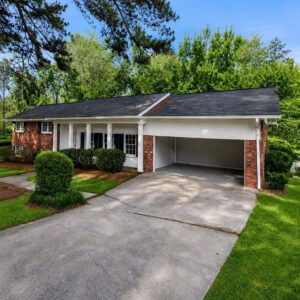
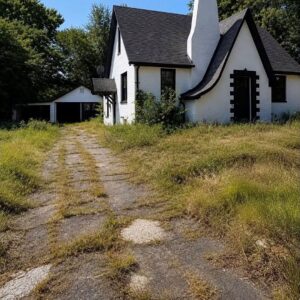
The house appeared between the trees, exactly where it had always been. The roof caught the late light, and for a second I could see the place the way I remembered it instead of the way it had become.
There was no one standing outside.
No realtor.
No sheriff.
No brother.
No stepmother.
Just the house.
I slowed down as I passed.
I did not stop.
That was important to me.
After everything that had happened, I didn’t want my last memory of the property to be another confrontation. I didn’t want another conversation that could be twisted into something else. I didn’t want another argument about what my father believed I had done or what I believed he had done.
So I drove past.
One more time.
I looked toward the porch and remembered sitting there years earlier, before the paperwork, before lawyers, before the arguments about property lines and authority and who had promised what to whom.
Back then, the house had simply been Dad’s house.
It hadn’t been evidence.
It hadn’t been contested property.
It hadn’t been the center of a dispute that required attorneys and court filings.
It was just home.
That was probably why I drove past it.
Not because I wanted to go back.
Because some part of me needed to see it one last time before I admitted to myself that I was leaving the valley for good.
The road continued downhill.
I didn’t turn around again.
By the time I reached the main road, the house was hidden behind the trees.
My phone buzzed.
It was a message from my attorney.
He wanted to make sure I was already out of the immediate area and reminded me not to communicate directly with anyone involved unless absolutely necessary.
I read the message twice.
Then I put the phone down.
For months, I had believed that winning would feel different.
I thought there would be some obvious moment when the paperwork was filed, the order was recognized, and everyone finally understood that they had pushed too far.
Instead, it felt strangely quiet.
There was no victory.
There was only distance.
The legal documents would remain. The order would remain. The property dispute would probably continue in one form or another. There would be more calls, more paperwork, more explanations.
But I was done standing at that gate.
I was done explaining myself to people who had already decided what they wanted to believe.
Most of all, I was done confusing the place where I grew up with the people who had made it impossible for me to stay.
As the valley disappeared behind me, I realized something I hadn’t understood when the morning began.
The attorney’s filing had protected more than a piece of property.
It had given me a boundary.
A legal one, yes.
But also a personal one.
For the first time, I could leave without wondering whether leaving meant surrendering.
It didn’t.