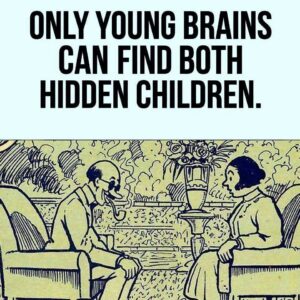
Have you ever stared at a picture for what feels like several minutes, convinced that you’ve examined every corner, only to suddenly discover that something important was hiding right in front of you?
Hidden-object puzzles are designed to create exactly that experience.
At first, an image may look completely ordinary. You might see trees, buildings, people, shadows, or everyday objects. Nothing appears unusual. Then someone tells you there is a hidden man wearing a hat somewhere in the picture.
Suddenly, the challenge begins.
You start scanning the image.
You examine the edges.
You look between objects.
You study shadows and outlines.
And then, sometimes almost magically, you see him.
“There he is!”
Once the hidden figure becomes visible, it can be difficult to understand how you missed him in the first place.
This type of puzzle is often accompanied by the playful claim that your brain is still young if you can find the man quickly.
It sounds intriguing, but it isn’t scientifically accurate.
Finding a hidden figure quickly does not prove that your brain is younger, healthier, or more intelligent. The puzzle is better understood as a test of visual attention, pattern recognition, and the way your brain searches through complex information.
And that is actually more interesting than the brain-age claim.
Why Can Something So Obvious Be So Difficult to See?
The human brain receives an enormous amount of visual information every moment.
If we consciously processed every line, color, shape, texture, and movement around us, everyday life would become overwhelming.
Instead, the brain filters information.
It decides what appears important and what can be ignored.
When you look at a picture of a landscape, for example, your brain might immediately recognize a tree as a tree. You don’t normally examine every branch individually.
When you see a person’s face, you don’t consciously analyze every pixel.
Your brain rapidly organizes visual information into meaningful objects.
This ability is incredibly useful.
But hidden-object puzzles take advantage of it.
The puzzle may disguise the man’s face or body by making his outline resemble something that belongs in the background.
A hat might look like part of a branch.
A face might be formed by shadows.
An arm could blend into another object.
A body might be created by several separate lines.
Your eyes may actually receive all of the necessary information.
The problem is that your brain initially interprets that information differently.
The Importance of Pattern Recognition
Pattern recognition is one of the most important skills involved in solving a hidden-image puzzle.
Your brain constantly looks for familiar patterns.
It recognizes faces.
It identifies letters.
It understands road signs.
It distinguishes animals from plants.
It allows you to recognize familiar people even when they’re far away.
In a hidden-picture puzzle, the brain has to do something slightly different.
Instead of simply recognizing an obvious object, it needs to discover an unexpected pattern inside another image.
At first, the lines may look meaningless.
Then you notice a curve.
Another line seems to connect with it.
A darker area begins to resemble a face.
Suddenly, the pieces come together.
The scattered details become a recognizable figure.
That’s the famous “aha!” moment.
Why Does the Figure Become Obvious After You Find It?
One of the strangest things about hidden-object puzzles is how dramatically perception can change after the answer is revealed.
Before finding the man, you might stare at the same section of the image without seeing anything unusual.
After someone points him out, the figure may suddenly appear obvious.
This happens because your brain has gained a new way of interpreting the same visual information.
The image itself hasn’t changed.
Your interpretation has.
Once you’ve learned which lines belong to the hidden figure, your brain can organize those lines into a meaningful shape much more easily.
That’s why someone may say, “How could you possibly not see him?”
The answer is simple.
You were seeing the image.
You just weren’t interpreting it in the way the puzzle required.
Does Finding Him Quickly Mean Your Brain Is Younger?
Not necessarily.
There are many reasons someone might solve the puzzle quickly.
They may simply have more experience with hidden-picture challenges.
They might already know what to look for.
They could be particularly attentive to unusual shapes.
They may naturally scan images systematically.
Even the environment can make a difference.
Lighting, screen size, image quality, distractions, fatigue, and viewing distance can all affect visual search.
Someone might find the figure immediately one day and struggle with the same type of puzzle another day.
That doesn’t mean their brain suddenly became older.
It simply means performance on a particular visual task can vary.
So if you don’t find the man quickly, there’s no reason to worry.
And if you find him immediately, congratulations—but you haven’t discovered your biological brain age.
You’ve simply solved a puzzle.
How to Find the Hidden Man
If you’re struggling, don’t repeatedly stare at the center of the image.
Instead, use a systematic search.
Start by dividing the picture into sections.
Look at the top first.
Then move slowly from left to right.
Examine the middle.
Finally, inspect the bottom.
This prevents your eyes from repeatedly returning to the same familiar areas.
Next, stop looking for a complete person.
Look for individual features.
Can you see something that resembles a hat?
Is there a curved shape that could form a shoulder?
Does a dark area resemble a face?
Could two unrelated objects combine to create the outline of a body?
This approach can be much more effective.
Try Looking at Negative Space
One of the most useful techniques in visual puzzles is examining the empty space between objects.
Sometimes the hidden figure isn’t created by the objects themselves.
Instead, it is formed by the spaces around them.
Negative space can create surprising shapes.
The gap between two branches might form an arm.
The space between objects might create the outline of a hat.
An apparently empty section of the image might contain the most important clue.
Change Your Viewing Distance
If you’re looking at the puzzle on a phone, move the device slightly farther away.
Then bring it closer.
You can also briefly squint.
Squinting reduces the importance of tiny details and can make larger shapes easier to recognize.
Another useful trick is to look away for a few seconds before looking back.
Your brain may approach the image differently when you stop staring continuously.
Why These Puzzles Are So Satisfying
Hidden-object puzzles aren’t really about proving that you’re smarter than someone else.
Their appeal comes from discovery.
You begin with confusion.
Then curiosity takes over.
You search.
You doubt yourself.
You look again.
And eventually, something clicks.
That moment of recognition is satisfying because your brain has successfully transformed meaningless or ordinary visual information into a meaningful pattern.
It’s a small demonstration of how powerful perception can be.
The puzzle also reminds us that seeing and noticing are not exactly the same thing.
Your eyes can receive information without your conscious mind immediately recognizing its significance.
That’s why people can sometimes miss objects that are surprisingly obvious once they’re pointed out.
The Real Lesson Behind the Puzzle
So, can you find the man in the hat?
If you can, enjoy the victory.
If you can’t, don’t worry.
The result doesn’t reveal whether your brain is young or old, and it isn’t a reliable test of intelligence or cognitive health.
What it does reveal is something much more interesting: your brain is constantly filtering, organizing, and interpreting the world around you.
The hidden man is simply taking advantage of that process.
The next time you see a puzzle claiming that finding a hidden object proves you’re young, treat the statement as entertainment rather than science.
Look carefully.